Institute for Maternal and Child Health, IRCCS "Burlo Garofolo", Trieste, Italy.
Children's Hospital, ASST-Spedali Civili, Brescia, Italy.
BMJ Paediatr Open. 2024 Sep 4;8(1):e002719. doi: 10.1136/bmjpo-2024-002719.
Despite evidence showing that the intranasal and sublingual routes are safe and effective in providing analgesia, no data are available about their day-to-day use in the emergency department (ED). The aim of this study was to assess the frequency of the use of the intranasal and sublingual routes, and the clinical characteristics of the patients receiving analgesia through these routes.
A multicentre study was performed in the EDs participating in the Pain in Paediatric Emergency Room research group. It included a survey and a retrospective data collection in which the medical records of all patients who received analgesia from 1 April 2022 to 31 May 2022 were collected.
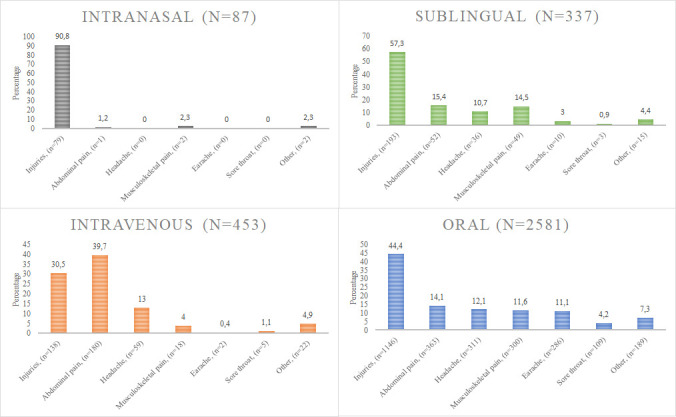
48 centres (91%) answered the survey. The intranasal and sublingual routes were used in 25 centres (52%). 13 centres (27%) used both routes, 9 centres (19%) used only the sublingual and 3 centres (6%) used only the intranasal route.12 centres (48%) participated in the retrospective study. Data about 3409 patients, median age 9 years (IQR 5-12), were collected. Among them, 337 patients (9.6%) received sublingual analgesia, and 87 patients (2.5%) received intranasal analgesia. The intranasal route was employed for injuries in 79 (90.8%) cases, and fentanyl was the drug delivered in 85 (97.7%) cases. The sublingual route was used mainly for injuries (57.3%), but also for abdominal pain (15.4%), musculoskeletal pain (14.5%) and headache (10.7%). Paracetamol, ketorolac and tramadol were administered through this route.
The use of the intranasal and sublingual routes for analgesia in the paediatric ED is still limited.
尽管有证据表明鼻内和舌下途径在提供镇痛方面是安全有效的,但尚无关于其在急诊科日常使用的数据。本研究的目的是评估鼻内和舌下途径的使用频率,以及通过这些途径接受镇痛治疗的患者的临床特征。
在参与儿科急诊疼痛研究组的急诊科进行了一项多中心研究。它包括一项调查和一项回顾性数据收集,其中收集了所有在 2022 年 4 月 1 日至 5 月 31 日期间接受镇痛治疗的患者的病历。
48 个中心(91%)回答了调查。25 个中心(52%)使用了鼻内和舌下途径。13 个中心(27%)同时使用了这两种途径,9 个中心(19%)仅使用舌下途径,3 个中心(6%)仅使用鼻内途径。12 个中心(48%)参与了回顾性研究。共收集了 3409 名患者的数据,中位数年龄为 9 岁(IQR 5-12)。其中,337 名患者(9.6%)接受了舌下镇痛,87 名患者(2.5%)接受了鼻内镇痛。鼻内途径用于 79 例(90.8%)损伤,85 例(97.7%)使用芬太尼给药。舌下途径主要用于损伤(57.3%),但也用于腹痛(15.4%)、肌肉骨骼疼痛(14.5%)和头痛(10.7%)。通过该途径给予对乙酰氨基酚、酮咯酸和曲马多。
儿科急诊科使用鼻内和舌下途径进行镇痛仍然有限。