Infectious and Tropical Diseases Research Center, Hormozgan Health Institute, Hormozgan University of Medical Sciences, Bandar Abbas, Iran.
Student Research Committee, Faculty of Pharmacy, Tabriz University of Medical Sciences, Tabriz, Iran.
Sci Rep. 2024 Sep 5;14(1):20677. doi: 10.1038/s41598-024-71829-x.
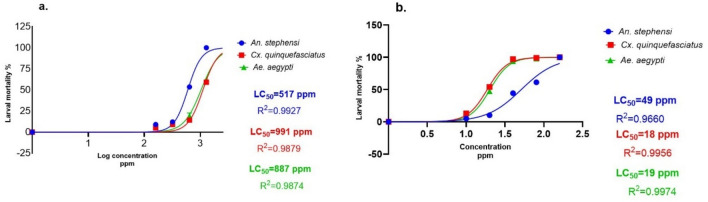
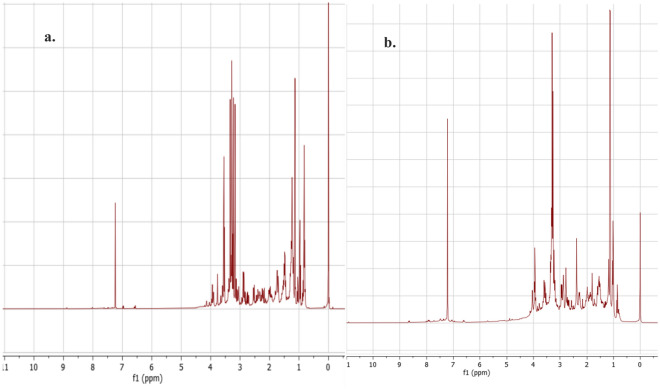
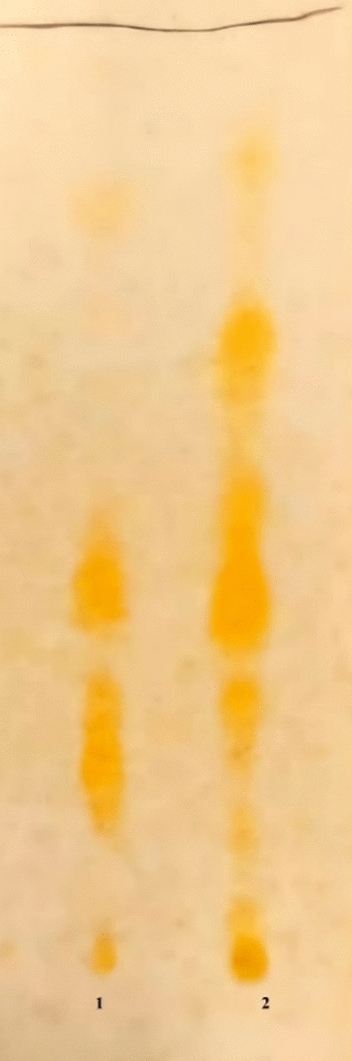
Mosquito-borne diseases, such as malaria, dengue, and Zika, pose major public health challenges globally, affecting millions of people. The growing resistance of mosquito populations to synthetic insecticides underscores the critical need for effective and environmentally friendly larvicides. Although chemical pesticides can initially be effective, they often lead to negative environmental consequences and health hazards for non-target species, including humans. This study aimed to evaluate the larvicidal effects of Trachyspermum ammi essential oil and Delphinium speciosum extract on the larvae of three major mosquito species: Aedes aegypti, Anopheles stephensi, and Culex quinquefasciatus. Mosquito larvae of Ae. aegypti, An. stephensi, and Cx. quinquefasciatus were reared under controlled laboratory conditions. The larvicidal activity of T. ammi essential oil and D. speciosum extract was evaluated through standard bioassays, using various concentrations of essential oils (10, 20, 40, 80, and 160 ppm) and extracts (160, 320, 640, 1280, and 2560 ppm) to determine the lethal concentration (LC) values after 24 h of exposure. Fresh plant materials were collected, with the essential oil extracted via hydro-distillation, and the extract prepared using methanol solvent extraction. The chemical composition of T. ammi essential oil was examined using gas chromatography-mass spectrometry (GC-MS). Additionally, the preliminary analysis of the chemical compounds in D. speciosum extract was carried out using thin layer chromatography (TLC) and nuclear magnetic resonance spectroscopy (NMR) techniques. The results indicated that the essential oil of T. ammi exhibited more effective larvicidal activity compared to the D. speciosum extract. Specifically, the essential oil demonstrated LC values of 18 ppm for Cx. quinquefasciatus and 19 ppm for Ae. aegypti. In contrast, the D. speciosum extract showed the strongest larvicidal effect against An. stephensi, with an LC of 517 ppm. Concentrations of 40 ppm of the essential oil and 1280 ppm of the extract resulted in 100% mortality across all three species. Both the essential oil of T. ammi and the D. speciosum extract exhibited concentration-dependent larvicidal activity, and these results were statistically significant (p < 0.001) compared to the no-treatment group. GC-MS analysis revealed thymol (88.95%), o-cymen-5-ol (4.11%), and γ-terpinene (2.10%) as the major constituents of the T. ammi essential oil. Additionally, TLC verified the presence of alkaloids in both chloroform and methanolic extracts. Proton NMR identified a diterpene structure for these alkaloids. These findings suggest that T. ammi essential oil is a promising candidate for natural mosquito control strategies. Given its efficacy, further research is warranted to explore its potential in integrated vector management programs.
蚊媒疾病,如疟疾、登革热和寨卡病毒,对全球公共卫生构成重大挑战,影响了数百万人。蚊子种群对合成杀虫剂的抗药性日益增强,这突显了有效和环保的幼虫防治剂的迫切需要。虽然化学农药在初期可能有效,但它们往往会对非目标物种,包括人类,造成负面的环境后果和健康危害。本研究旨在评估芫荽精油和翠雀花提取物对三种主要蚊子幼虫的杀幼虫效果:埃及伊蚊、疟蚊和致倦库蚊。在受控实验室条件下饲养埃及伊蚊、疟蚊和致倦库蚊的幼虫。通过标准生物测定评估芫荽精油和翠雀花提取物的杀幼虫活性,使用不同浓度的精油(10、20、40、80 和 160ppm)和提取物(160、320、640、1280 和 2560ppm),确定暴露 24 小时后的致死浓度(LC)值。采集新鲜植物材料,通过水蒸馏提取精油,使用甲醇溶剂提取提取物。使用气相色谱-质谱联用仪(GC-MS)检查芫荽精油的化学成分。此外,使用薄层层析(TLC)和核磁共振波谱(NMR)技术对翠雀花提取物中的化学化合物进行了初步分析。结果表明,芫荽精油的杀幼虫活性比翠雀花提取物更有效。具体来说,精油对致倦库蚊的 LC 值为 18ppm,对埃及伊蚊的 LC 值为 19ppm。相比之下,翠雀花提取物对疟蚊表现出最强的杀幼虫效果,LC 值为 517ppm。精油浓度为 40ppm,提取物浓度为 1280ppm,三种蚊子的死亡率均达到 100%。芫荽精油和翠雀花提取物均表现出浓度依赖性的杀幼虫活性,与无处理组相比,这些结果具有统计学意义(p<0.001)。GC-MS 分析显示,芫荽精油的主要成分是百里酚(88.95%)、o-香芹酚(4.11%)和γ-萜品烯(2.10%)。此外,TLC 验证了氯仿和甲醇提取物中均存在生物碱。质子 NMR 确定这些生物碱的二萜结构。这些发现表明,芫荽精油是一种有前途的天然蚊虫控制策略的候选物。鉴于其功效,有必要进一步研究其在综合病媒管理计划中的潜力。