Division of Anaesthesiology and Intensive Care Medicine 1, Department of Anaesthesiology and Intensive Care Medicine, Medical University of Graz, Graz, Styria, Austria.
Division of Anaesthesiology and Intensive Care Medicine 2, Department of Anaesthesiology and Intensive Care Medicine, Medical University of Graz, Graz, Styria, Austria.
Scand J Trauma Resusc Emerg Med. 2024 Sep 5;32(1):82. doi: 10.1186/s13049-024-01260-8.
Pneumothorax may occur as a complication of cardiopulmonary resuscitation (CPR) and could pose a potentially life-threatening condition. In this study we sought to investigate the incidence of pneumothorax following CPR for out-of-hospital cardiac arrest (OHCA), identify possible risk factors, and elucidate its association with outcomes.
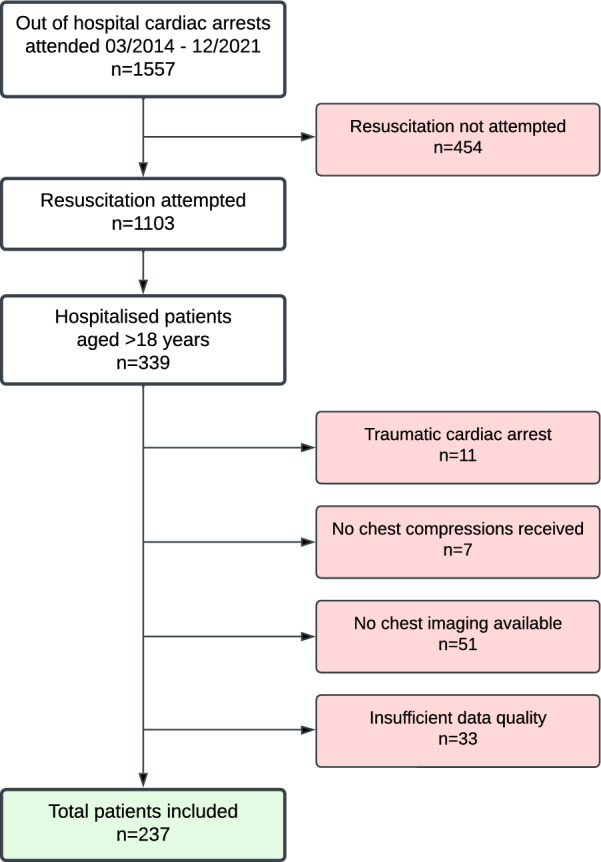
This study was a retrospective data analysis of patients hospitalized following CPR for OHCA. We included cases from 1st March 2014 to 31st December 2021 which were attended by teams of the physician staffed ambulance based at the University Medical Centre Graz, Austria. Chest imaging after CPR was reviewed to assess whether pneumothorax was present or not. Logistic regression analysis was performed to identify factors for the development of pneumothorax relevant and to assess its association with outcomes [survival to hospital discharge and cerebral performance category (CPC)].
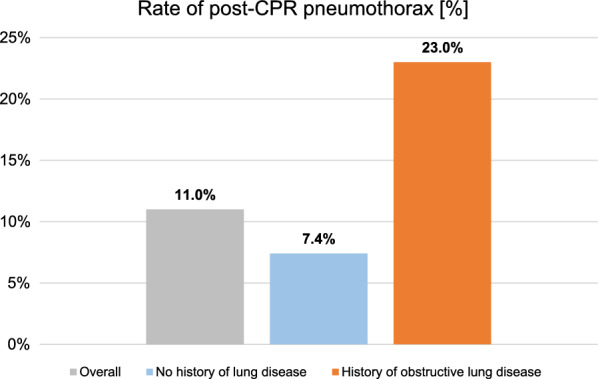
Pneumothorax following CPR was found in 26 out of 237 included cases (11.0%). History of obstructive lung disease was significantly associated with presence of pneumothorax after CPR. This subgroup of patients (n = 61) showed a pneumothorax rate of 23.0%. Pneumothorax was not identified as a relevant factor to predict survival to hospital discharge or favourable neurological outcome (CPC1 + 2).
Pneumothorax may be present in greater than one in ten patients hospitalized after CPR for OHCA. Pre-existent obstructive pulmonary disease seems to be a relevant risk factor for development of post-CPR pneumothorax.
gov ID: NCT06182007 (retrospectively registered).
NCT06182007 (retrospectively registered).
气胸可能是心肺复苏(CPR)的并发症,并可能构成潜在的危及生命的状况。在这项研究中,我们旨在调查院外心脏骤停(OHCA)后 CPR 后气胸的发生率,确定可能的危险因素,并阐明其与结果的关系。
这是一项对因 OHCA 接受 CPR 后住院的患者进行的回顾性数据分析研究。我们纳入了 2014 年 3 月 1 日至 2021 年 12 月 31 日期间由奥地利格拉茨大学医疗中心的医生配备的救护车团队收治的病例。对 CPR 后的胸部影像学进行评估,以确定是否存在气胸。进行逻辑回归分析以确定与气胸发展相关的因素,并评估其与结果(出院时存活和脑功能分类(CPC))的关系。
在 237 例纳入病例中,有 26 例(11.0%)在 CPR 后出现气胸。阻塞性肺病病史与 CPR 后气胸的存在显著相关。这组患者(n=61)的气胸发生率为 23.0%。气胸未被确定为预测出院时存活或良好神经结局(CPC1+2)的相关因素。
在因 OHCA 接受 CPR 后住院的患者中,超过十分之一的患者可能存在气胸。预先存在的阻塞性肺疾病似乎是 CPR 后气胸发展的一个相关危险因素。
gov ID:NCT06182007(回顾性注册)。
NCT06182007(回顾性注册)。