Department of Clinical Laboratory, the First Affiliated Hospital of Harbin Medical University, Harbin, Heilongjiang, China.
Department of Clinical Laboratory, Shangluo Central Hospital, Shangluo, Shaanxi, China.
Front Immunol. 2024 Aug 22;15:1443108. doi: 10.3389/fimmu.2024.1443108. eCollection 2024.
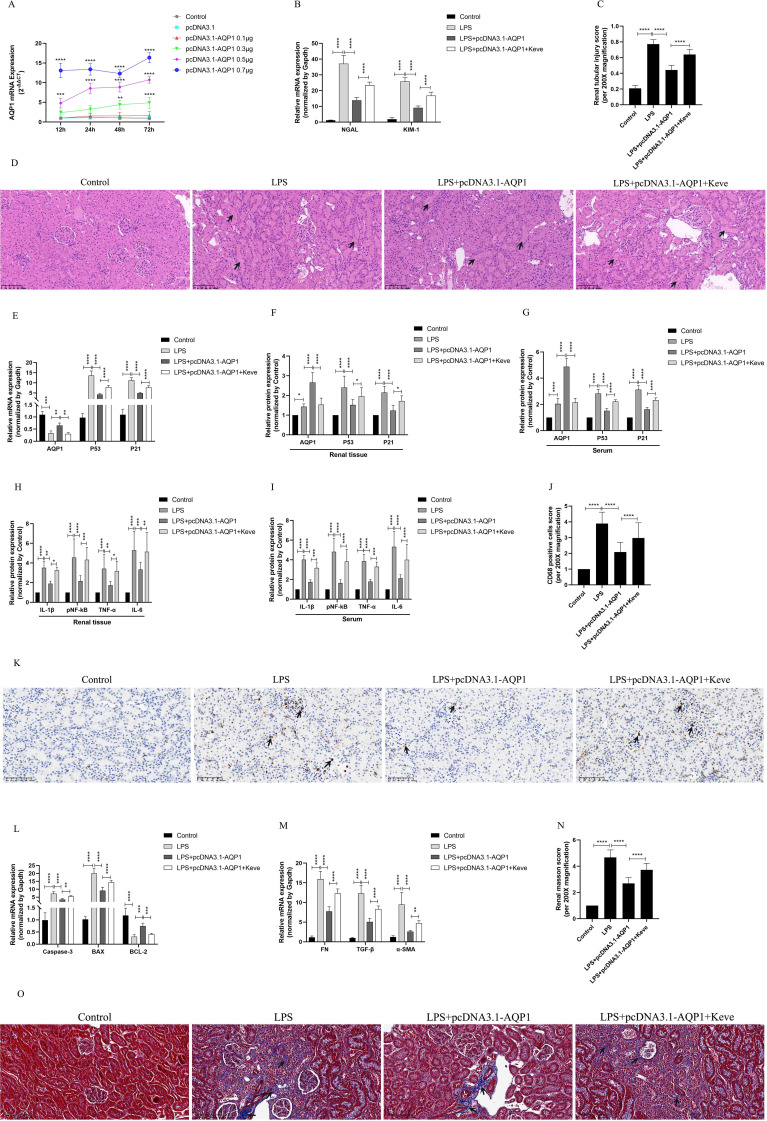
Sepsis associated Acute kidney injury (AKI) is a common clinical syndrome characterized by suddenly decreased in renal function and urinary volume. This study was designed to investigate the role of Aquaporin 1 (AQP1) and P53 in the development of sepsis-induced AKI and their potential regulatory mechanisms. Firstly, transcriptome sequencing analysis of mice kidney showed AQP1 expression was reduced and P53 expression was elevated in Cecal ligation and puncture (CLP)-induced AKI compared with controls. Bioinformatics confirmed that AQP1 expression was remarkably decreased and P53 expression was obviously elevated in renal tissues or peripheral blood of septic AKI patients. Moreover, we found experiments that AQP1 mRNA levels were dramatically decreased and P53 mRNA significantly increased following the increased expression of inflammation, apoptosis, fibrosis, NGAL and KIM-1 at various periods in septic AKI. Meanwhile, AQP1 and P53 protein levels increased significantly first and then decreased gradually in kidney tissue and serum of rats in different stages of septic AKI. Most importantly, and vitro experiments demonstrated that silencing of AQP1 greatly exacerbates renal or cellular injury by up-regulating P53 expression promoting inflammatory response, apoptosis and fibrosis. Overexpression of AQP1 prevented the elevation of inflammation, apoptosis and fibrosis by down-regulating P53 expression in Lipopolysaccharide (LPS)-induced AKI or HK-2 cells. Therefore, our results suggested that AQP1 plays a protective role in modulating AKI and can attenuate inflammatory response, apoptosis and fibrosis via downregulating P53 in septic AKI or LPS-induced HK-2cells. The pharmacological targeting of AQP1 mediated P53 expression might be identified as potential targets for the early treatment of septic AKI.
脓毒症相关性急性肾损伤(AKI)是一种常见的临床综合征,其特征为肾功能和尿量突然下降。本研究旨在探讨水通道蛋白 1(AQP1)和 P53 在脓毒症诱导的 AKI 发展中的作用及其潜在的调节机制。首先,对小鼠肾脏进行转录组测序分析显示,与对照组相比,盲肠结扎穿孔(CLP)诱导的 AKI 中 AQP1 表达降低,P53 表达升高。生物信息学证实,脓毒症 AKI 患者的肾脏组织或外周血中 AQP1 表达显著降低,P53 表达明显升高。此外,我们发现实验中,在脓毒症 AKI 的各个时期,AQP1mRNA 水平显著降低,炎症、凋亡、纤维化、NGAL 和 KIM-1 表达增加,P53mRNA 明显升高。同时,AQP1 和 P53 蛋白水平在脓毒症 AKI 不同阶段大鼠的肾脏组织和血清中先升高后逐渐下降。最重要的是,体内外实验表明,沉默 AQP1 通过上调 P53 表达,显著加重肾脏或细胞损伤,促进炎症反应、凋亡和纤维化。在脂多糖(LPS)诱导的 AKI 或 HK-2 细胞中过表达 AQP1 可通过下调 P53 表达来预防炎症、凋亡和纤维化的升高。因此,我们的研究结果表明,AQP1 通过下调 P53 表达在脓毒症 AKI 或 LPS 诱导的 HK-2 细胞中发挥保护作用,可减轻炎症反应、凋亡和纤维化。AQP1 介导的 P53 表达的药理学靶向可能被确定为脓毒症 AKI 早期治疗的潜在靶点。