Minnesota Center for Prion Research and Outreach (MNPRO), University of Minnesota, St. Paul, MN, United States.
Department of Biomedical and Veterinary Sciences, University of Minnesota College of Veterinary Medicine, St. Paul, MN, United States.
Front Immunol. 2024 Aug 22;15:1426656. doi: 10.3389/fimmu.2024.1426656. eCollection 2024.
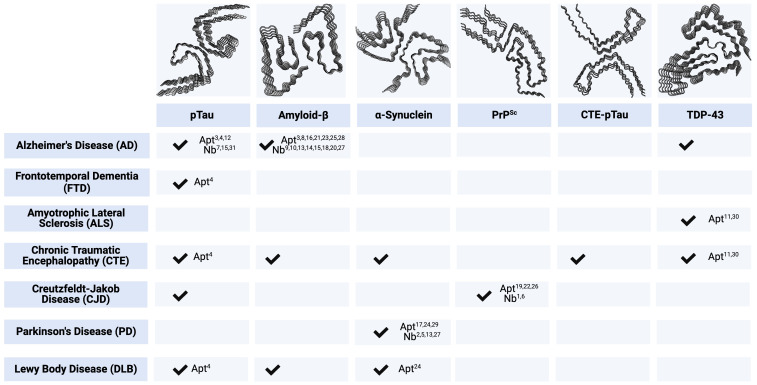
Neurodegenerative diseases (NDs) in mammals, such as Alzheimer's disease (AD), Parkinson's disease (PD), and transmissible spongiform encephalopathies (TSEs), are characterized by the accumulation of misfolded proteins in the central nervous system (CNS). Despite the presence of these pathogenic proteins, the immune response in affected individuals remains notably muted. Traditional immunological strategies, particularly those reliant on monoclonal antibodies (mAbs), face challenges related to tissue penetration, blood-brain barrier (BBB) crossing, and maintaining protein stability. This has led to a burgeoning interest in alternative immunotherapeutic avenues. Notably, single-domain antibodies (or nanobodies) and aptamers have emerged as promising candidates, as their reduced size facilitates high affinity antigen binding and they exhibit superior biophysical stability compared to mAbs. Aptamers, synthetic molecules generated from DNA or RNA ligands, present both rapid production times and cost-effective solutions. Both nanobodies and aptamers exhibit inherent qualities suitable for ND research and therapeutic development. Cross-seeding events must be considered in both traditional and small-molecule-based immunodiagnostic and therapeutic approaches, as well as subsequent neurotoxic impacts and complications beyond protein aggregates. This review delineates the challenges traditional immunological methods pose in ND research and underscores the potential of nanobodies and aptamers in advancing next-generation ND diagnostics and therapeutics.
哺乳动物的神经退行性疾病(NDs),如阿尔茨海默病(AD)、帕金森病(PD)和传染性海绵状脑病(TSEs),其特征是中枢神经系统(CNS)中错误折叠蛋白质的积累。尽管存在这些致病性蛋白质,但受影响个体的免疫反应仍然明显受到抑制。传统的免疫策略,特别是那些依赖单克隆抗体(mAbs)的策略,面临着与组织穿透、血脑屏障(BBB)穿越和维持蛋白质稳定性相关的挑战。这导致人们对替代免疫治疗途径产生了浓厚的兴趣。值得注意的是,单域抗体(或纳米抗体)和适体已成为有前途的候选物,因为它们的体积减小有助于高亲和力抗原结合,并且与 mAbs 相比表现出更好的生物物理稳定性。适体是由 DNA 或 RNA 配体生成的合成分子,具有快速的生产时间和具有成本效益的解决方案。纳米抗体和适体都具有适合 ND 研究和治疗开发的固有特性。在传统和基于小分子的免疫诊断和治疗方法中,以及随后的神经毒性影响和蛋白质聚集以外的并发症中,都必须考虑交叉接种事件。本综述阐述了传统免疫学方法在 ND 研究中面临的挑战,并强调了纳米抗体和适体在推进下一代 ND 诊断和治疗方面的潜力。