Petkar Shubham, Wanjari Dnyanshree, Priya Vishnu
Anaesthesiology, Jawaharlal Nehru Medical College, Datta Meghe Institute of Higher Education and Research, Wardha, IND.
Cureus. 2024 Aug 6;16(8):e66264. doi: 10.7759/cureus.66264. eCollection 2024 Aug.
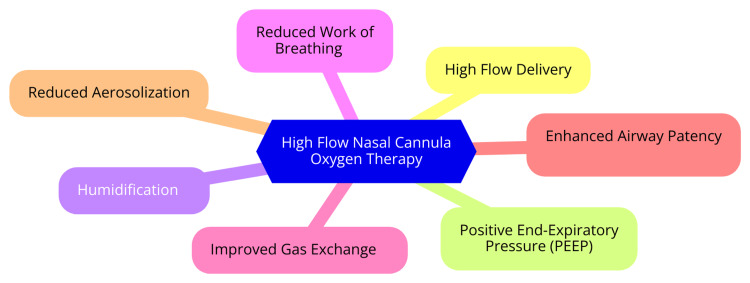
High-flow nasal cannula (HFNC) therapy has emerged as a significant advancement in respiratory support, offering a non-invasive alternative to traditional oxygen delivery methods in critical care settings. This review comprehensively evaluates HFNC therapy, focusing on its definition, historical evolution, and current clinical applications. HFNC therapy delivers humidified and heated oxygen at high flow rates through a nasal cannula, enhancing oxygenation and patient comfort. The review highlights the physiological mechanisms underlying HFNC and its efficacy in managing acute respiratory failure, chronic obstructive pulmonary disease exacerbations, and postoperative respiratory support. Key findings from clinical trials and meta-analyses are discussed, emphasizing HFNC's advantages over conventional methods, such as reduced intubation rates and shorter ICU stays. The review also addresses safety considerations, including potential risks and complications associated with HFNC therapy. Furthermore, it explores future directions for research and technological advancements aimed at optimizing HFNC use in diverse patient populations. This review aims to provide evidence-based insights to inform clinical practice and guide future investigations in respiratory therapy.
高流量鼻导管(HFNC)治疗已成为呼吸支持领域的一项重大进展,在重症监护环境中为传统氧气输送方法提供了一种无创替代方案。本综述全面评估了HFNC治疗,重点关注其定义、历史演变和当前的临床应用。HFNC治疗通过鼻导管以高流量输送加湿和加热的氧气,增强氧合作用并提高患者舒适度。该综述强调了HFNC治疗背后的生理机制及其在治疗急性呼吸衰竭、慢性阻塞性肺疾病急性加重和术后呼吸支持方面的疗效。讨论了临床试验和荟萃分析的主要发现,强调了HFNC相对于传统方法的优势,如降低插管率和缩短重症监护病房住院时间。该综述还涉及安全考虑因素,包括与HFNC治疗相关的潜在风险和并发症。此外,它探讨了旨在优化HFNC在不同患者群体中使用的未来研究方向和技术进步。本综述旨在提供基于证据的见解,为临床实践提供参考并指导呼吸治疗领域的未来研究。