Pank N P, Aung A, Kama G, Murray A, Huang K L, Greig J, Bauri M, Chan G, Masah C, Kaison K, Umali S, Peter T, Wera C, Velaki C, Ase M, Krangaie I, Viru R, Kurumop T, Keam T, Islam S, Pomat W, Maha A, Boga M, Kal M, Wuatai N, Graham S M, Majumdar S S, Marukutira T
Burnet Institute, Daru, Western Province, Papua New Guinea and Melbourne, Australia.
Western Provincial Health Authority, Daru, Western Province, Papua New Guinea.
Public Health Action. 2024 Sep 1;14(3):97-104. doi: 10.5588/pha.24.0013. eCollection 2024 Sep.
Daru Island in Papua New Guinea (PNG) has a high prevalence of TB and multidrug-resistant TB (MDR-TB).
To evaluate the early implementation of a community-wide project to detect and treat TB disease and infection, outline the decision-making processes, and change the model of care.
A continuous quality improvement (CQI) initiative used a plan-do-study-act (PDSA) framework for prospective implementation. Care cascades were analysed for case detection, treatment, and TB preventive treatment (TPT) initiation.
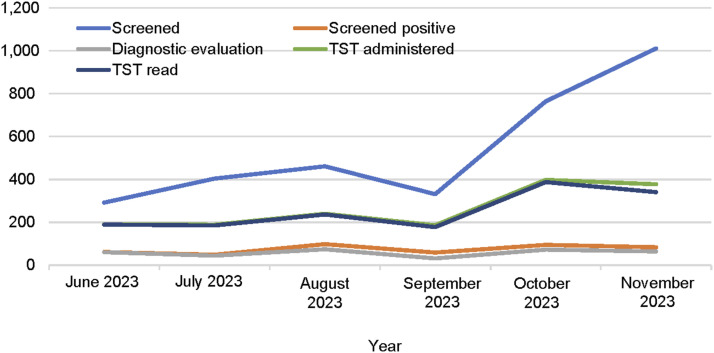
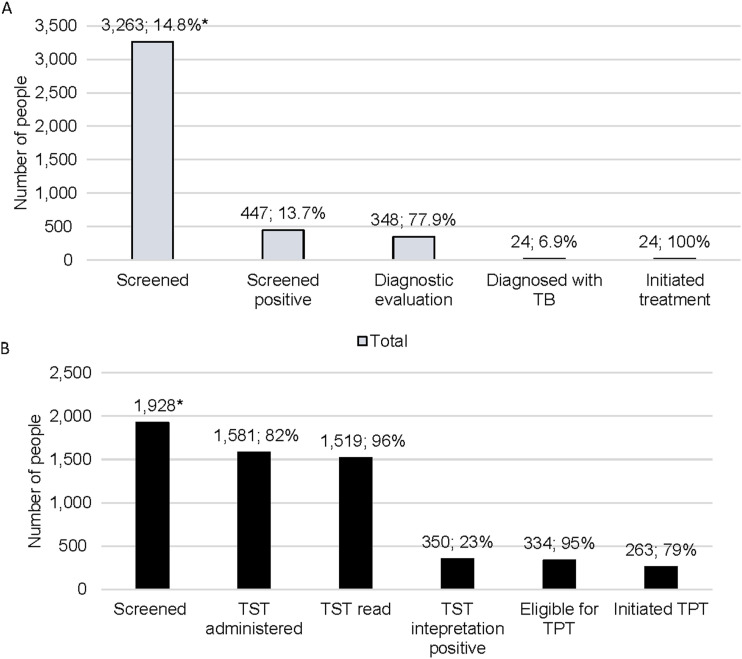
Of 3,263 people screened for TB between June and December 2023, 13.7% (447/3,263) screened positive (CAD4TB or symptoms), 77.9% (348/447) had Xpert Ultra testing, 6.9% (24/348) were diagnosed with TB and all initiated treatment. For 5-34-year-olds without active TB ( = 1,928), 82.0% (1,581/1,928) had tuberculin skin testing (TST), 96.1% (1,519/1,581) had TST read, 23.0% (350/1,519) were TST-positive, 95.4% (334/350) were TPT eligible, and 78.7% (263/334) initiated TPT. Three PDSA review cycles informed adjustments to the model of care, including CAD4TB threshold and TPT criteria. Key challenges identified were meeting screening targets, sputum unavailability from asymptomatic individuals with high CAD4TB scores, and consumable stock-outs.
CQI improved project implementation by increasing the detection of TB disease and infection and accelerating the pace of screening needed to achieve timely community-wide coverage.
巴布亚新几内亚(PNG)的达鲁岛结核病和耐多药结核病(MDR-TB)患病率很高。
评估一项全社区项目在结核病疾病和感染检测与治疗方面的早期实施情况,概述决策过程,并改变护理模式。
一项持续质量改进(CQI)举措采用计划-执行-研究-行动(PDSA)框架进行前瞻性实施。对病例检测、治疗和结核病预防性治疗(TPT)启动的护理级联进行了分析。
在2023年6月至12月期间接受结核病筛查的3263人中,13.7%(447/3263)筛查呈阳性(CAD4TB或有症状),77.9%(348/447)接受了Xpert Ultra检测,6.9%(24/348)被诊断为结核病并全部开始治疗。对于5至34岁无活动性结核病的人群(n = 1928),82.0%(1581/1928)进行了结核菌素皮肤试验(TST),96.1%(1519/1581)读取了TST结果,23.0%(350/1519)TST呈阳性,95.4%(334/350)符合TPT条件,78.7%(263/334)开始接受TPT。三个PDSA审查周期为护理模式的调整提供了依据,包括CAD4TB阈值和TPT标准。确定的主要挑战包括实现筛查目标、CAD4TB评分高的无症状个体无法提供痰液以及消耗品缺货。
CQI通过增加结核病疾病和感染的检测以及加快实现全社区及时覆盖所需的筛查速度,改进了项目实施。