Graduate Institute of Sports Science, National Taiwan Sport University, Taoyuan City, Taiwan.
Shulin Branch Fifth Corps, Fire Department, New Taipei City Government, New Taipei City, Taiwan.
Int J Med Sci. 2024 Aug 1;21(11):2031-2039. doi: 10.7150/ijms.96269. eCollection 2024.
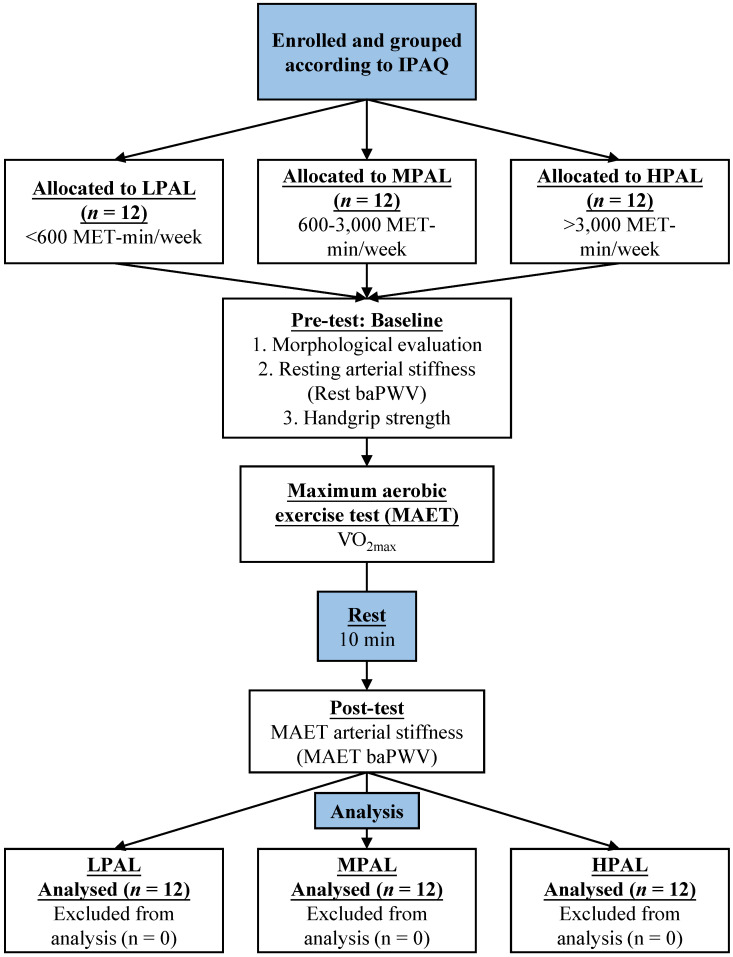
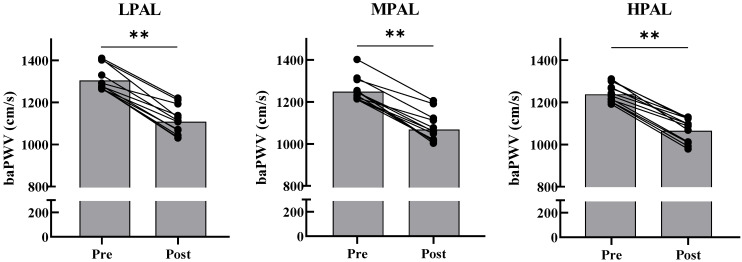
Firefighters have lower levels of physical activity while on call. It is critical to understand the impact of firefighters' physical activity on arterial stiffness. This study classified groups by physical activity level and combined peripheral vascular monitor measurement to explore the relationships between the level of physical activity and cardiovascular (CV) risk and physical fitness (PF) of firefighters, as well as the acute response to arterial stiffness (AS) following maximal aerobic exercise test (MAET) intervention. The International Physical Activity Questionnaire (IPAQ) was used to classify the participants into 3 groups: low, moderate, and high level of physical activity group, respectively. A total of 36 participants were recruited, 12 in each group. Participants were assessed for body composition, rest brachial-ankle pulse wave velocity (baPWV), handgrip strength (HGS), maximal oxygen uptake (V̇O), and MAET baPWV. In the three groups, significant differences were observed in V̇O, HGS, relative fat mass (%FM), body mass index (BMI), muscle mass ratio (MMR), and Rest baPWV ( < 0.05). After maximal aerobic exercise, the MAET baPWV values decreased significantly in all groups (all < 0.001). Rest baPWV was significantly correlated with firefighters' age, seniority, metabolic equivalents (METs), height and muscle mass (MM) ( < 0.05). Firefighters with high levels of physical activity had better body composition and physical fitness and lower Rest baPWV. In all three groups, baPWV was lower after the MAET than before it. Therefore, regardless of a firefighter's level of physical activity, high-intensity aerobic exercise may have a beneficial effect on arterial stiffness.
消防员在值班时的身体活动水平较低。了解消防员身体活动对动脉僵硬的影响至关重要。本研究通过身体活动水平对消防员的心血管(CV)风险和身体状况(PF)进行分组,并结合外周血管监测仪测量,探讨了身体活动水平与心血管风险和身体状况(PF)的关系,以及最大有氧运动量测试(MAET)干预后动脉僵硬(AS)的急性反应。采用国际体力活动问卷(IPAQ)将参与者分为三组:低、中、高体力活动组,每组 12 人。对参与者进行身体成分、休息时臂踝脉搏波速度(baPWV)、握力(HGS)、最大摄氧量(V̇O)和 MAET baPWV 评估。在三组中,V̇O、HGS、相对脂肪量(%FM)、体重指数(BMI)、肌肉质量比(MMR)和休息时 baPWV 均有显著差异(<0.05)。最大有氧运动后,三组 MAET baPWV 值均显著降低(均<0.001)。休息时 baPWV 与消防员年龄、工龄、代谢当量(METs)、身高和肌肉质量(MM)显著相关(<0.05)。身体活动水平较高的消防员具有更好的身体成分和身体状况,且休息时 baPWV 较低。在三组中,MAET 后 baPWV 均低于 MAET 前。因此,无论消防员的身体活动水平如何,高强度有氧运动可能对动脉僵硬有有益的影响。