Dementia Research Center, Tokyo General Hospital, Tokyo, Japan.
Department of Geriatric Medicine, Tokyo Medical University, Tokyo, Japan.
J Alzheimers Dis. 2024;101(2):651-660. doi: 10.3233/JAD-240347.
The entorhinal cortex is the very earliest involvement of Alzheimer's disease (AD). Grid cells in the medial entorhinal cortex form part of the spatial navigation system.
We aimed to determine whether path integration performance can be used to detect patients with mild cognitive impairment (MCI) at high risk of developing AD, and whether it can predict cognitive decline.
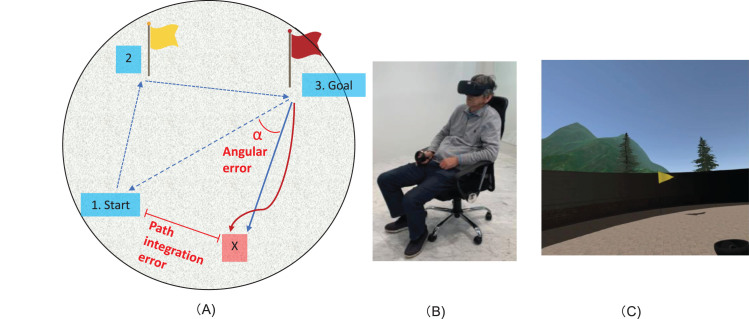
Path integration performance was assessed in 71 patients with early MCI (EMCI) and late MCI (LMCI) using a recently developed 3D virtual reality navigation task. Patients with LMCI were further divided into those displaying characteristic brain imaging features of AD, including medial temporal lobe atrophy on magnetic resonance imaging and posterior hypoperfusion on single-photon emission tomography (LMCI+), and those not displaying such features (LMCI-).
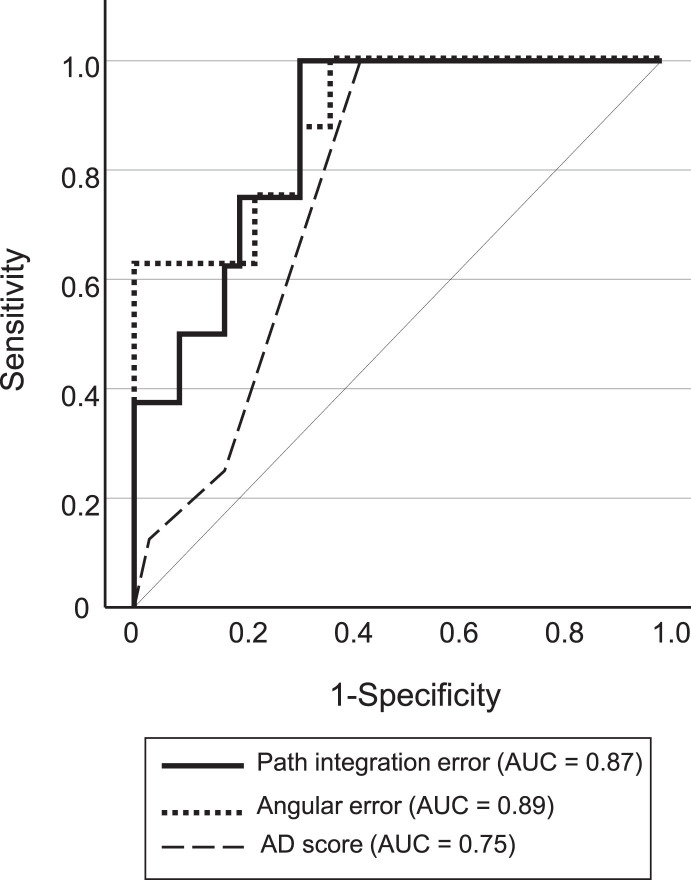
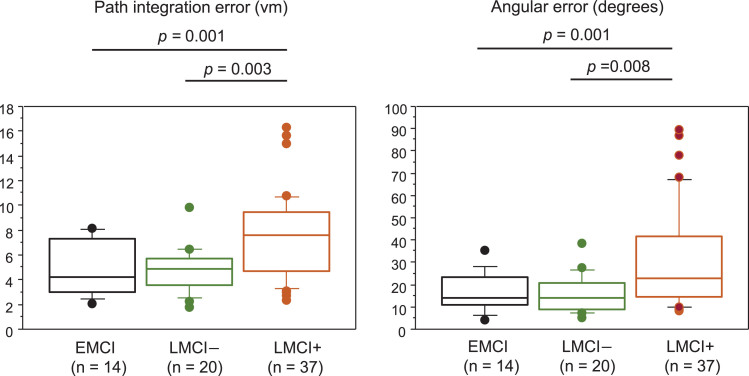
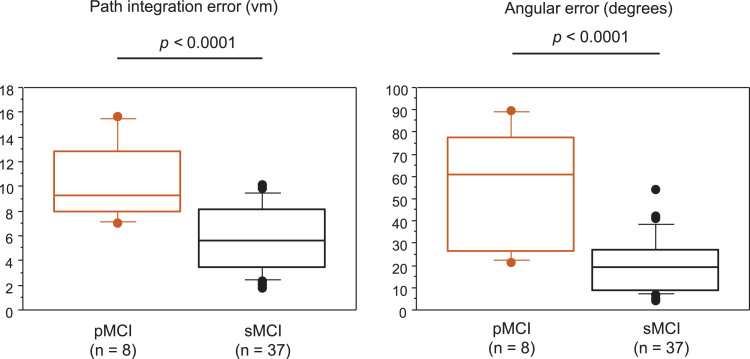
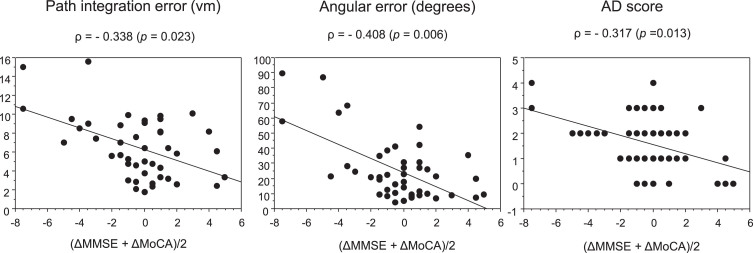
Path integration performance was significantly lower in patients with LMCI+than in those with EMCI and LMCI-. A significantly lower performance was observed in patients who showed progression of MCI during 12 months, than in those with stable MCI. Path integration performance distinguished patients with progressive MCI from those with stable MCI, with a high classification accuracy (a sensitivity of 0.88 and a specificity of 0.70).
Our results suggest that the 3D virtual reality navigation task detects prodromal AD patients and predicts cognitive decline after 12 months. Our navigation task, which is simple, short (12-15 minutes), noninvasive, and inexpensive, may be a screening tool for therapeutic choice of disease-modifiers in individuals with prodromal AD.
内嗅皮层是阿尔茨海默病(AD)最早受累的部位。内嗅皮层的网格细胞构成空间导航系统的一部分。
我们旨在确定路径整合表现是否可用于检测有发生 AD 风险的轻度认知障碍(MCI)患者,并预测认知能力下降。
使用新开发的 3D 虚拟现实导航任务,对 71 名早期 MCI(EMCI)和晚期 MCI(LMCI)患者进行路径整合表现评估。LMCI 患者进一步分为表现出 AD 特征性脑成像特征的患者,包括磁共振成像上的内侧颞叶萎缩和单光子发射断层扫描上的后部灌注不足(LMCI+),以及不表现出此类特征的患者(LMCI-)。
LMCI+患者的路径整合表现明显低于 EMCI 和 LMCI-患者。在 12 个月内表现出 MCI 进展的患者的表现明显低于稳定 MCI 的患者。路径整合表现将进展性 MCI 患者与稳定 MCI 患者区分开来,具有较高的分类准确性(敏感性为 0.88,特异性为 0.70)。
我们的研究结果表明,3D 虚拟现实导航任务可检测前驱 AD 患者,并预测 12 个月后的认知下降。我们的导航任务简单、简短(12-15 分钟)、无创且价格低廉,可能是前驱 AD 患者选择疾病修饰治疗的筛选工具。