Medicine for Older People, Amsterdam UMC, Location VUmc, Amsterdam, The Netherlands.
Internal Medicine, Geriatric Medicine Section, Amsterdam UMC, Location VUmc, Amsterdam, The Netherlands.
J Alzheimers Dis. 2024;101(3):1001-1013. doi: 10.3233/JAD-240526.
Post-diagnostic care for people with vascular cognitive impairment (VCI) typically involves multiple professions and disjointed care pathways not specifically designed to aid VCI needs.
Exploring perspectives of healthcare professionals on post-diagnostic care for people with VCI.
We conducted a qualitative focus group study. We used purposive sampling to include healthcare professionals in different compositions of primary and secondary care professionals per focus group. Thematic saturation was reached after seven focus groups. Transcripts were iteratively coded and analyzed using inductive thematic analysis.
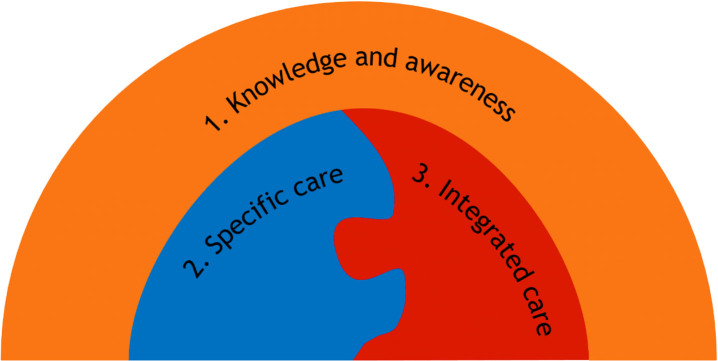
Forty participants were included in seven focus groups (4-8 participants). Results showed knowledge and awareness of VCI as prerequisites for adequate post-diagnostic care, and for pre-diagnostic detection of people with VCI (theme 1). In light of perceived lack of differentiation between cognitive disorders, participants shared specific advice regarding post-diagnostic care for people with VCI and informal caregivers (theme 2). Participants thought current care for VCI was fragmented and recommended further integration of care and collaboration across settings (theme 3).
People with VCI and their caregivers risk getting stuck in a "no man's land" between post-diagnostic care pathways; challenges lie in acknowledgement of VCI and associated symptoms, and alignment between healthcare professionals. Education about the symptoms and consequences of VCI, to healthcare professionals, people with VCI and caregivers, may increase awareness of VCI and thereby better target care. Specific attention for symptoms common in VCI could further tailor care and reduce caregiver burden. Integration could be enhanced by combining expertise of dementia and stroke/rehabilitation pathways.
血管性认知障碍(VCI)患者的诊断后护理通常涉及多个专业领域和不连贯的护理路径,这些路径并非专门为满足 VCI 的需求而设计。
探讨医疗保健专业人员对 VCI 患者诊断后护理的看法。
我们进行了一项定性焦点小组研究。我们采用目的抽样法,根据每个焦点小组的组成,包括初级和二级保健专业人员的不同组合。在进行了七个焦点小组后,达到了主题饱和。使用归纳主题分析对转录本进行迭代编码和分析。
共有 40 名参与者参加了七个焦点小组(每组 4-8 名参与者)。结果表明,VCI 的知识和意识是充分诊断后护理的前提,也是 VCI 患者(主题 1)预诊断检测的前提。鉴于认知障碍之间缺乏差异的感知,参与者就 VCI 的诊断后护理以及非正规照护者(主题 2)提出了具体建议。参与者认为当前的 VCI 护理是碎片化的,并建议进一步整合护理并在各场所之间进行协作(主题 3)。
VCI 患者及其照护者有陷入诊断后护理路径之间的“无人区”的风险;挑战在于承认 VCI 及其相关症状,并使医疗保健专业人员之间保持一致。向医疗保健专业人员、VCI 患者和照护者进行有关 VCI 的症状和后果的教育,可能会提高对 VCI 的认识,从而更好地确定护理目标。针对 VCI 常见症状的特别关注可以进一步调整护理并减轻照护者的负担。通过整合痴呆症和中风/康复途径的专业知识,可以增强整合。