Departamento de Biología y Química, Facultad de Ciencias Básicas e Ingeniería, Universidad de los Llanos, Villavicencio, Colombia.
Escuela de Ciencias Animales, Facultad de Ciencias Agropecuarias y Recursos Naturales, Universidad de los Llanos, Villavicencio, Colombia.
Biomedica. 2024 Aug 29;44(3):340-354. doi: 10.7705/biomedica.7168.
Due to the cross-reactivity between SARS-CoV-2 and common human coronaviruses, previous infections with these viruses could contribute to serological or cellular cross-protection against severe COVID-19. However, protective immunity may not develop, or pre-existing immunity could increase COVID-19 severity.
To determine the seroprevalence of IgG antibodies against HCoV-NL63 and HCoV-HKU1 and correlate previous exposure with COVID-19 signs in patients from Villavicencio.
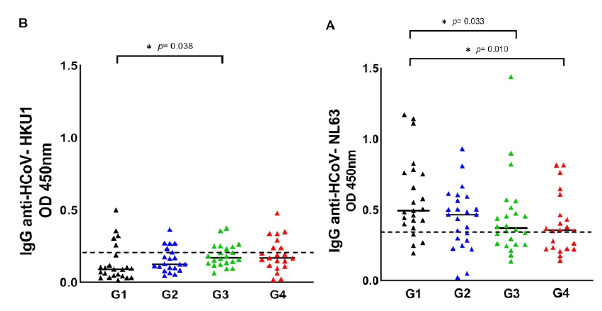
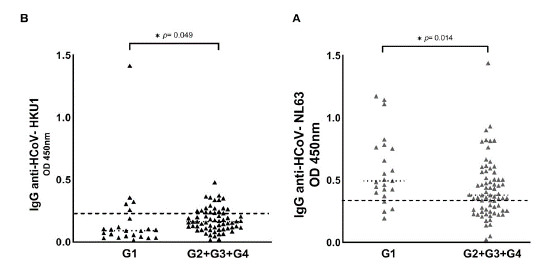
A cross-sectional retrospective study was conducted. ELISA technique was used to search for IgG antibodies against HCoV-NL3 and HCoV-HKU1 in patients with positive RT-qPCR results for SARS-CoV-2. Patients were grouped according to COVID-19 clinical characteristics in four groups: group 1: asymptomatic (n = 23); group 2: hospitalized (n = 24); group 3: intensive care units (n = 24), and group 4: dead (n = 22).
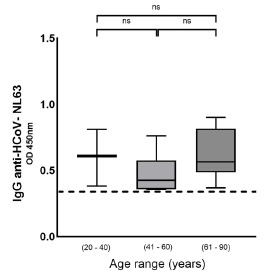
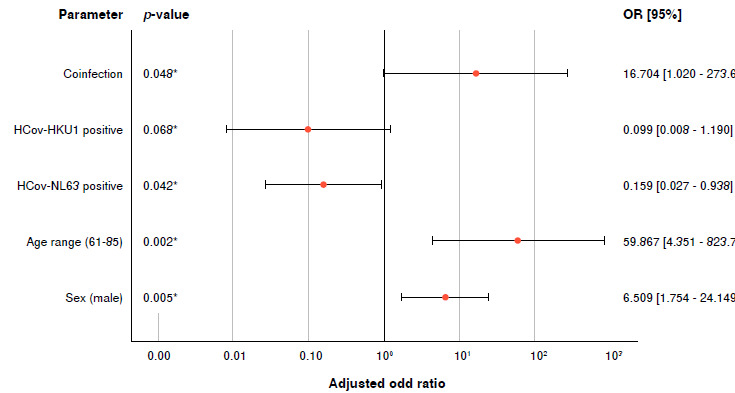
The overall seroprevalence of IgG antibodies against HCoV was 74.2% (n = 69; 95% CI: 65.3-83.1), with 66.7% of HCoV-NL63 (n = 62; 95% CI: 57,1-76,2), and 25.8% of HCoV-HKU1 (n = 24; 95% CI: 16,9-34,7). Based on crosstab analysis, prior exposure to HCoV-NL63 was associated with protection against severe COVID-19 (p = 0.042; adjusted OR = 0.159; 95% CI: 0.027-0.938), and previous coinfection of HCoV-NL63 and HCoVHKU1 was considered a positive association to severe COVID-19 (p = 0.048; adjusted OR = 16.704; 95% CI: 1.020 - 273.670).
To our knowledge, this is the first study addressing seroprevalence of HCoV IgG antibodies in Colombia and Latin America. Previous exposure to HCoV-NL63 could protect against severe COVID-19, whereas patients with underlying HCoV-NL63 and HCoVHKU1 coinfection could be hospitalized with severe signs of COVID-19.
由于 SARS-CoV-2 与常见人类冠状病毒之间存在交叉反应,因此以前感染这些病毒可能会对严重 COVID-19 产生血清学或细胞交叉保护。然而,保护性免疫可能无法发展,或者先前的免疫可能会增加 COVID-19 的严重程度。
确定来自维拉维森西奥的患者中针对 HCoV-NL63 和 HCoV-HKU1 的 IgG 抗体的血清流行率,并将先前的暴露与 COVID-19 症状相关联。
进行了一项横断面回顾性研究。使用 ELISA 技术在 SARS-CoV-2 的 RT-qPCR 结果为阳性的患者中搜索针对 HCoV-NL3 和 HCoV-HKU1 的 IgG 抗体。根据 COVID-19 临床特征将患者分为四组:第 1 组:无症状(n = 23);第 2 组:住院(n = 24);第 3 组:重症监护病房(n = 24)和第 4 组:死亡(n = 22)。
针对 HCoV 的 IgG 抗体的总体血清流行率为 74.2%(n = 69;95%CI:65.3-83.1),其中 HCoV-NL63 为 66.7%(n = 62;95%CI:57,1-76.2),而 HCoV-HKU1 为 25.8%(n = 24;95%CI:16.9-34.7)。基于交叉表分析,先前暴露于 HCoV-NL63 与严重 COVID-19 的保护有关(p = 0.042;调整后的 OR = 0.159;95%CI:0.027-0.938),而先前的 HCoV-NL63 和 HCoV-HKU1 共感染被认为与严重 COVID-19 呈正相关(p = 0.048;调整后的 OR = 16.704;95%CI:1.020-273.670)。
据我们所知,这是首次在哥伦比亚和拉丁美洲研究 HCoV IgG 抗体的血清流行率。先前暴露于 HCoV-NL63 可能会对严重 COVID-19 起到保护作用,而同时患有基础 HCoV-NL63 和 HCoV-HKU1 共感染的患者可能会因严重的 COVID-19 症状住院。