Department of Medicine (Hematology/Oncology), University of California San Francisco Helen Diller Family Comprehensive Cancer Center, San Francisco, USA.
Medical Oncology Department, Vall d'Hebron University Hospital, Barcelona; Breast Cancer Unit, Vall d'Hebron Institute of Oncology (VHIO), Barcelona, Spain.
ESMO Open. 2024 Sep;9(9):103697. doi: 10.1016/j.esmoop.2024.103697. Epub 2024 Sep 5.
Capivasertib is a potent, selective pan-AKT inhibitor. In CAPItello-291, the addition of capivasertib to fulvestrant resulted in a statistically significant (P < 0.001) improvement in progression-free survival over fulvestrant monotherapy in patients with hormone receptor-positive/human epidermal growth factor receptor 2-negative advanced breast cancer and disease progression on or after aromatase inhibitor-based therapy. Characterization of the capivasertib-fulvestrant adverse event (AE) profile as managed in CAPItello-291 can inform future management guidance and optimize clinical benefit.
Seven hundred and eight patients were randomized 1 : 1 to capivasertib (400 mg twice daily; 4 days on, 3 days off) or placebo, plus fulvestrant, on a 4-week cycle. Dose reductions/interruptions for capivasertib/placebo were permitted (up to two dose reductions). Safety analyses included exposure, AE, and clinical laboratory data and were conducted in patients who received at least one dose of capivasertib, fulvestrant, or placebo. Frequent AEs associated with phosphoinositide 3-kinase (PI3K)/protein kinase (AKT) pathway inhibition (diarrhea, rash, hyperglycemia) were characterized using group terms. AEs were summarized using descriptive statistics; time-to-event analyses were conducted.
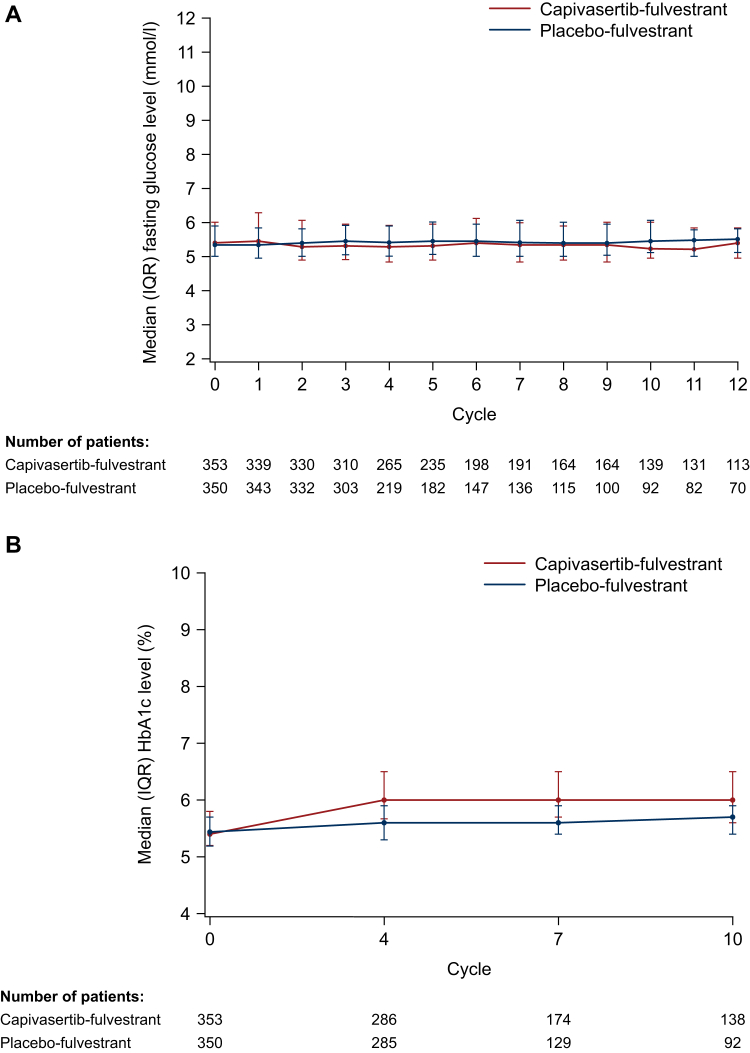
Safety analyses included 705 patients: capivasertib-fulvestrant (n = 355) and placebo-fulvestrant (n = 350). Frequent any-grade AEs with capivasertib-fulvestrant were diarrhea (72.4%), rash (38.0%), and nausea (34.6%); frequent grade ≥3 AEs were rash (12.1%), diarrhea (9.3%), and hyperglycemia (2.3%). Diarrhea, rash, and hyperglycemia occurred shortly after starting capivasertib-fulvestrant [median days to onset (interquartile range) of any grade: 8 (2-22), 12 (10-15), and 15 (1-51), respectively], and were managed with supportive medications, dose reductions, interruptions, and/or discontinuation. Discontinuation rates were 2.0%, 4.5%, and 0.3%, respectively. Overall, 13.0% discontinued capivasertib due to AEs.
Frequent AEs associated with PI3K/AKT pathway inhibition occurred early and were manageable. The low rate of treatment discontinuations suggests that, when appropriately managed, these AEs do not pose a challenge to clinical benefit.
Capivasertib 是一种有效的、选择性的全人源 AKT 抑制剂。在 CAPItello-291 中,与氟维司群单药治疗相比,卡培他滨联合氟维司群治疗激素受体阳性/人表皮生长因子受体 2 阴性晚期乳腺癌患者,并在基于芳香酶抑制剂治疗后疾病进展,可显著改善无进展生存期(P < 0.001)。对 CAPItello-291 中卡培他滨-氟维司群不良事件(AE)特征的描述,可为未来的管理提供信息,并优化临床获益。
708 例患者按 1:1 随机分为卡培他滨(400mg,每日两次;4 天给药,3 天停药)组或安慰剂组,联合氟维司群,每 4 周为一个周期。允许卡培他滨/安慰剂减量/中断(最多两次减量)。安全性分析包括暴露、AE 和临床实验室数据,纳入至少接受过一次卡培他滨、氟维司群或安慰剂治疗的患者。使用组术语描述与磷酸肌醇 3-激酶(PI3K)/蛋白激酶(AKT)通路抑制相关的常见 AEs(腹泻、皮疹、高血糖)。使用描述性统计方法总结 AE;进行时间事件分析。
安全性分析包括 705 例患者:卡培他滨-氟维司群组(n=355)和安慰剂-氟维司群组(n=350)。卡培他滨-氟维司群组常见的任何级别 AEs 为腹泻(72.4%)、皮疹(38.0%)和恶心(34.6%);常见的≥3 级 AEs 为皮疹(12.1%)、腹泻(9.3%)和高血糖(2.3%)。腹泻、皮疹和高血糖在开始卡培他滨-氟维司群组治疗后不久发生[任何级别中位发病天数(四分位距):8(2-22)、12(10-15)和 15(1-51)],通过支持性药物治疗、剂量减少、中断和/或停药进行管理。停药率分别为 2.0%、4.5%和 0.3%。总体而言,13.0%的患者因 AE 而停用卡培他滨。
与 PI3K/AKT 通路抑制相关的常见 AEs 发生较早,且可管理。低治疗中断率表明,在适当管理的情况下,这些 AEs 不会对临床获益构成挑战。