Department of Hepatology, The First Affiliated Hospital of Fujian Medical University, No. 20, Chazhong Road, Fuzhou, 350005, Fujian, China.
Sci Rep. 2024 Sep 6;14(1):20883. doi: 10.1038/s41598-024-70648-4.
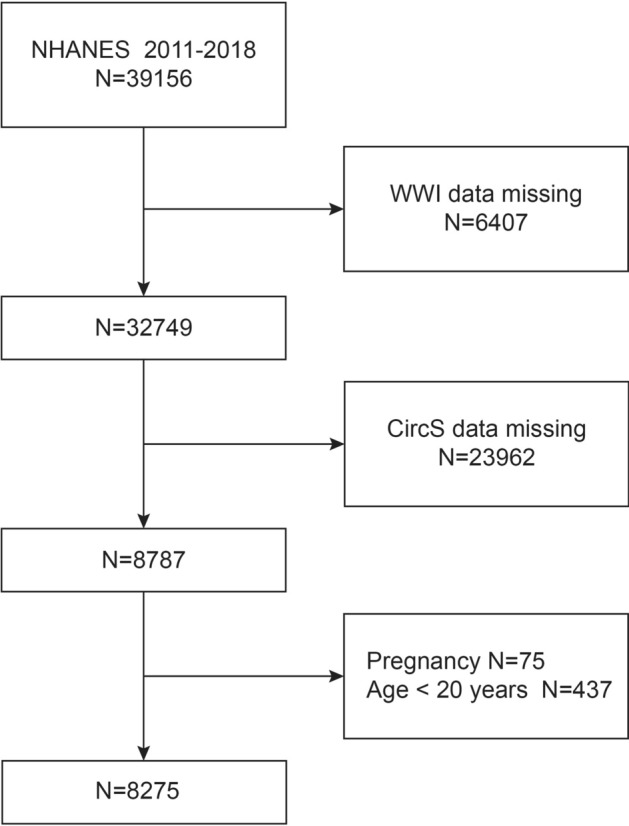
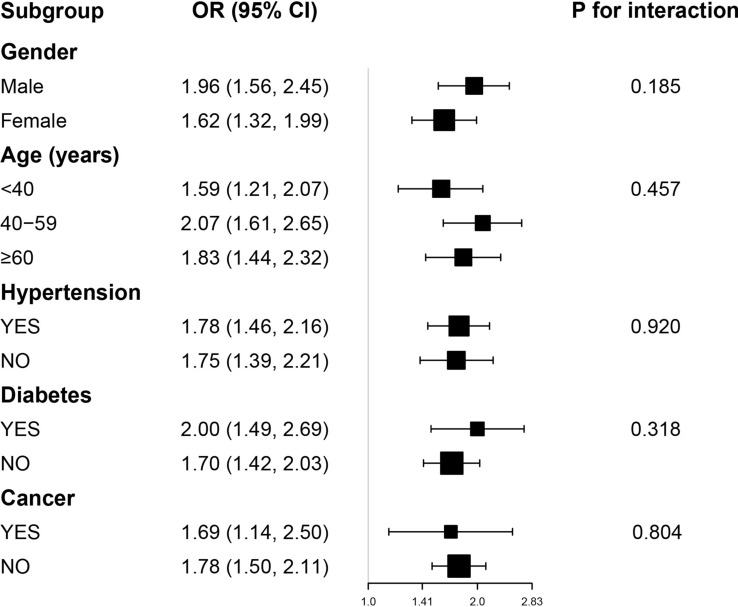
Weight-adjusted-waist index (WWI) is an emerging parameter for evaluating obesity. We sought to ascertain the link between WWI and circadian syndrome (CircS). The study population consisted of 8275 eligible subjects who were included in the ultimate analysis from the NHANES 2011-2018. By using multivariable regression models, the association of WWI and CircS was analyzed. In subgroup analysis, we explored the relationship in different groups and tested the stability of the intergroup connection using interaction testing. To investigate whether WWI and CircS had a potential non-linear relationship, smooth curve fittings, and threshold effects tests were also constructed. In a multivariate linear regression model, WWI is significantly positively related to CircS (OR = 1.77, 95% CI 1.50-2.08). Through subgroup analysis and interaction testing, the stability of this positive association was also validated. It was further found that there was an inverted U-shaped association, with a turning point of 11.84, between WWI and CircS. Our findings supported a strong association between WWI values and CircS. Central obesity management is pivotal for preventing or alleviating CircS.
体重调整腰围指数(WWI)是评估肥胖的新兴参数。我们旨在确定 WWI 与昼夜节律综合征(CircS)之间的联系。该研究人群包括来自 NHANES 2011-2018 的最终分析中纳入的 8275 名合格受试者。通过使用多变量回归模型,分析了 WWI 和 CircS 的相关性。在亚组分析中,我们探索了不同组之间的关系,并使用交互检验测试了组间联系的稳定性。为了研究 WWI 和 CircS 是否存在潜在的非线性关系,还构建了平滑曲线拟合和阈值效应检验。在多元线性回归模型中,WWI 与 CircS 呈显著正相关(OR=1.77,95%CI 1.50-2.08)。通过亚组分析和交互检验,也验证了这种正相关关系的稳定性。此外,还发现 WWI 和 CircS 之间存在倒 U 形关联,转折点为 11.84。我们的研究结果支持了 WWI 值与 CircS 之间的强烈关联。中心性肥胖管理对于预防或缓解 CircS 至关重要。