
全球入侵禾本科植物系统发育和生物地理因素中的对比模式。
Contrasting patterns in phylogenetic and biogeographic factories of invasive grasses (Poaceae) across the globe.
作者信息
Pertierra Luis R, Martínez Pablo A, Rubalcaba Juan G, Richardson David M, Olalla-Tárraga Miguel A
机构信息
BIOMA Lab, Departamento de Biología, Geología, Química y Física Inorgánica, Universidad Rey Juan Carlos, Móstoles, Spain.
Department of Plant & Soil Sciences, University of Pretoria, Pretoria, South Africa.
出版信息
NPJ Biodivers. 2023 May 18;2(1):11. doi: 10.1038/s44185-023-00016-4.
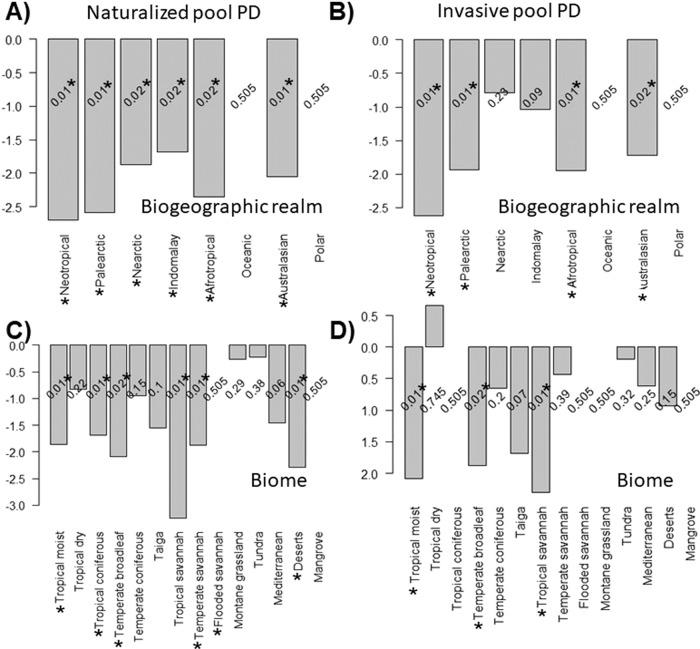
Grasses (Family Poaceae) are among the most successful invasive plants in the world. Here we evaluate phylogenetic and biogeographic patterns of emergence of naturalized and invasive species among grasses globally. In our data, circa 19% of the grasses are currently catalogued as invasive and almost 38% are listed as naturalized; these are among the highest ratios for single families of organisms. Remarkably, most tribes of grasses contain numerous naturalized and invasive species, suggesting that the invasion success is rooted broadly in ancestral traits in the Poaceae. Moreover, the probability of invasiveness is positively related to the diversification rates in the family also suggesting a link with recent radiation events. The phylogenetic distribution of the invasive condition is neither strongly conserved nor purely random. Phylogenetic clumping levels also vary between Poaceae subclades. We postulate that this diffuse clumping could be partially attributed to the expression of labile traits that contribute to species invasiveness. In addition, floristic regions (biomes and biogeographic realms) have different proportions of invasive species, with the temperate Palearctic region having the highest ratio of invasive vs. non-invasive species. The phylodiversity of aliens across regions is also variable in space. Comparison of alien phylodiversity levels across biogeographic realms and biomes reveals regions producing highly restricted invasive lineages and others where the diversity of aliens exported is no different from global mean diversity levels in grasses. Elucidating the evolutionary patterns and drivers of invasiveness is useful for understanding and managing invasions, with the low phylogenetic structure of alien grasses warning of their overall high invasiveness potential.
禾本科植物是世界上最成功的入侵植物之一。在此,我们评估了全球禾本科植物中归化植物和入侵植物出现的系统发育和生物地理模式。在我们的数据中,约19%的禾本科植物目前被列为入侵植物,近38%被列为归化植物;这些比例在单一生物科中是最高的。值得注意的是,大多数禾本科植物部落都包含大量归化植物和入侵植物,这表明入侵成功广泛源于禾本科的祖先特征。此外,入侵的可能性与该科的多样化速率呈正相关,这也表明与近期的辐射事件有关。入侵状态的系统发育分布既不是高度保守的,也不是完全随机的。禾本科亚分支之间的系统发育聚集水平也有所不同。我们推测这种分散的聚集可能部分归因于有助于物种入侵的不稳定性状的表达。此外,植物区系区域(生物群落和生物地理区域)中入侵物种的比例不同,温带古北区的入侵物种与非入侵物种的比例最高。不同区域外来物种的系统发育多样性在空间上也存在差异。比较不同生物地理区域和生物群落的外来物种系统发育多样性水平,发现有些区域产生的入侵谱系非常有限,而其他区域输出的外来物种多样性与禾本科植物的全球平均多样性水平并无差异。阐明入侵的进化模式和驱动因素有助于理解和管理入侵,外来禾本科植物较低的系统发育结构警示着它们总体上具有较高的入侵潜力。


 Zotero 插件