
肥胖症手术治疗后出现的酒精使用障碍:一项利用关联健康索赔和调查数据开展的研究。
Alcohol use disorders after bariatric surgery: a study using linked health claims and survey data.
机构信息
Leibniz Institute for Prevention Research and Epidemiology-BIPS, Bremen, Germany.
, Hamburg, Germany.
出版信息
Int J Obes (Lond). 2024 Nov;48(11):1656-1663. doi: 10.1038/s41366-024-01606-3. Epub 2024 Sep 6.
BACKGROUND
Previous studies have repeatedly reported alcohol use disorders (AUDs) in patients after bariatric surgery (BS). This research field can benefit from studies combining health claims data with survey data.
METHODS
Based on a combined retrospective cohort and cross-sectional study, 2151 patients with BS identified in a large health claims database received a questionnaire, by which we assessed the presence of AUDs based on a validated instrument (AUDIT) as well as by ICD-10 codes from the health claims data. We described patients with vs. without AUDs regarding sex, time since surgery, satisfaction with weight loss and health care resource utilization (HCRU).
RESULTS
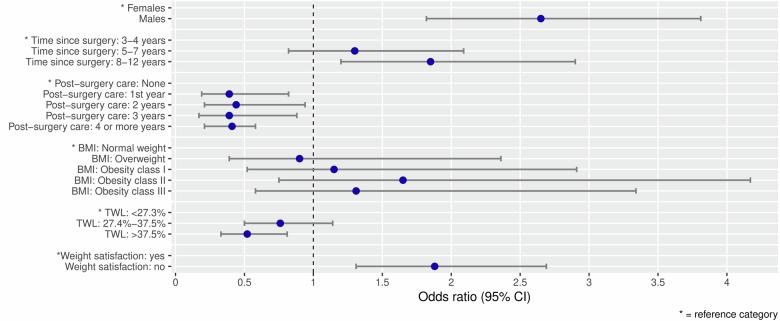
The majority of patients were female (80.7%) with a median time since surgery of 6 years (Interquartile range: 4-9 years). For the majority of patients, the bariatric intervention was either a RYGB-Bypass (50%) or sleeve gastrectomy (43%). Overall, 3% had at least one AUD diagnosis code in the claims data (men: 5.5%, women: 2.5%). Among men, 43.6% of diagnoses were coded after but not before the surgery (women: 52%). According to AUDIT (completed by 1496 patients), 9.4% of all patients showed at least hazardous/harmful alcohol consumption. Higher scores were associated with sex of the person, longer time since surgery, dissatisfaction with the weight loss and higher HCRU, with contradicting results regarding psychotherapeutic care.
CONCLUSIONS
The proportion with AUDs in the study population gives rise to concern as alcohol consumption should be restricted after BS. The results suggest the necessity for close monitoring and post-surgical care.
背景
先前的研究反复报告了减重手术后(BS)患者的酒精使用障碍(AUD)。该研究领域可以从结合健康索赔数据和调查数据的研究中受益。
方法
基于回顾性队列和横断面研究的组合,在一个大型健康索赔数据库中确定了 2151 名 BS 患者,他们收到了一份问卷,我们根据经过验证的工具(AUDIT)以及健康索赔数据中的 ICD-10 代码来评估 AUD 的存在情况。我们描述了有无 AUD 的患者的性别、手术时间、对减肥和医疗保健资源利用(HCRU)的满意度。
结果
大多数患者为女性(80.7%),手术后中位数时间为 6 年(四分位数范围:4-9 年)。对于大多数患者,减重干预措施要么是 RYGB 旁路(50%),要么是袖状胃切除术(43%)。总体而言,有 3%的患者在索赔数据中至少有一个 AUD 诊断代码(男性:5.5%,女性:2.5%)。在男性中,43.6%的诊断是在手术后而不是手术前编码的(女性:52%)。根据 AUDIT(由 1496 名患者完成),所有患者中有 9.4%至少存在危险/有害的饮酒行为。更高的分数与患者的性别、手术后时间、对减肥的不满和更高的 HCRU 相关,但关于心理治疗的结果却存在矛盾。
结论
研究人群中 AUD 的比例令人担忧,因为 BS 后应限制饮酒。结果表明需要密切监测和术后护理。


 Zotero 插件