Department of Epidemiology and Population Health, Stanford University School of Medicine, Stanford, CA, 94305, USA.
Division of Infectious Diseases and Geographic Medicine, Stanford University School of Medicine, Stanford, CA, 94305, USA.
Nat Commun. 2024 Sep 7;15(1):7832. doi: 10.1038/s41467-024-51018-0.
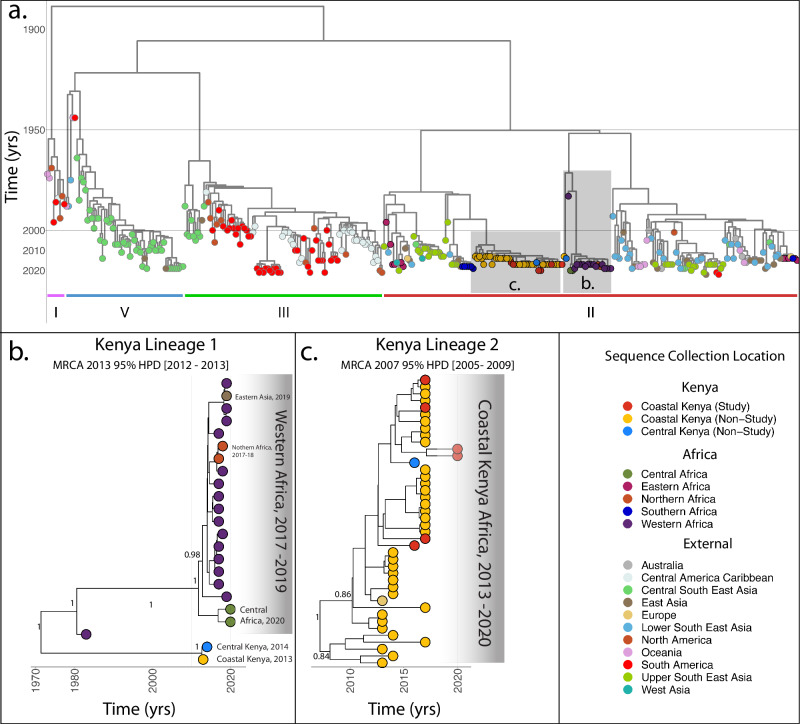
Despite the increasing burden of dengue, the regional emergence of the virus in Kenya has not been examined. This study investigates the genetic structure and regional spread of dengue virus-2 in Kenya. Viral RNA from acutely ill patients in Kenya was enriched and sequenced. Six new dengue-2 genomes were combined with 349 publicly available genomes and phylogenies used to infer gene flow between Kenya and other countries. Analyses indicate two dengue-2 Cosmopolitan genotype lineages circulating in Kenya, linked to recent outbreaks in coastal Kenya and Burkina Faso. Lineages circulating in Western, Southern, and Eastern Africa exhibiting similar evolutionary features are also reported. Phylogeography suggests importation of dengue-2 into Kenya from East and Southeast Asia and bidirectional geneflow. Additional lineages circulating in Africa are also imported from East and Southeast Asia. These findings underscore how intermittent importations from East and Southeast Asia drive dengue-2 circulation in Kenya and Africa more broadly.
尽管登革热负担日益加重,但肯尼亚该区域的病毒流行情况尚未得到检测。本研究调查了肯尼亚的登革热病毒 2 型的基因结构和区域传播。从肯尼亚急性病患者中富集并测序了病毒 RNA。将 6 个新的登革热 2 型基因组与 349 个公开可用的基因组相结合,并利用系统发育推断了肯尼亚与其他国家之间的基因流动。分析表明,肯尼亚存在两种登革热 2 型世界性基因型谱系,与肯尼亚沿海地区和布基纳法索的近期暴发有关。还报告了在西部、南部和东部非洲流行的具有相似进化特征的谱系。系统发生地理学表明,登革热 2 型从东亚和东南亚输入到肯尼亚,并存在双向基因流动。在非洲流行的其他谱系也从东亚和东南亚输入。这些发现强调了东亚和东南亚的间歇性输入如何推动肯尼亚乃至整个非洲的登革热 2 型传播。