Department of Neurosurgery, Nakamura Memorial Hospital.
Department of Neurology, Nakamura Memorial Hospital.
Neurol Med Chir (Tokyo). 2024 Oct 15;64(10):360-368. doi: 10.2176/jns-nmc.2024-0017. Epub 2024 Sep 7.
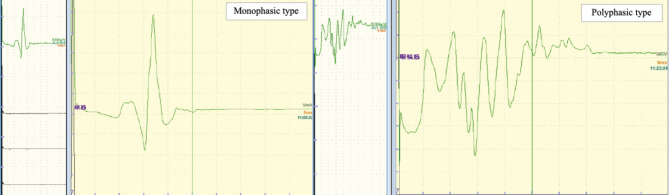
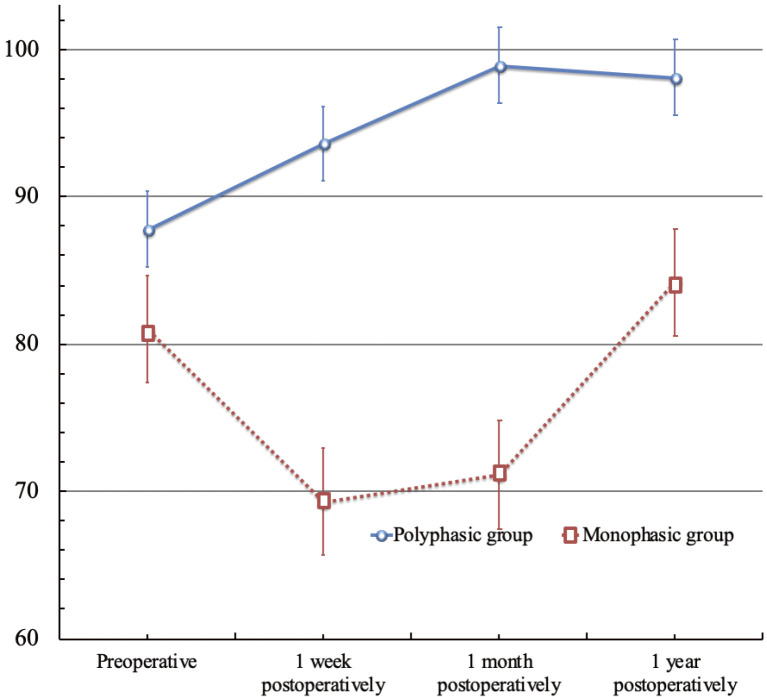
Although microvascular decompression (MVD) is a reliable treatment for hemifacial spasm (HFS), postoperative delayed relief is one of its main issues. We previously evaluated the morphology of the lateral spread response (LSR) and reported correlation between delayed relief after MVD and polyphasic morphology of the LSR. This study aimed to investigate the morphology of LSR and the course of recovery of the compound motor action potential (CMAP), to better understand the pathophysiology of delayed healing of HFS. Based on the pattern of the initial LSR morphology on temporal and marginal mandibular branches stimulation, patients were divided into two groups: the monophasic and polyphasic groups. The results of MVD surgery and sequential changes in the CMAP were evaluated 1 week, 1 month, 1 year, and final follow-up after the surgery. Significantly higher rates of persistent postoperative HFS were observed in patients with the polyphasic type of initial LSR at 1 week and 1 month after the surgery (P < 0.05, respectively). In the polyphasic group, the amplitude of the CMAP tended to gradually improve with time, while in the monophasic group, the amplitude of the CMAP decreased on the seventh postoperative day, followed by its gradual improvement. There is a significant correlation between delayed relief after MVD and polyphasic morphology of the initial LSR in patients with HFS. In the polyphasic group, CMAP recovered earlier and showed less reduction in amplitude, suggesting segmental demyelination, with less damage to peripheral nerves.
尽管微血管减压术(MVD)是治疗面肌痉挛(HFS)的可靠方法,但术后延迟缓解是其主要问题之一。我们之前评估了外侧扩散反应(LSR)的形态,并报告了 MVD 后延迟缓解与 LSR 多相形态之间的相关性。本研究旨在研究 LSR 的形态和复合运动动作电位(CMAP)的恢复过程,以更好地了解 HFS 延迟愈合的病理生理学。根据颞支和下颌缘支刺激时初始 LSR 形态的模式,将患者分为单相组和多相组。评估了 MVD 手术后的结果以及手术后 1 周、1 个月、1 年和最终随访时 CMAP 的连续变化。在手术后 1 周和 1 个月时,具有初始 LSR 多相型的患者持续术后 HFS 的发生率明显更高(P < 0.05)。在多相组中,CMAP 的幅度随时间逐渐增加,而在单相组中,CMAP 的幅度在术后第 7 天下降,随后逐渐增加。HFS 患者 MVD 后延迟缓解与初始 LSR 的多相形态之间存在显著相关性。在多相组中,CMAP 更早恢复,幅度降低较少,提示节段性脱髓鞘,周围神经损伤较小。