Department of Neurosurgery, Nakamura Memorial Hospital.
Department of Neurology, Nakamura Memorial Hospital.
Neurol Med Chir (Tokyo). 2021 Aug 15;61(8):461-467. doi: 10.2176/nmc.oa.2020-0217. Epub 2021 May 14.
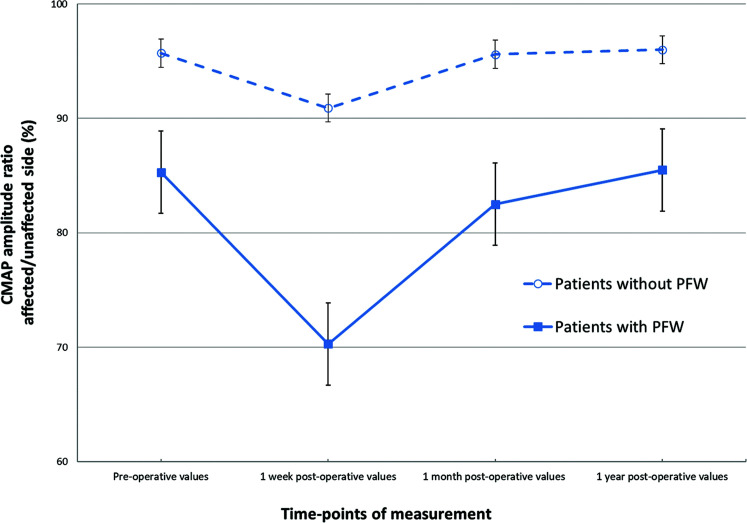
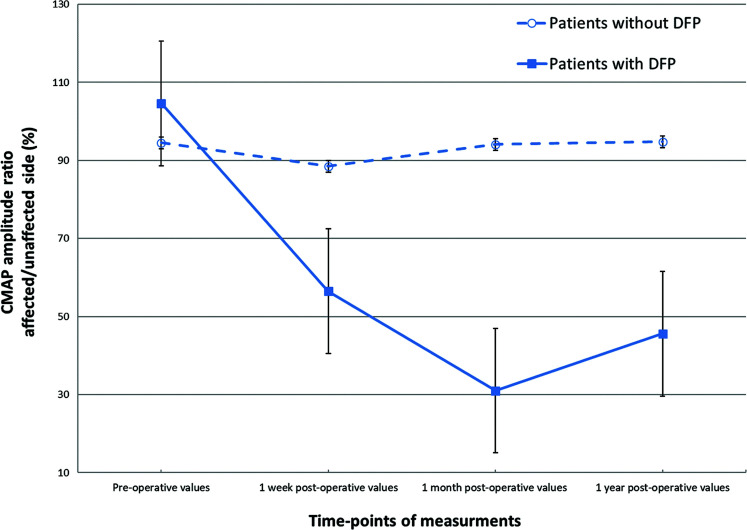
Hemifacial spasm (HFS) patients occasionally present with preoperative facial weakness (PFW) or develop delayed facial palsy (DFP) after microvascular decompression (MVD). This study is aimed to evaluate the neurophysiology underlying facial nerve motor dysfunction in HFS patients preoperatively and postoperatively. In all, 54 HFS patients without prior botulinum toxin injection who underwent MVD were retrospectively reviewed. The compound muscle action potential (CMAP) amplitude ratios of the affected and unaffected facial nerves, measured at 4 time points from preoperation to 1 year post-surgery, were aggregated. Clinical outcomes and the CMAP amplitude ratios were evaluated. Six patients (11.1%) presented with PFW, which correlated with advanced age (p = 0.007) and symptom duration (p = 0.001). The average duration to achieve PFW relief was 2.67 months postoperatively. The preoperative CMAP amplitude ratios of PFW patients were lower than those of patients without PFW (85.3% vs 95.7%). The ratios showed the lowest value at 1-week post-surgery in both groups (70.3% vs 90.9%), had a tendency toward improvement at 1 month, and finally recovered to almost the same level as that before the surgery at 1 year. Three patients (5.6%), whose CMAP ratios showed a persistent decrease from 1 week (56.5%) to 1 month (31%) after MVD, developed DFP. This study illustrates PFW in HFS patients reflects facial nerve axonal stress. MVD is effective in resolving spasm and PFW, without long-term damage to the facial nerve in most patients. In DFP patients, the direct and subsequent secondary axonal disorder develops on the postoperative facial nerve.
面肌痉挛(HFS)患者偶尔会出现术前面部无力(PFW),或在微血管减压术(MVD)后出现迟发性面瘫(DFP)。本研究旨在评估 HFS 患者术前和术后面神经运动功能障碍的神经生理学基础。回顾性分析了 54 例未接受肉毒毒素注射且接受 MVD 的 HFS 患者。从术前到术后 1 年,共测量了 4 个时间点的患侧和健侧面神经复合肌肉动作电位(CMAP)幅度比。评估了临床结果和 CMAP 幅度比。6 例(11.1%)患者出现 PFW,与年龄较大(p = 0.007)和症状持续时间较长(p = 0.001)有关。PFW 缓解的平均时间为术后 2.67 个月。PFW 患者的术前 CMAP 幅度比低于无 PFW 患者(85.3% vs 95.7%)。两组患者的比值在术后 1 周时均达到最低值(70.3% vs 90.9%),1 个月时呈上升趋势,1 年后基本恢复到术前水平。3 例(5.6%)患者的 CMAP 比值在 MVD 后 1 周(56.5%)和 1 个月(31%)持续下降,出现 DFP。本研究表明 HFS 患者的 PFW 反映了面神经轴突的应激。MVD 可有效缓解痉挛和 PFW,大多数患者面神经不会长期受损。在 DFP 患者中,术后面神经出现直接和随后的继发性轴索紊乱。