Interdisciplinary Research Team on Internet and Society, Masaryk University, Brno, Czech Republic.
URMIS, Université Côté d'Azur, Nice, France.
Trauma Violence Abuse. 2025 Jan;26(1):86-102. doi: 10.1177/15248380241275971. Epub 2024 Sep 8.
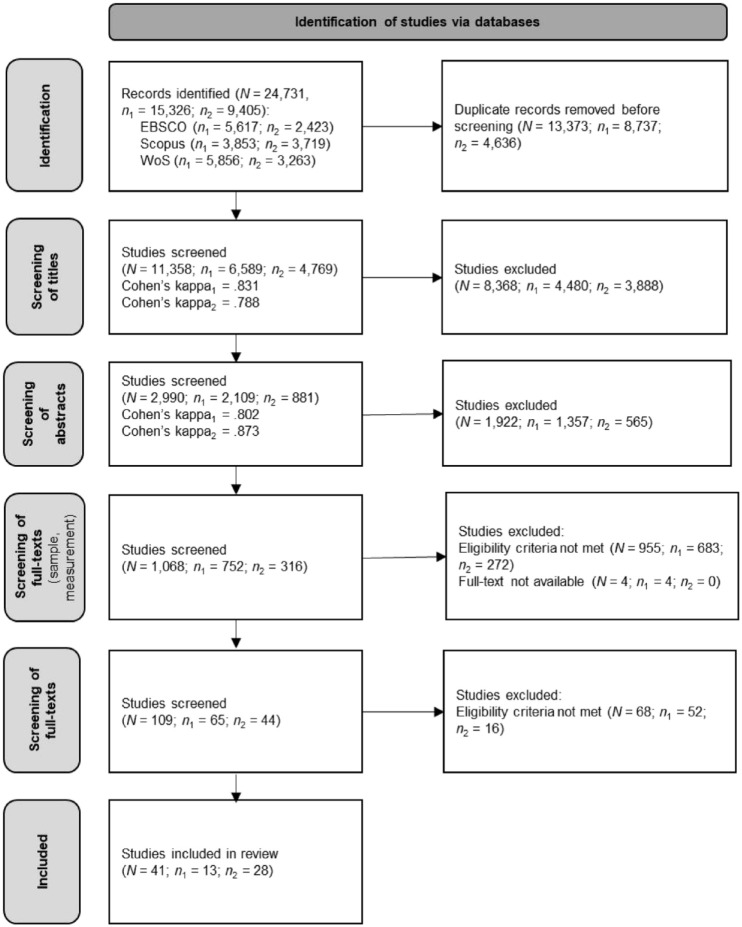
Bias-based cyberaggression-hateful and bias-based content and interactions via information and communication technologies-is a frequent experience for young internet users that can result in detrimental consequences for both individuals and society. Ample research has focused on the factors related to involvement in bias-based cyberaggression. This study systematically reviews the research published in the past decade about the investigations into exposure, vicarious and direct victimization, and aggression among young people (up to age 30). We aimed to provide a complex summarization of the research findings about the risk and protective factors and the consequences of experiences with bias-based cyberaggression-specifically the diverse manifestations of bias-based cyberaggression targeted toward ethnicity, race, nationality, religion, sexual orientation, gender, weight, and disability. Three academic databases (EBSCO, Scopus, and WoS) were searched and 41 articles were included in the review. The results show a dominant research focus on bias-based cyberaggression victimization and on the bias-based cyberaggression that targets ethnicity, race, nationality, and religion, leaving a gap in the knowledge about the different types of targeted group categories and bias-based cyberaggression perpetration. The identified risk factors for bias-based cyberaggression involvement included being a minority, low psychological well-being, other victimization experiences, higher internet use, and risky internet use. An overlap was found for bias-based cyberaggression involvement with other offline and online victimization experiences. This review showed limited knowledge about protective factors, namely the social-level and contextual factors. The identified factors, as well as the gaps in the knowledge, are discussed in relation to research implications and practice and policy implications.
基于偏见的网络欺凌——通过信息和通信技术传播的仇恨和偏见内容和互动——是年轻互联网用户的常见体验,这可能对个人和社会都造成有害后果。大量研究集中在与参与基于偏见的网络欺凌相关的因素上。本研究系统地回顾了过去十年中关于年轻人(至 30 岁)中基于偏见的网络欺凌暴露、替代性和直接受害以及攻击的研究。我们旨在对基于偏见的网络欺凌风险和保护因素以及相关经验后果的研究结果进行复杂总结,具体来说,是对针对种族、民族、国籍、宗教、性取向、性别、体重和残疾的基于偏见的网络欺凌的各种表现形式进行总结。我们在三个学术数据库(EBSCO、Scopus 和 WoS)中进行了搜索,共纳入了 41 篇文章。研究结果表明,研究主要集中在基于偏见的网络欺凌受害以及针对种族、民族、国籍和宗教的网络欺凌上,而对于针对不同目标群体类别的网络欺凌和基于偏见的网络欺凌的研究则存在空白。与基于偏见的网络欺凌参与相关的风险因素包括少数民族身份、心理健康水平低、其他受害经历、较高的互联网使用和危险的互联网使用。还发现基于偏见的网络欺凌参与与其他线下和线上受害经历之间存在重叠。本综述表明,关于保护因素的知识有限,即社会层面和背景因素。讨论了所确定的因素以及知识空白与研究意义和实践及政策意义之间的关系。