Grossar Lorenz, Raevens Sarah, Van Steenkiste Christophe, Colle Isabelle, De Vloo Charlotte, Orlent Hans, Schouten Jeoffrey, Gallant Marie, Van Driessche Annelien, Lefere Sander, Devisscher Lindsey, Geerts Anja, Van Vlierberghe Hans, Verhelst Xavier
Department of Internal Medicine and Paediatrics, Hepatology Research Unit, Ghent University, Ghent, Belgium.
Liver Research Centre Ghent, Ghent University, Ghent University Hospital, Ghent, Belgium.
JHEP Rep. 2024 Jun 23;6(9):101149. doi: 10.1016/j.jhepr.2024.101149. eCollection 2024 Sep.
BACKGROUND & AIMS: The goal of treatment in autoimmune hepatitis (AIH) is induction of remission to prevent the development of liver fibrosis, cirrhosis, and its related complications. Various definitions of treatment response and remission have been used. The International Autoimmune Hepatitis Group (IAIHG) recently defined consensus criteria for treatment response. We aimed to validate the IAIHG response criteria in our cohort and establish correlations with survival endpoints.
We performed a retrospective, multicentric cohort study in one tertiary and seven secondary care centres in Belgium. Eligible patients were at least 18 years of age at data collection and were diagnosed with AIH by a simplified IAIHG score of ≥6. Complete biochemical response (CBR) was defined according to the IAIHG consensus criteria as normalisation of transaminases and serum IgG within the first 6 months of treatment. The primary endpoint was liver-related survival - defined as freedom from liver-related death or liver transplantation. Secondary endpoints were overall mortality and transplant-free survival. Outcomes were compared between patients attaining CBR and those with insufficient response.
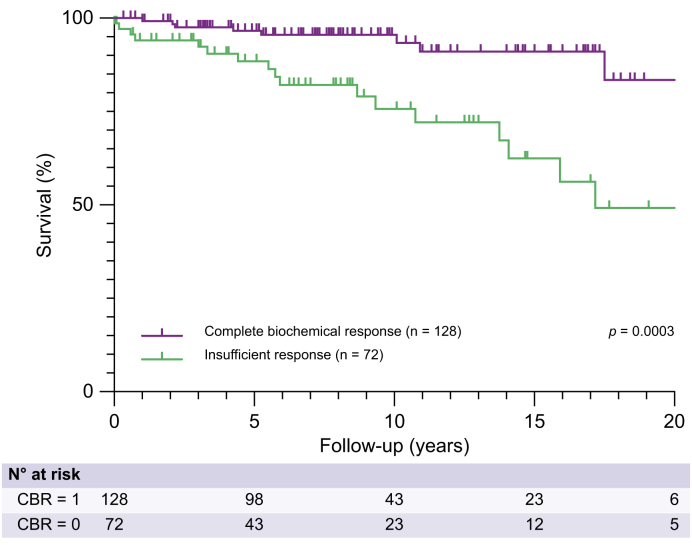
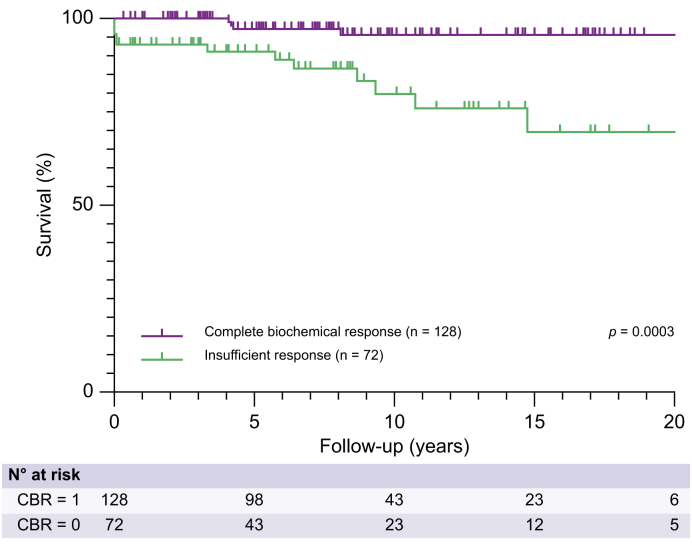
Biochemical response status could be determined in 200 patients with AIH: CBR was achieved in 128 (64.0%) individuals. Patients not achieving CBR more frequently presented with cirrhosis on initial histology (22.2% . 10.9%, 0.036). Liver-related mortality or liver transplantation as a primary outcome occurred in 26 patients (13.0%). Patients achieving CBR exhibited superior liver-related (hazard ratio 0.118; 95% CI 0.052-0.267; <0.0001) and overall (hazard ratio 0.253; 95% CI 0.111-0.572; 0.0003) survival.
We externally validated the IAIHG consensus criteria for CBR and confirmed their correlation with survival endpoints in a multicentric, real-world cohort. Patients with AIH achieving CBR as an intermediate endpoint have significantly superior liver-related and overall survival.
Corticosteroids remain the cornerstone of treatment to induce remission of disease activity in autoimmune hepatitis (AIH), and the majority of patients require long-term corticosteroid treatment to achieve sustained remission. Definitions of response to treatment have varied over the years, and consistently used intermediate endpoints are needed to facilitate advancements in non-corticosteroid treatment for autoimmune hepatitis. The International Autoimmune Hepatitis Group (IAIHG) defined consensus criteria on endpoints in the treatment of AIH, for which further external validation is needed. Here, we demonstrate the usefulness of the IAIHG consensus criteria and corroborate their correlation to primary endpoints, such as liver-related survival and native liver survival in a multicentric, real-world setting. The design of future studies can rely on the IAIHG consensus criteria as intermediate endpoints.
自身免疫性肝炎(AIH)的治疗目标是诱导病情缓解,以预防肝纤维化、肝硬化及其相关并发症的发生。治疗反应和缓解的定义多种多样。国际自身免疫性肝炎小组(IAIHG)最近制定了治疗反应的共识标准。我们旨在验证我们队列中IAIHG的反应标准,并建立与生存终点的相关性。
我们在比利时的一家三级医疗中心和七家二级医疗中心进行了一项回顾性多中心队列研究。符合条件的患者在数据收集时至少18岁,通过简化的IAIHG评分≥6被诊断为AIH。根据IAIHG共识标准,完全生化反应(CBR)定义为治疗前6个月内转氨酶和血清IgG正常化。主要终点是肝脏相关生存——定义为无肝脏相关死亡或肝移植。次要终点是总死亡率和无移植生存。比较达到CBR的患者和反应不足的患者的结局。
可以确定200例AIH患者的生化反应状态:128例(64.0%)患者实现了CBR。未实现CBR的患者在初始组织学检查中更常出现肝硬化(22.2%对10.9%,P = 0.036)。26例患者(13.0%)发生了肝脏相关死亡或肝移植作为主要结局。实现CBR的患者在肝脏相关生存(风险比0.118;95%CI 0.052 - 0.267;P < 0.0001)和总体生存(风险比0.253;95%CI 0.111 - 0.572;P = 0.0003)方面表现更优。
我们在外部验证了IAIHG关于CBR的共识标准,并在多中心真实世界队列中证实了它们与生存终点的相关性。以CBR作为中间终点的AIH患者在肝脏相关生存和总体生存方面显著更优。
皮质类固醇仍然是诱导自身免疫性肝炎(AIH)疾病活动缓解的治疗基石,大多数患者需要长期皮质类固醇治疗以实现持续缓解。多年来治疗反应的定义各不相同,需要一致使用的中间终点来促进自身免疫性肝炎非皮质类固醇治疗的进展。国际自身免疫性肝炎小组(IAIHG)定义了AIH治疗终点的共识标准,对此还需要进一步的外部验证。在此,我们证明了IAIHG共识标准的实用性,并在多中心真实世界环境中证实了它们与主要终点的相关性,如肝脏相关生存和自体肝生存。未来研究的设计可以依赖IAIHG共识标准作为中间终点。