Khan Hafiz, Farhana Fardous, Mostafa Fahad, Rafiq Aamrin, Nizia Effat Walia, Razzaq Refaya, Atique Rumana, Dauenhauer Megan, Zabin Zawah, Palle Komaraiah, Reddy P Hemachandra
Department of Public Health, Julia Jones Matthews School of Population and Public Health, Texas Tech University Health Sciences Center, Lubbock, TX, USA.
Nutritional Sciences Department, Texas Tech University, Lubbock, TX, USA.
J Alzheimers Dis Rep. 2024 Aug 22;8(1):1133-1151. doi: 10.3233/ADR-240092. eCollection 2024.
Alzheimer's disease (AD) is related to one or more chronic illnesses, which may develop cognitive decline and dementia. Cognitive impairment is increasing, and public health officials must address risk factors for AD to improve the health of rural West Texas communities.
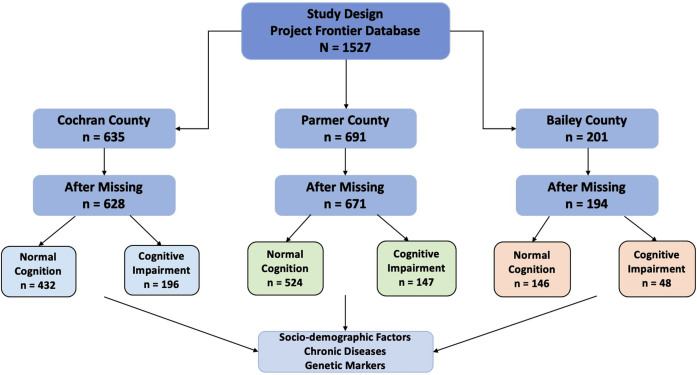
The purpose of this study was to explore the sociodemographic and chronic disease risk factors related to cognitive impairment among elderly adults living in Cochran, Parmer, and Bailey counties in rural West Texas.
Statistical methods such as Pearson's chi-squared, proportion tests, univariate binary logistic regression, and a multivariable logistic regression were utilized to analyze data. SPSS software was used to detect the significant relationship between cognitive impairment and risk factors.
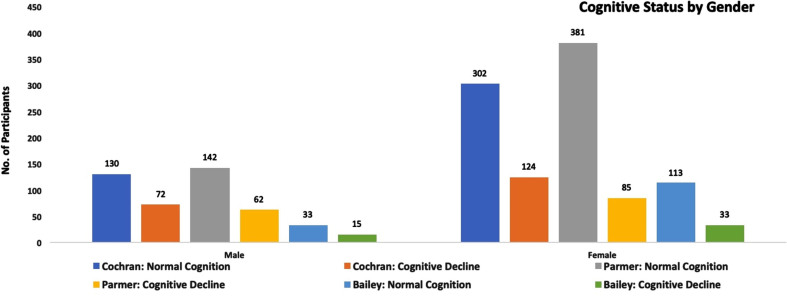
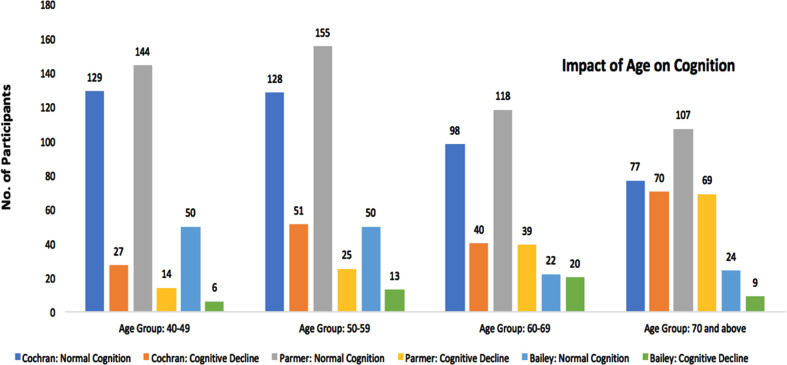
Summary statistics were obtained for sociodemographic and chronic diseases by using cross-tabulation analysis and comparing the county respondents with proportion tests. A univariate binary logistic regression method was utilized and found that age group 60-69, anxiety, depression, diabetes, hypertension, and cardiovascular disease were significantly associated with cognitive impairment. Using a multivariable logistic regression approach, it was found that Bailey County (age group 60-69) had a higher likelihood ( = 0.002) of cognitive impairment than Parmer ( = 0.067) and Cochran counties ( = 0.064). The risk of females ( = 0.033) in Parmer County was 78.3% lower compared to males in developing AD.
Identifying significant risk factors for cognitive impairment are important in addressing issues of geographic variations and integrating such factors may guide relevant policy interventions to reduce cognitive impairment incidence in rural communities within West Texas.
阿尔茨海默病(AD)与一种或多种慢性疾病相关,这些慢性疾病可能会导致认知能力下降和痴呆。认知障碍日益增多,公共卫生官员必须应对AD的风险因素,以改善西德克萨斯农村社区的健康状况。
本研究旨在探讨西德克萨斯农村地区 Cochr an、Parmer和Bailey县老年人认知障碍的社会人口统计学和慢性病风险因素。
采用Pearson卡方检验、比例检验、单变量二元逻辑回归和多变量逻辑回归等统计方法分析数据。使用SPSS软件检测认知障碍与风险因素之间的显著关系。
通过交叉表分析并使用比例检验比较各县受访者,得出了社会人口统计学和慢性病的汇总统计数据。采用单变量二元逻辑回归方法,发现60 - 69岁年龄组、焦虑、抑郁、糖尿病、高血压和心血管疾病与认知障碍显著相关。使用多变量逻辑回归方法发现,Bailey县(60 - 69岁年龄组)发生认知障碍的可能性(=0.002)高于Parmer县(=0.067)和Cochran县(=0.064)。与男性相比,Parmer县女性患AD的风险(=0.033)低78.3%。
确定认知障碍的重要风险因素对于解决地理差异问题很重要,整合这些因素可能会指导相关政策干预措施,以降低西德克萨斯农村社区认知障碍的发病率。