Department of Cardiology, Pulmonology, and Vascular Medicine, Medical Faculty, University Düsseldorf, Germany (S.B., M. Stern, P.W., J.S., R.S., M. Spieker, G.W., F.B., C.Q., C.H., M.K., L.B.).
Department of Clinical and Experimental Medicine, Faculty of Health and Medical Sciences, University of Surrey, Guildford, United Kingdom (C.H.).
Circ Heart Fail. 2024 Sep;17(9):e011258. doi: 10.1161/CIRCHEARTFAILURE.123.011258. Epub 2024 Sep 9.
Recent research indicates that there is a high prevalence of heart failure with preserved ejection fraction in patients with peripheral artery disease. We hypothesized that endovascular treatment (EVT) of flow-limiting peripheral stenosis improves left ventricular (LV) diastolic function.
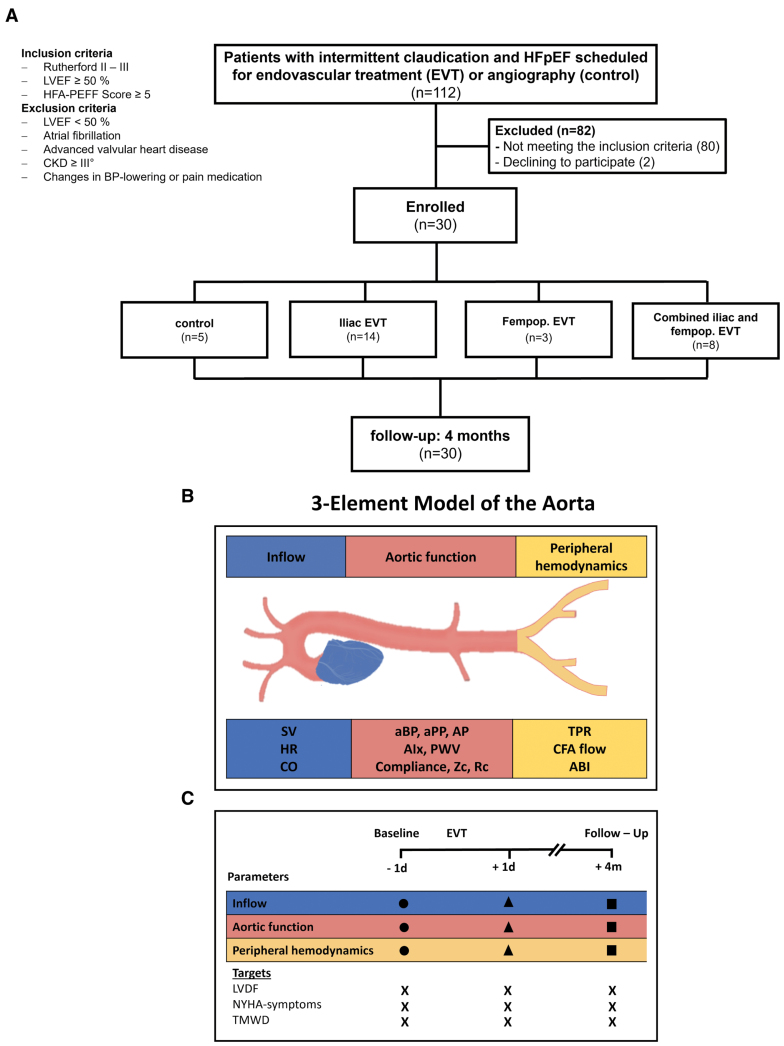
Thirty patients with symptomatic peripheral artery disease and heart failure with preserved ejection fraction according to Heart Failure Association-preserved ejection fraction score who were scheduled for EVT or angiography were investigated at baseline, the day after EVT (n=25) or angiography (control, n=5), and at 4 months follow-up. Peripheral hemodynamics were determined by the total peripheral resistance, common femoral artery flow, and ankle brachial index. Aortic function was measured by arterial compliance, augmentation index, and pulse wave velocity. Aortic pulsatile load was estimated as the characteristic impedance of the proximal aorta and the magnitude of wave reflection (reflection coefficient). LV mass index, LV mean wall thickness, and systolic and diastolic function were assessed using echocardiography. Patient-centered outcomes were treadmill walking distance and New York Heart Association class.
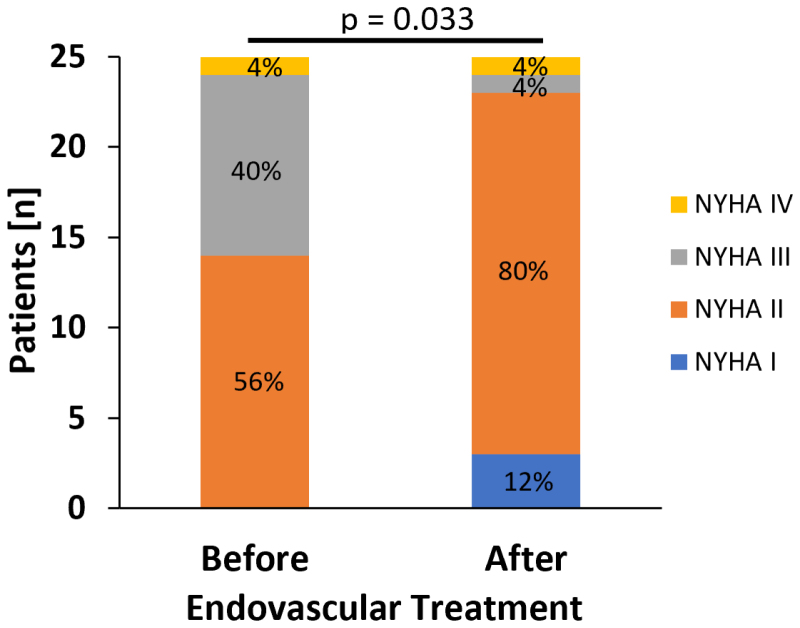
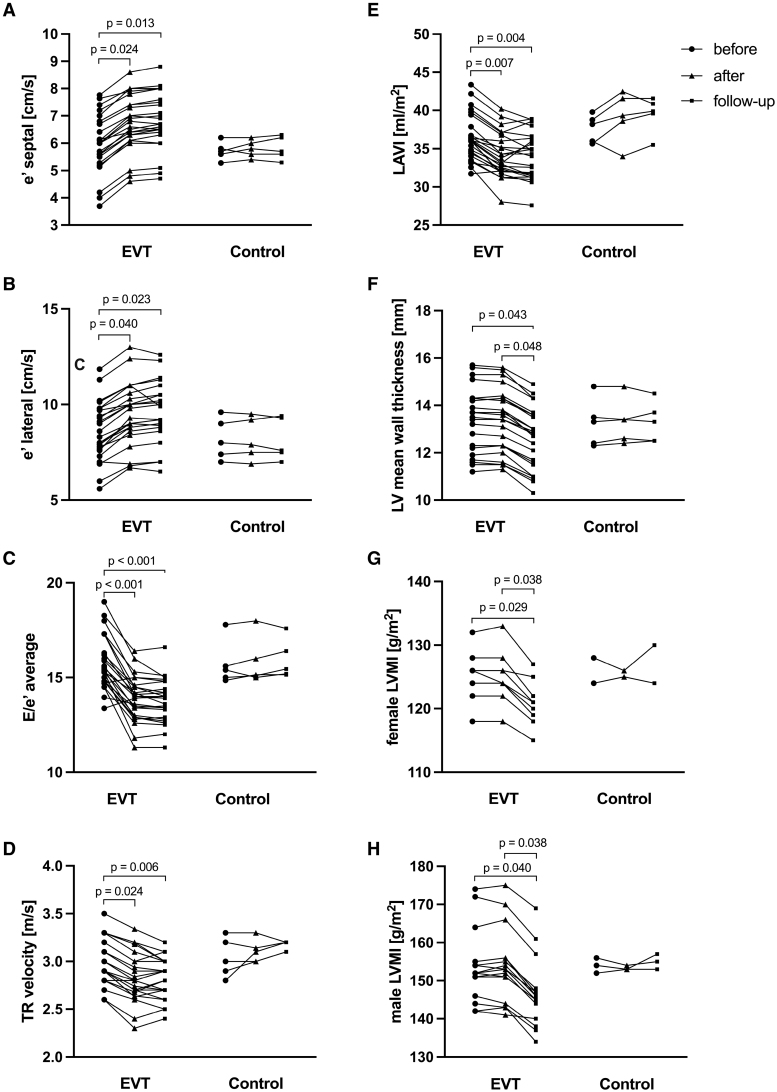
After EVT, peripheral hemodynamics changed significantly with a decrease in total peripheral resistance and an increase in common femoral artery flow and ankle brachial index. Aortic function improved after EVT, with significantly reduced augmentation index and pulse wave velocity and increased compliance immediately and at follow-up, resulting in a reduction in aortic pulsatile load (characteristic impedance of the proximal aorta and reflection coefficient). Concurrently, LV diastolic function improved after EVT compared with control, acutely and at follow-up, with increased septal and lateral e´ velocities and decreased /´ and left atrial volume index. The LV mass index and LV mean wall thickness decreased at follow-up. The New York Heart Association class and treadmill walking distance improved post-EVT at follow-up. Augmentation index, pulse wave velocity, and arterial compliance were identified as independent contributors to /´.
Endovascular treatment of flow-limiting iliofemoral stenosis reduces aortic pulsatile load and concurrently lowers total peripheral resistance. This beneficial effect is associated with an acute and sustained improvement of left ventricular diastolic function.
URL: http://www.clinicaltrials.gov; Unique identifier: NCT02728479.
最近的研究表明,外周动脉疾病患者中存在射血分数保留的心力衰竭的高患病率。我们假设,限制血流的外周狭窄的血管内治疗(EVT)可改善左心室(LV)舒张功能。
30 名患有症状性外周动脉疾病和射血分数保留心力衰竭的患者(根据心力衰竭协会射血分数评分),计划进行 EVT 或血管造影检查,在基线时、EVT 后一天(n=25)或血管造影(对照组,n=5)以及 4 个月随访时进行检查。外周血流动力学通过总外周阻力、股总动脉流量和踝臂指数来确定。主动脉功能通过动脉顺应性、增强指数和脉搏波速度来测量。主动脉脉动负荷通过近端主动脉特征阻抗和波反射幅度(反射系数)来估计。使用超声心动图评估 LV 质量指数、LV 平均壁厚度以及收缩和舒张功能。以跑步机步行距离和纽约心脏协会(NYHA)心功能分级作为患者为中心的结局。
EVT 后,外周血流动力学发生显著变化,总外周阻力降低,股总动脉流量和踝臂指数增加。EVT 后主动脉功能得到改善,增强指数和脉搏波速度显著降低,顺应性立即和随访时增加,导致主动脉脉动负荷降低(近端主动脉特征阻抗和反射系数)。同时,与对照组相比,LV 舒张功能在 EVT 后即刻和随访时均得到改善,室间隔和侧壁 e´速度增加,/´和左心房容积指数降低。LV 质量指数和 LV 平均壁厚度在随访时降低。NYHA 心功能分级和跑步机步行距离在随访时改善。增强指数、脉搏波速度和动脉顺应性被确定为 /´的独立贡献因素。
限制血流的髂股动脉狭窄的血管内治疗可降低主动脉脉动负荷,并同时降低总外周阻力。这种有益作用与左心室舒张功能的急性和持续改善有关。