• 文献检索
  • 文档翻译
  • 深度研究
  • 学术资讯
  • Suppr Zotero 插件Zotero 插件
  • 邀请有礼
  • 套餐&价格
  • 历史记录
应用&插件
Suppr Zotero 插件Zotero 插件浏览器插件Mac 客户端Windows 客户端微信小程序
定价
高级版会员购买积分包购买API积分包
服务
文献检索文档翻译深度研究API 文档MCP 服务
关于我们
关于 Suppr公司介绍联系我们用户协议隐私条款
关注我们

Suppr 超能文献

核心技术专利:CN118964589B侵权必究
粤ICP备2023148730 号-1Suppr @ 2026

文献检索

告别复杂PubMed语法,用中文像聊天一样搜索,搜遍4000万医学文献。AI智能推荐,让科研检索更轻松。

立即免费搜索

文件翻译

保留排版,准确专业,支持PDF/Word/PPT等文件格式,支持 12+语言互译。

免费翻译文档

深度研究

AI帮你快速写综述,25分钟生成高质量综述,智能提取关键信息,辅助科研写作。

立即免费体验

热休克转录因子 1 通过驱动 MYCN 的超级增强子介导的转录促进肝癌进展。

Heat shock transcription factor 1 facilitates liver cancer progression by driving super-enhancer-mediated transcription of MYCN.

机构信息

Fudan University Shanghai Cancer Center and Institutes of Biomedical Sciences; Department of Oncology, Shanghai Medical College, Fudan University, Shanghai, China.

Key Laboratory of Breast Cancer in Shanghai, Fudan University Shanghai Cancer Center, Fudan University, Shanghai, China.

出版信息

Cancer Med. 2024 Sep;13(17):e70157. doi: 10.1002/cam4.70157.

DOI:10.1002/cam4.70157
PMID:39248163
原文链接:https://pmc.ncbi.nlm.nih.gov/articles/PMC11382014/
Abstract

BACKGROUND

Heat shock transcription factors (HSFs) play crucial roles in the development of malignancies. However, the specific roles of HSFs in hepatocellular carcinoma (HCC) have yet to be fully elucidated.

AIMS

To explore the involvement of the HSF family, particularly HSF1, in the progression and prognosis of HCC.

MATERIALS & METHODS: We conducted a thorough analysis of HSF expression and copy number variations across various cancer datasets. Specifically focusing on HSF1, we examined its expression levels and prognostic implications in HCC. In vitro and in vivo experiments were carried out to evaluate the impact of HSF1 on liver cancer cell proliferation. Additionally, we utilized CUT&Tag, H3K27 acetylation enrichment, and RNA sequencing (RNA-seq) to investigate the super-enhancer (SE) regulatory landscapes of HSF1 in liver cancer cell lines.

RESULTS

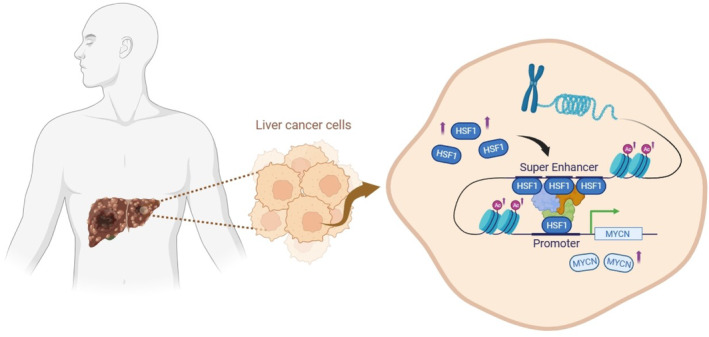
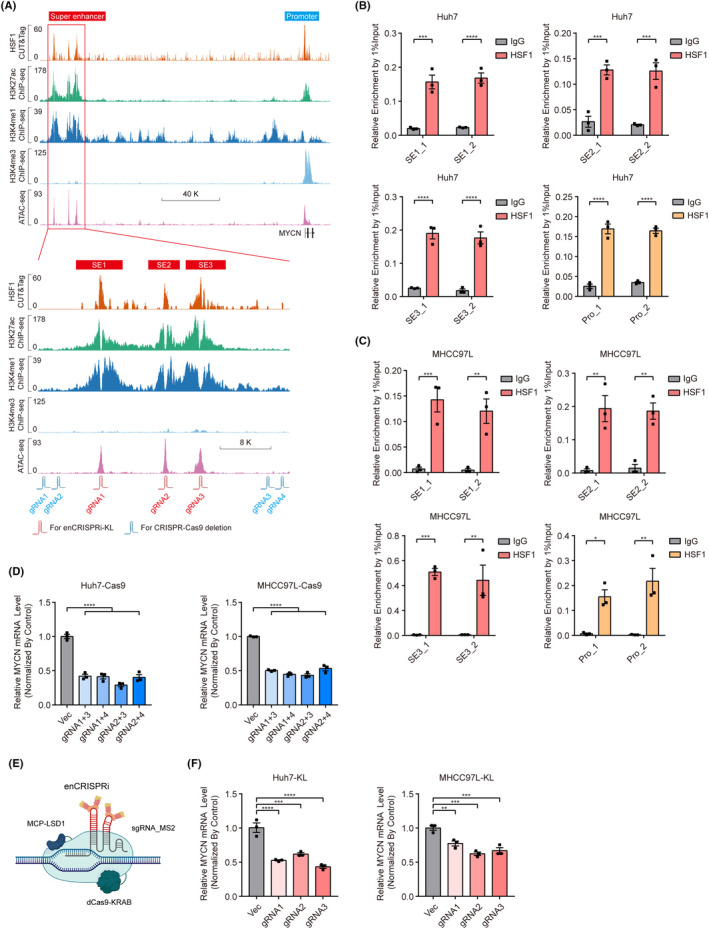
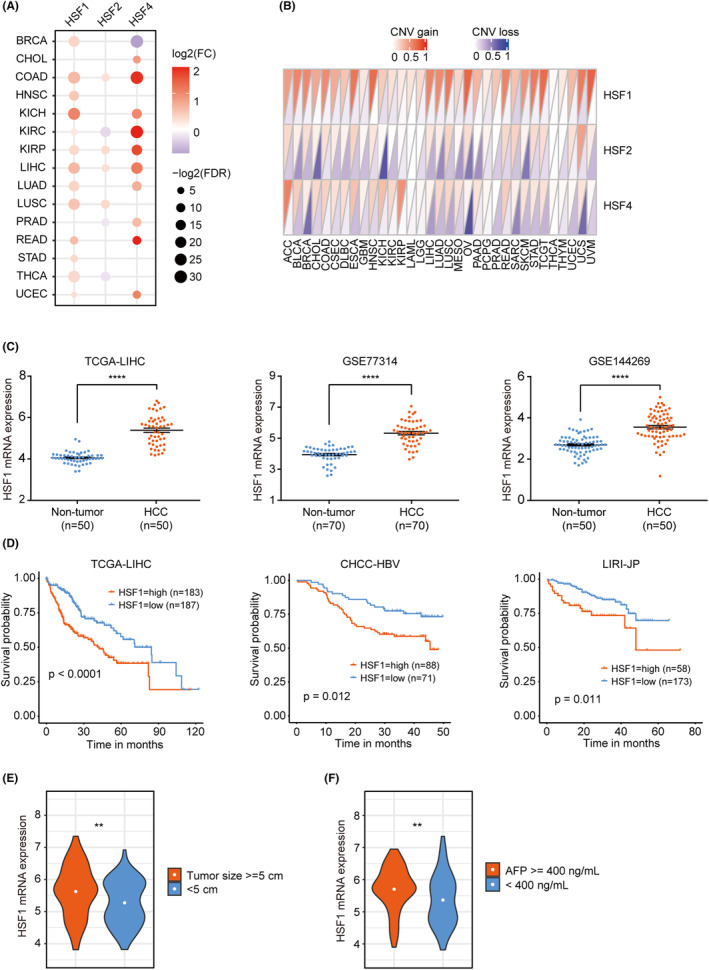
HSF1 expression is elevated in HCC and is linked to poor prognosis in several datasets. HSF1 stimulates liver cancer cell proliferation both in vitro and in vivo, partly through modulation of H3K27ac levels, influencing enhancer distribution. Mechanistically, our findings demonstrate that HSF1 transcriptionally activates MYCN expression by binding to its promoter and SE elements, thereby promoting liver cancer cell proliferation. Moreover, increased MYCN expression was detected in HCC tumors and correlated with unfavorable patient outcomes.

DISCUSSION

Our study sheds light on previously unexplored aspects of HSF1 biology, identifying it as a transcription factor capable of shaping the epigenetic landscape in the context of HCC. Given HSF1's potential as an epigenetic regulator, targeting the HSF1-MYCN axis could open up new therapeutic possibilities for HCC treatment.

CONCLUSION

The HSF1-MYCN axis constitutes a transcription-dependent regulatory mechanism that may function as both a prognostic indicator and a promising therapeutic target in liver cancer. Further exploration of this axis could yield valuable insights into novel treatment strategies for HCC.

摘要

背景

热休克转录因子(HSFs)在恶性肿瘤的发展中起着至关重要的作用。然而,HSFs 在肝细胞癌(HCC)中的具体作用尚未完全阐明。

目的

探讨 HSF 家族,特别是 HSF1,在 HCC 进展和预后中的作用。

材料与方法

我们对各种癌症数据集进行了 HSF 表达和拷贝数变异的全面分析。特别关注 HSF1,我们研究了其在 HCC 中的表达水平及其预后意义。进行了体外和体内实验,以评估 HSF1 对肝癌细胞增殖的影响。此外,我们利用 CUT&Tag、H3K27 乙酰化富集和 RNA 测序(RNA-seq)研究了 HSF1 在肝癌细胞系中的超级增强子(SE)调控景观。

结果

HSF1 在 HCC 中表达上调,并且在几个数据集中与预后不良相关。HSF1 在体外和体内均刺激肝癌细胞增殖,部分通过调节 H3K27ac 水平影响增强子分布。从机制上讲,我们的研究结果表明,HSF1 通过结合其启动子和 SE 元件转录激活 MYCN 表达,从而促进肝癌细胞增殖。此外,在 HCC 肿瘤中检测到 MYCN 表达增加,并与患者不良预后相关。

讨论

我们的研究揭示了 HSF1 生物学的以前未探索的方面,确定 HSF1 是一种能够在 HCC 背景下塑造表观遗传景观的转录因子。鉴于 HSF1 作为表观遗传调节剂的潜力,靶向 HSF1-MYCN 轴可能为 HCC 治疗开辟新的治疗可能性。

结论

HSF1-MYCN 轴构成了一种转录依赖性调节机制,可能作为肝癌的预后指标和有前途的治疗靶点。进一步研究该轴可能为 HCC 的治疗提供有价值的新策略。
https://cdn.ncbi.nlm.nih.gov/pmc/blobs/c9c2/11382014/056ef4ca032c/CAM4-13-e70157-g007.jpg
https://cdn.ncbi.nlm.nih.gov/pmc/blobs/c9c2/11382014/ac182975bcf0/CAM4-13-e70157-g005.jpg
https://cdn.ncbi.nlm.nih.gov/pmc/blobs/c9c2/11382014/8815a50aac81/CAM4-13-e70157-g003.jpg
https://cdn.ncbi.nlm.nih.gov/pmc/blobs/c9c2/11382014/851bdfaefc31/CAM4-13-e70157-g001.jpg
https://cdn.ncbi.nlm.nih.gov/pmc/blobs/c9c2/11382014/726d1be17b82/CAM4-13-e70157-g004.jpg
https://cdn.ncbi.nlm.nih.gov/pmc/blobs/c9c2/11382014/00ae32e6c91c/CAM4-13-e70157-g002.jpg
https://cdn.ncbi.nlm.nih.gov/pmc/blobs/c9c2/11382014/056ef4ca032c/CAM4-13-e70157-g007.jpg
https://cdn.ncbi.nlm.nih.gov/pmc/blobs/c9c2/11382014/ac182975bcf0/CAM4-13-e70157-g005.jpg
https://cdn.ncbi.nlm.nih.gov/pmc/blobs/c9c2/11382014/8815a50aac81/CAM4-13-e70157-g003.jpg
https://cdn.ncbi.nlm.nih.gov/pmc/blobs/c9c2/11382014/851bdfaefc31/CAM4-13-e70157-g001.jpg
https://cdn.ncbi.nlm.nih.gov/pmc/blobs/c9c2/11382014/726d1be17b82/CAM4-13-e70157-g004.jpg
https://cdn.ncbi.nlm.nih.gov/pmc/blobs/c9c2/11382014/00ae32e6c91c/CAM4-13-e70157-g002.jpg
https://cdn.ncbi.nlm.nih.gov/pmc/blobs/c9c2/11382014/056ef4ca032c/CAM4-13-e70157-g007.jpg

相似文献

1
Heat shock transcription factor 1 facilitates liver cancer progression by driving super-enhancer-mediated transcription of MYCN.热休克转录因子 1 通过驱动 MYCN 的超级增强子介导的转录促进肝癌进展。
Cancer Med. 2024 Sep;13(17):e70157. doi: 10.1002/cam4.70157.
2
Combined inhibition of AURKA and HSF1 suppresses proliferation and promotes apoptosis in hepatocellular carcinoma by activating endoplasmic reticulum stress.联合抑制 AURKA 和 HSF1 通过激活内质网应激抑制肝癌细胞增殖并促进其凋亡。
Cell Oncol (Dordr). 2021 Oct;44(5):1035-1049. doi: 10.1007/s13402-021-00617-w. Epub 2021 Jun 26.
3
Lipid desaturation-associated endoplasmic reticulum stress regulates MYCN gene expression in hepatocellular carcinoma cells.脂质去饱和相关内质网应激调节肝癌细胞中 MYCN 基因的表达。
Cell Death Dis. 2020 Jan 27;11(1):66. doi: 10.1038/s41419-020-2257-y.
4
Glucose regulates heat shock factor 1 transcription activity via mTOR pathway in HCC cell lines.葡萄糖通过mTOR途径调节肝癌细胞系中的热休克因子1转录活性。
Cell Biol Int. 2015 Nov;39(11):1217-24. doi: 10.1002/cbin.10493. Epub 2015 Jul 6.
5
MicroRNA-493-5p-mediated repression of the MYCN oncogene inhibits hepatic cancer cell growth and invasion.miR-493-5p 通过抑制 MYCN 癌基因抑制肝癌细胞生长和侵袭。
Cancer Sci. 2020 Mar;111(3):869-880. doi: 10.1111/cas.14292. Epub 2020 Jan 25.
6
Prevention of hepatocellular carcinoma by targeting MYCN-positive liver cancer stem cells with acyclic retinoid.用无环维甲酸靶向 MYCN 阳性肝癌干细胞预防肝细胞癌。
Proc Natl Acad Sci U S A. 2018 May 8;115(19):4969-4974. doi: 10.1073/pnas.1802279115. Epub 2018 Apr 23.
7
Deregulation of DNA-dependent protein kinase catalytic subunit contributes to human hepatocarcinogenesis development and has a putative prognostic value.DNA 依赖性蛋白激酶催化亚基的失调促进了人类肝癌的发生发展,并具有潜在的预后价值。
Br J Cancer. 2013 Nov 12;109(10):2654-64. doi: 10.1038/bjc.2013.606. Epub 2013 Oct 17.
8
Long noncoding RNA UPK1A-AS1 indicates poor prognosis of hepatocellular carcinoma and promotes cell proliferation through interaction with EZH2.长链非编码 RNA UPK1A-AS1 提示肝细胞癌预后不良,并通过与 EZH2 相互作用促进细胞增殖。
J Exp Clin Cancer Res. 2020 Oct 29;39(1):229. doi: 10.1186/s13046-020-01748-y.
9
Upregulation of heat shock factor 1 transcription activity is associated with hepatocellular carcinoma progression.热休克因子1转录活性的上调与肝细胞癌进展相关。
Mol Med Rep. 2014 Nov;10(5):2313-21. doi: 10.3892/mmr.2014.2547. Epub 2014 Sep 8.
10
Mitochondrial Respiratory Dysfunction Induces Claudin-1 Expression via Reactive Oxygen Species-mediated Heat Shock Factor 1 Activation, Leading to Hepatoma Cell Invasiveness.线粒体呼吸功能障碍通过活性氧介导的热休克因子1激活诱导Claudin-1表达,导致肝癌细胞侵袭性。
J Biol Chem. 2015 Aug 28;290(35):21421-31. doi: 10.1074/jbc.M115.654913. Epub 2015 Jul 8.

引用本文的文献

1
Diagnostic technologies for neuroblastoma.神经母细胞瘤的诊断技术
Lab Chip. 2025 Jul 14. doi: 10.1039/d4lc00005f.
2
Targeting super-enhancers in liver cancer: from pathogenic mechanisms to clinical applications.靶向肝癌中的超级增强子:从致病机制到临床应用
Front Pharmacol. 2025 Jun 18;16:1589455. doi: 10.3389/fphar.2025.1589455. eCollection 2025.

本文引用的文献

1
Targeting HSF1 for cancer treatment: mechanisms and inhibitor development.靶向 HSF1 治疗癌症:机制与抑制剂开发。
Theranostics. 2023 Apr 17;13(7):2281-2300. doi: 10.7150/thno.82431. eCollection 2023.
2
Immune checkpoint inhibitor resistance in hepatocellular carcinoma.肝细胞癌的免疫检查点抑制剂耐药性。
Cancer Lett. 2023 Feb 28;555:216038. doi: 10.1016/j.canlet.2022.216038. Epub 2022 Dec 16.
3
Evolving therapeutic landscape of advanced hepatocellular carcinoma.晚期肝细胞癌不断演变的治疗格局。
Nat Rev Gastroenterol Hepatol. 2023 Apr;20(4):203-222. doi: 10.1038/s41575-022-00704-9. Epub 2022 Nov 11.
4
Heat Shock Proteins and HSF1 in Cancer.癌症中的热休克蛋白与热休克因子1
Front Oncol. 2022 Mar 2;12:860320. doi: 10.3389/fonc.2022.860320. eCollection 2022.
5
Cancer proteogenomics: current impact and future prospects.癌症蛋白质基因组学:当前影响与未来展望。
Nat Rev Cancer. 2022 May;22(5):298-313. doi: 10.1038/s41568-022-00446-5. Epub 2022 Mar 2.
6
UALCAN: An update to the integrated cancer data analysis platform.UALCAN:一个集成癌症数据分析平台的更新。
Neoplasia. 2022 Mar;25:18-27. doi: 10.1016/j.neo.2022.01.001. Epub 2022 Jan 22.
7
Molecular mechanisms of heat shock factor 1 regulation.热休克因子 1 调节的分子机制。
Trends Biochem Sci. 2022 Mar;47(3):218-234. doi: 10.1016/j.tibs.2021.10.004. Epub 2021 Nov 19.
8
Immunotherapies for hepatocellular carcinoma.肝细胞癌的免疫疗法
Nat Rev Clin Oncol. 2022 Mar;19(3):151-172. doi: 10.1038/s41571-021-00573-2. Epub 2021 Nov 11.
9
The heat shock response and small molecule regulators.热休克反应与小分子调节剂。
Eur J Med Chem. 2021 Dec 15;226:113846. doi: 10.1016/j.ejmech.2021.113846. Epub 2021 Sep 13.
10
Tracking Cancer Evolution through the Disease Course.通过疾病进程追踪癌症演进。
Cancer Discov. 2021 Apr;11(4):916-932. doi: 10.1158/2159-8290.CD-20-1559.