Division of Molecular and Cellular Medicine, National Cancer Center Research Institute, Tokyo, Japan.
Department of Integrative Bioscience and Biomedical Engineering, Graduate School of Advanced Science and Engineering, Waseda University, Tokyo, Japan.
Cancer Sci. 2020 Mar;111(3):869-880. doi: 10.1111/cas.14292. Epub 2020 Jan 25.
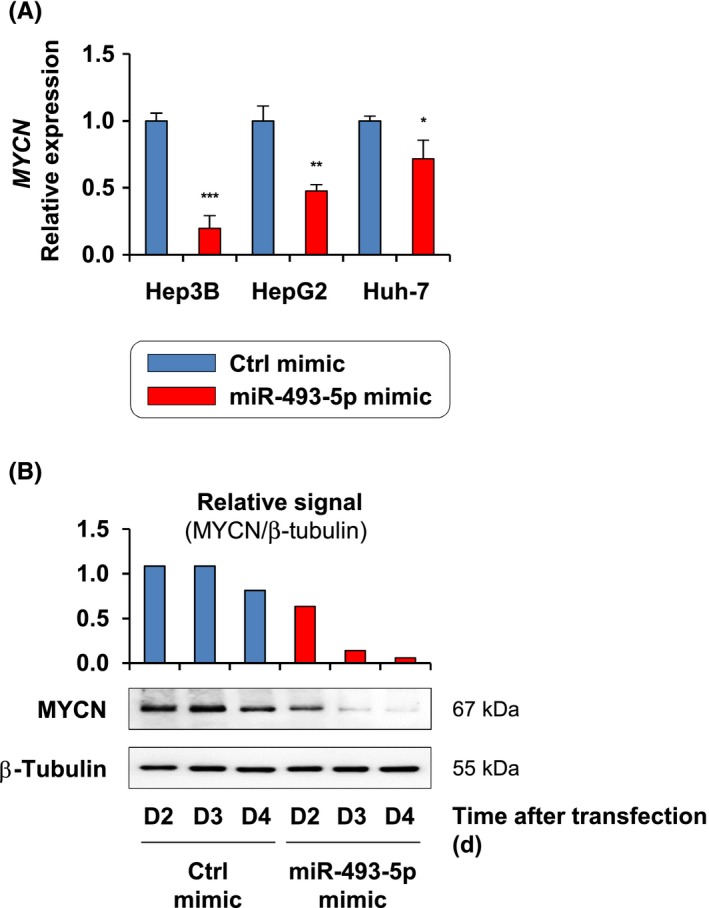
Primary hepatic tumors mainly include hepatocellular carcinoma (HCC), which is one of the most frequent causes of cancer-related deaths worldwide. Thus far, HCC prognosis has remained extremely poor given the lack of effective treatments. Numerous studies have described the roles played by microRNAs (miRNAs) in cancer progression and the potential of these small noncoding RNAs for diagnostic or therapeutic applications. The current consensus supports the idea that direct repression of a wide range of oncogenes by a single key miRNA could critically affect the malignant properties of cancer cells in a synergistic manner. In this study, we aimed to investigate the oncogenes controlled by miR-493-5p, a major tumor suppressor miRNA that inactivates miR-483-3p oncomir in hepatic cancer cells. Using global gene expression analysis, we highlighted a set of candidate genes potentially regulated by miR-493-5p. In particular, the canonical MYCN protooncogene (MYCN) appeared to be an attractive target of miR-493-5p given its significant inhibition through 3'-UTR targeting in miR-493-5p-rescued HCC cells. We showed that MYCN was overexpressed in liver cancer cell lines and clinical samples from HCC patients. Notably, MYCN expression levels were inversely correlated with miR-493-5p in tumor tissues. We confirmed that MYCN knockdown mimicked the anticancer effect of miR-493-5p by inhibiting HCC cell growth and invasion, whereas MYCN rescue hindered miR-493-5p activity. In summary, miR-493-5p is a pivotal miRNA that modulates various oncogenes after its reexpression in liver cancer cells, suggesting that tumor suppressor miRNAs with a large spectrum of action could provide valuable tools for miRNA replacement therapies.
原发性肝肿瘤主要包括肝细胞癌(HCC),这是全球癌症相关死亡的最常见原因之一。迄今为止,由于缺乏有效的治疗方法,HCC 的预后仍然非常差。许多研究描述了 microRNAs(miRNAs)在癌症进展中的作用,以及这些小非编码 RNA 用于诊断或治疗应用的潜力。目前的共识支持这样一种观点,即单个关键 miRNA 对广泛的癌基因的直接抑制作用可能以协同的方式严重影响癌细胞的恶性特性。在这项研究中,我们旨在研究 miR-493-5p 控制的癌基因,miR-493-5p 是一种主要的肿瘤抑制 miRNA,它使肝癌细胞中的 miR-483-3p oncomir 失活。通过全基因表达分析,我们突出了一组可能受 miR-493-5p 调节的候选基因。特别是,经典的 MYCN 原癌基因(MYCN)似乎是 miR-493-5p 的一个有吸引力的靶标,因为它通过 miR-493-5p 在 HCC 细胞中的 3'-UTR 靶向而显著抑制。我们表明,MYCN 在肝癌细胞系和 HCC 患者的临床样本中过度表达。值得注意的是,MYCN 表达水平与肿瘤组织中的 miR-493-5p 呈负相关。我们证实,通过抑制 HCC 细胞生长和侵袭,MYCN 敲低模拟了 miR-493-5p 的抗癌作用,而 MYCN 挽救则阻碍了 miR-493-5p 的活性。总之,miR-493-5p 是一种关键的 miRNA,它在肝癌细胞中重新表达后调节各种癌基因,这表明具有广谱作用的肿瘤抑制 miRNA 可能为 miRNA 替代疗法提供有价值的工具。