• 文献检索
  • 文档翻译
  • 深度研究
  • 学术资讯
  • Suppr Zotero 插件Zotero 插件
  • 邀请有礼
  • 套餐&价格
  • 历史记录
应用&插件
Suppr Zotero 插件Zotero 插件浏览器插件Mac 客户端Windows 客户端微信小程序
定价
高级版会员购买积分包购买API积分包
服务
文献检索文档翻译深度研究API 文档MCP 服务
关于我们
关于 Suppr公司介绍联系我们用户协议隐私条款
关注我们

Suppr 超能文献

核心技术专利:CN118964589B侵权必究
粤ICP备2023148730 号-1Suppr @ 2026

文献检索

告别复杂PubMed语法,用中文像聊天一样搜索,搜遍4000万医学文献。AI智能推荐,让科研检索更轻松。

立即免费搜索

文件翻译

保留排版,准确专业,支持PDF/Word/PPT等文件格式,支持 12+语言互译。

免费翻译文档

深度研究

AI帮你快速写综述,25分钟生成高质量综述,智能提取关键信息,辅助科研写作。

立即免费体验

意大利青少年社交媒体使用问题:SMART 项目的方案和原理。

Problematic Social Media Use Among Italian Midadolescents: Protocol and Rationale of the SMART Project.

机构信息

Department of Neuroscience, Biomedicine and Movement Science, Section of Clinical Psychology, University of Verona, Verona, Italy.

Department of Psychology, Educational Science and Human Movement, University of Palermo, Palermo, Italy.

出版信息

JMIR Res Protoc. 2024 Sep 9;13:e58739. doi: 10.2196/58739.

DOI:10.2196/58739
PMID:39248403
原文链接:https://pmc.ncbi.nlm.nih.gov/articles/PMC11420604/
Abstract

BACKGROUND

Social media (SM) use constitutes a large portion of midadolescents' daily lives as a way of peer interaction. A significant percentage of adolescents experience intense or problematic social media use (PSMU), an etiologically complex behavior potentially associated with psychological distress. To date, studies longitudinally testing for risk or protective factors of PSMU, and collecting qualitative data are still scarce among midadolescents. Self-help interventions specifically targeting PSMU in this population and involving midadolescents in co-creation are needed.

OBJECTIVE

The 2-year SMART multicenter project aims to (1) advance knowledge on PSMU; (2) co-design an unguided self-help app for promoting awareness and functional SM use; and (3) test feasibility and provide preliminary findings on its effectiveness to further improve and adapt the app.

METHODS

The SMART project is organized in 3 phases: phase 1 will focus on knowledge advancement on PSMU and its risk and protective factors using a longitudinal design; phase 2 will explore adolescents perspectives using qualitative approach and will co-design an unguided self-help app for reducing PSMU, which will be evaluated and adapted in phase 3. Around 1500 midadolescents (aged 14-18 years) will be recruited in northern, central, and southern Italy to investigate the potential intra- and interpersonal psychological risk and protective factors for PSMU and define specific PSMU profiles and test for its association with psychological distress. Subjective (self-report) PSMU's psychosocial risk or protective factors will be assessed at 3 different time points and Ecological Momentary Assessment (EMA) will be used. Moreover, focus groups will be performed in a subsample of midadolescents to collect the adolescents' unique point of view on PSMU and experiences with SM. Those previous results will inform the self-help app, which will be co-designed through working groups with adolescents. Subsequently, the SMART app will be deployed and adapted, after testing its feasibility and potential effectiveness in a pilot study.

RESULTS

The project is funded by the Italian Ministry of University and Research as part of a national grant (PRIN, "Progetti di Rilevante Interesse Nazionale"). The research team received an official notice of research funding approval in July 2023 (Project Code 2022LC4FT7). The project was preregistered on Open Science Framework, while the ethics approval was obtained in November 2023. We started the enrollments in December 2023, with the final follow-up data to be collected within May 2025.

CONCLUSIONS

The innovative aspects of the SMART project will deepen the conceptualization of PSMU and of its biopsychosocial antecedents among midadolescents, with relevant scientific, technological, and socioeconomic impacts. The advancement of knowledge and the developed self-help app for PSMU will timely respond to midadolescents' increased loneliness and psychological burden due to COVID-19 pandemic and humanitarian crisis.

TRIAL REGISTRATION

OSF Registries; https://osf.io/2ucnk/.

INTERNATIONAL REGISTERED REPORT IDENTIFIER (IRRID): DERR1-10.2196/58739.
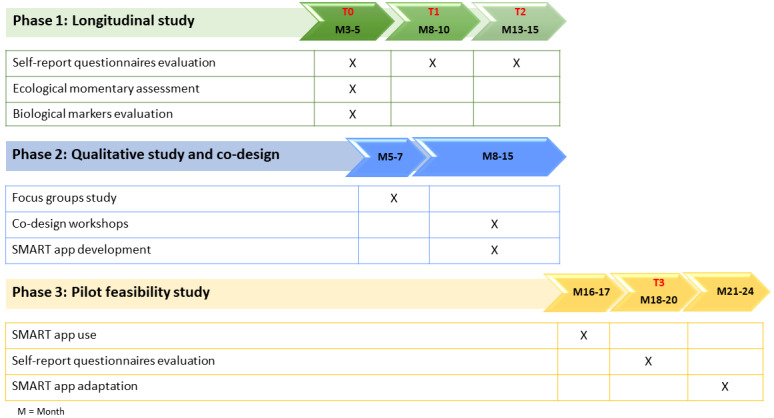
https://cdn.ncbi.nlm.nih.gov/pmc/blobs/21c6/11420604/46f347c804f6/resprot_v13i1e58739_fig1.jpg
摘要

背景

社交媒体(SM)的使用是青少年日常生活中同伴互动的重要组成部分。很大一部分青少年经历过强烈或有问题的社交媒体使用(PSMU),这是一种潜在与心理困扰相关的病因复杂的行为。迄今为止,在青少年中进行纵向测试 PSMU 的风险或保护因素并收集定性数据的研究仍然很少。需要针对该人群的 PSMU 进行自助干预,并让青少年共同参与创作。

目的

为期 2 年的 SMART 多中心项目旨在:(1)推进对 PSMU 的认识;(2)共同设计用于提高意识和促进功能性 SM 使用的无指导自助应用程序;(3)测试其可行性并提供初步效果发现,以进一步改进和调整应用程序。

方法

SMART 项目分为 3 个阶段:第 1 阶段将使用纵向设计专注于 PSMU 及其风险和保护因素的知识进步;第 2 阶段将使用定性方法探索青少年的观点,并共同设计用于减少 PSMU 的无指导自助应用程序,该应用程序将在第 3 阶段进行评估和调整。将在意大利北部、中部和南部招募约 1500 名青少年(年龄在 14-18 岁之间),以研究 PSMU 的潜在内在和人际心理风险和保护因素,并确定特定的 PSMU 特征,并测试其与心理困扰的关联。在 3 个不同的时间点评估主观(自我报告)PSMU 的心理社会风险或保护因素,并将使用生态瞬时评估(EMA)。此外,将在青少年的一个子样本中进行焦点小组,以收集青少年对 PSMU 的独特观点和他们对 SM 的体验。这些先前的结果将为自助应用程序提供信息,该应用程序将通过与青少年合作的工作组共同设计。随后,将部署 SMART 应用程序并进行调整,在试点研究中测试其可行性和潜在效果。

结果

该项目由意大利大学和研究部作为国家拨款的一部分(PRIN,“国家重要利益项目”)资助。研究团队于 2023 年 7 月收到了研究资金批准的正式通知(项目代码 2022LC4FT7)。该项目在开放科学框架上进行了预先登记,同时在 2023 年 11 月获得了伦理批准。我们于 2023 年 12 月开始招募参与者,将于 2025 年 5 月之前完成最后一次随访数据收集。

结论

SMART 项目的创新方面将深化青少年 PSMU 的概念化及其生物心理社会前因,具有重要的科学、技术和社会经济影响。知识的进步和开发的 PSMU 自助应用程序将及时应对由于 COVID-19 大流行和人道主义危机而导致青少年孤独感和心理负担增加的问题。

试验注册

OSF 注册表;https://osf.io/2ucnk/。

国际注册报告标识符(IRRID):DERR1-10.2196/58739。

相似文献

1
Problematic Social Media Use Among Italian Midadolescents: Protocol and Rationale of the SMART Project.意大利青少年社交媒体使用问题:SMART 项目的方案和原理。
JMIR Res Protoc. 2024 Sep 9;13:e58739. doi: 10.2196/58739.
2
Problematic social media use: associations with health complaints among adolescents.问题社交媒体使用:与青少年健康问题的关联。
Ann Ist Super Sanita. 2020 Oct-Dec;56(4):514-521. doi: 10.4415/ANN_20_04_16.
3
Investigating Parental Factors for Adolescent Problematic Gaming and Social Media Use - A Cross-sectional and Longitudinal Approach.调查青少年问题性游戏和社交媒体使用的父母因素:横断面和纵向研究。
J Adolesc Health. 2024 Oct;75(4):626-634. doi: 10.1016/j.jadohealth.2024.06.012. Epub 2024 Jul 27.
4
The longitudinal association between family functioning and problematic social media use among Chinese university students: Mediation via loneliness and a subgroup analysis by sex.中国大学生家庭功能与社交媒体使用问题之间的纵向关联:通过孤独感的中介作用及性别亚组分析
Addict Behav. 2025 Jul;166:108337. doi: 10.1016/j.addbeh.2025.108337. Epub 2025 Mar 20.
5
Communication attributes modify the anxiety risk associated with problematic social media use: Evidence from a prospective diary method study.沟通属性会改变与社交媒体使用问题相关的焦虑风险:来自前瞻性日记法研究的证据。
Addict Behav. 2025 Jul;166:108324. doi: 10.1016/j.addbeh.2025.108324. Epub 2025 Mar 7.
6
Problematic Social Media Use and Cyber Aggression in Italian Adolescents: The Remarkable Role of Social Support.意大利青少年的社交媒体使用问题和网络攻击:社会支持的显著作用。
Int J Environ Res Public Health. 2022 Aug 8;19(15):9763. doi: 10.3390/ijerph19159763.
7
Reciprocal Relationships Between Problematic Social Media Use, Problematic Gaming, and Psychological Distress Among University Students: A 9-Month Longitudinal Study.大学生中社交媒体使用问题、游戏问题和心理困扰之间的相互关系:一项为期 9 个月的纵向研究。
Front Public Health. 2022 Apr 8;10:858482. doi: 10.3389/fpubh.2022.858482. eCollection 2022.
8
Problematic social media use and self-rated health among Swedish adolescents: is the association moderated by family support?瑞典青少年中社交媒体使用问题与自评健康状况:这种关联是否受家庭支持的调节?
BMC Public Health. 2025 May 6;25(1):1670. doi: 10.1186/s12889-025-22927-6.
9
Similarities and differences in the psychological factors associated with generalised problematic internet use, problematic social media use, and problematic online gaming.与泛化性问题性互联网使用、问题性社交媒体使用和问题性在线游戏相关的心理因素的异同。
Compr Psychiatry. 2024 Oct;134:152512. doi: 10.1016/j.comppsych.2024.152512. Epub 2024 Jun 26.
10
Attentional Bias Is Associated with Negative Emotions in Problematic Users of Social Media as Measured by a Dot-Probe Task.注意偏向与社交媒体问题用户的负面情绪有关,这可以通过点探测任务来衡量。
Int J Environ Res Public Health. 2022 Dec 16;19(24):16938. doi: 10.3390/ijerph192416938.

本文引用的文献

1
Adolescent social media use: cultivating and constraining competence.青少年社交媒体使用:培养和约束能力。
Int J Qual Stud Health Well-being. 2023 Dec;18(1):2277623. doi: 10.1080/17482631.2023.2277623. Epub 2023 Nov 1.
2
Which social media platforms matter and for whom? Examining moderators of links between adolescents' social media use and depressive symptoms.哪些社交媒体平台重要,对谁重要?检验青少年社交媒体使用与抑郁症状之间关系的调节因素。
J Adolesc. 2023 Dec;95(8):1725-1748. doi: 10.1002/jad.12243. Epub 2023 Sep 12.
3
Time Spent on Mobile Apps Matters: A Latent Class Analysis of Patterns of Smartphone Use among Adolescents.
花在移动应用程序上的时间很重要:青少年智能手机使用模式的潜在类别分析
Int J Environ Res Public Health. 2023 Jul 25;20(15):6439. doi: 10.3390/ijerph20156439.
4
The Impact of Social Media Use Interventions on Mental Well-Being: Systematic Review.社交媒体使用干预对心理健康的影响:系统评价。
J Med Internet Res. 2023 Aug 11;25:e44922. doi: 10.2196/44922.
5
School dropouts related to mental disorders: A systematic review and meta-analysis.与精神障碍相关的辍学情况:一项系统评价与荟萃分析。
Asian J Psychiatr. 2023 Jul;85:103622. doi: 10.1016/j.ajp.2023.103622. Epub 2023 May 8.
6
Adolescent dropout from brief digital mental health interventions within and beyond randomized trials.随机试验内外的简短数字心理健康干预中青少年退出的情况。
Internet Interv. 2022 Jan 17;27:100496. doi: 10.1016/j.invent.2022.100496. eCollection 2022 Mar.
7
Using Co-design in Mobile Health System Development: A Qualitative Study With Experts in Co-design and Mobile Health System Development.运用共同设计于移动医疗系统发展:与共同设计和移动医疗系统发展专家的定性研究。
JMIR Mhealth Uhealth. 2021 Nov 10;9(11):e27896. doi: 10.2196/27896.
8
Tracing 20 years of research on problematic use of the internet and social media: Theoretical models, assessment tools, and an agenda for future work.追溯 20 年来互联网和社交媒体问题使用的研究:理论模型、评估工具以及未来工作的议程。
Compr Psychiatry. 2022 Jan;112:152286. doi: 10.1016/j.comppsych.2021.152286. Epub 2021 Oct 30.
9
Social media use and its impact on adolescent mental health: An umbrella review of the evidence.社交媒体的使用及其对青少年心理健康的影响:证据的伞式综述。
Curr Opin Psychol. 2022 Apr;44:58-68. doi: 10.1016/j.copsyc.2021.08.017. Epub 2021 Aug 18.
10
Review: Mental health impacts of the COVID-19 pandemic on children and youth - a systematic review.综述:COVID-19 大流行对儿童和青少年心理健康的影响 - 系统综述。
Child Adolesc Ment Health. 2022 May;27(2):173-189. doi: 10.1111/camh.12501. Epub 2021 Aug 28.