Department of Pharmacy, Ludwig Maximilian University of Munich, Butenandtstr. 7, 81377, Munich, Germany.
Faculty of Chemistry and Food Chemistry, Technical University of Dresden, Bergstr. 66, 01069, Dresden, Germany.
Angew Chem Int Ed Engl. 2024 Dec 2;63(49):e202410139. doi: 10.1002/anie.202410139. Epub 2024 Nov 6.
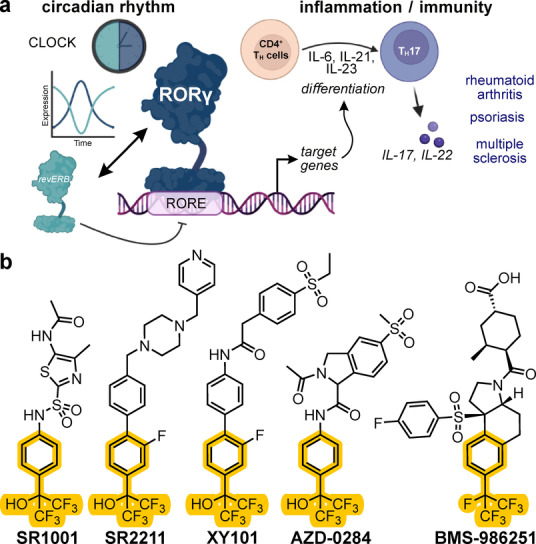
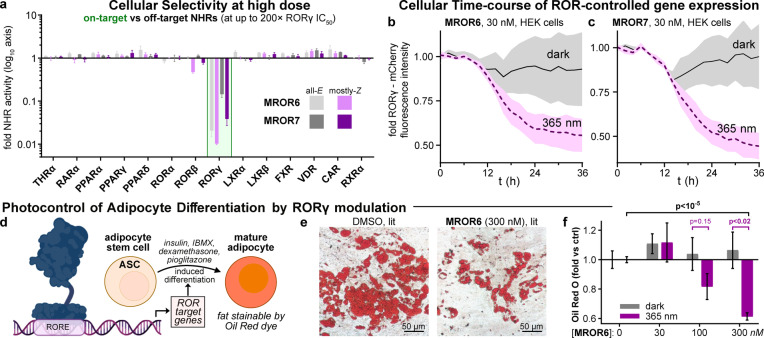
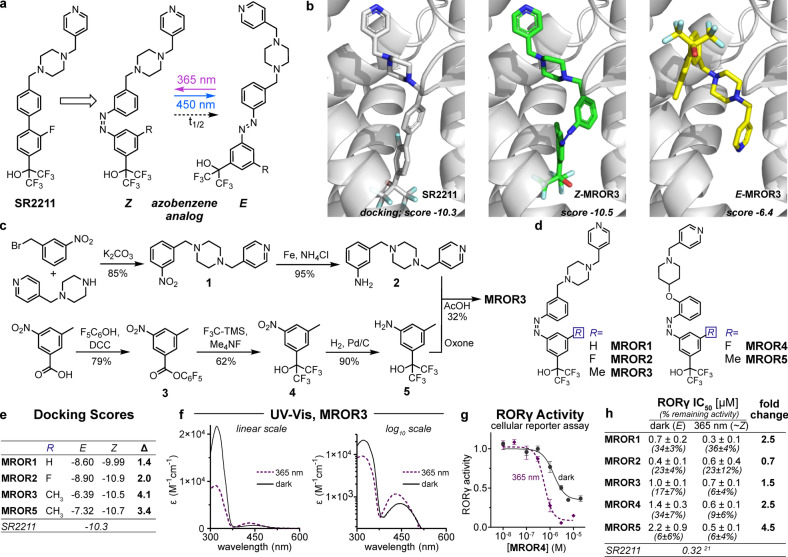
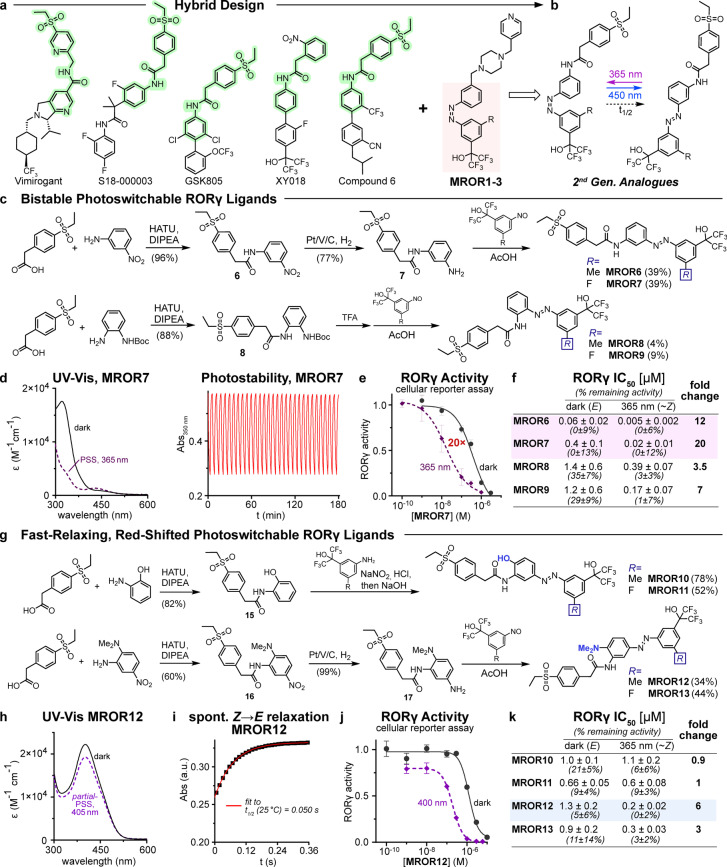
Retinoic acid receptor-related orphan receptor γ (RORγ) is a nuclear hormone receptor with multiple biological functions in circadian clock regulation, inflammation, and immunity. Its cyclic temporal role in circadian rhythms, and cell-specific activity in the immune system, make it an intriguing target for spatially and temporally localised pharmacology. To create tools that can study RORγ biology with appropriate spatiotemporal resolution, we designed light-dependent inverse RORγ agonists by building azobenzene photoswitches into ligand consensus structures. Optimizations gave photoswitchable RORγ inhibitors combining a large degree of potency photocontrol, with remarkable on-target potency, and excellent selectivity over related off-target receptors. This still rare combination of performance features distinguishes them as high quality photopharmaceutical probes, which can now serve as high precision tools to study the spatial and dynamic intricacies of RORγ action in signaling and in inflammatory disorders.
维甲酸相关孤儿受体γ(RORγ)是一种核激素受体,在生物钟调节、炎症和免疫方面具有多种生物学功能。它在生物钟节律中的循环时间作用,以及在免疫系统中的细胞特异性活性,使其成为空间和时间局部化药理学的一个有趣目标。为了创建能够以适当的时空分辨率研究 RORγ 生物学的工具,我们通过将偶氮苯光开关构建到配体共识结构中,设计了依赖光的反向 RORγ 激动剂。优化后得到的光可切换 RORγ 抑制剂具有很大程度的光控效力,与靶标效力显著相关,并且对相关的非靶标受体具有极好的选择性。这种性能特征的罕见组合将它们区分出来,成为高质量的光药物探针,现在可以作为高精度工具,研究 RORγ 在信号转导和炎症性疾病中的作用的空间和动态复杂性。