Kolarski Dušan, Szymanski Wiktor, Feringa Ben L
Max Planck Institute for Multidisciplinary Sciences, NanoBioPhotonics, Göttingen, Germany.
Centre for Systems Chemistry, Stratingh Institute for Chemistry, University of Groningen, Groningen, The Netherlands.
Med Res Rev. 2025 May;45(3):968-984. doi: 10.1002/med.22099. Epub 2025 Jan 5.
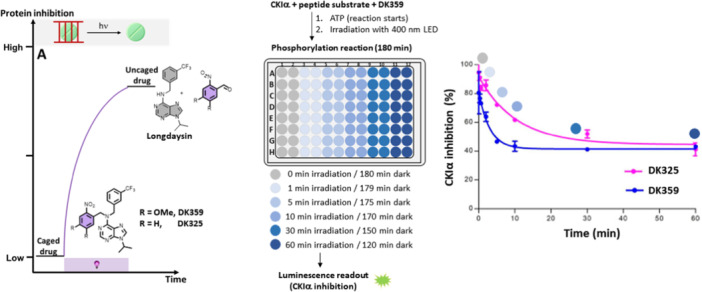
Circadian rhythms are endogenous biological oscillators that synchronize internal physiological processes and behaviors with external environmental changes, sustaining homeostasis and health. Disruption of circadian rhythms leads to numerous diseases, including cardiovascular and metabolic diseases, cancer, diabetes, and neurological disorders. Despite the potential to restore healthy rhythms in the organism, pharmacological chronotherapy lacks spatial and temporal resolution. Addressing this challenge, chrono-photopharmacology, the approach that employs small molecules with light-controlled activity, enables the modulation of circadian rhythms when and where needed. Two approaches-relying on irreversible and reversible drug activation-have been proposed for this purpose. These methodologies are based on photoremovable protecting groups and photoswitches, respectively. Designing photoresponsive bioactive molecules requires meticulous structural optimization to obtain the desired chemical and photophysical properties, and the design principles, detailed guidelines and challenges are summarized here. In this review, we also analyze all the known circadian modulators responsive to light and dissect the rationale following their construction and application to control circadian biology from the protein level to living organisms. Finally, we present the strength of a reversible approach in allowing the modulation of the circadian period and the phase.
昼夜节律是内源性生物振荡器,可使内部生理过程和行为与外部环境变化同步,维持体内平衡和健康。昼夜节律的破坏会导致多种疾病,包括心血管和代谢疾病、癌症、糖尿病和神经紊乱。尽管有可能恢复机体的健康节律,但药物时辰疗法缺乏空间和时间分辨率。为应对这一挑战,时辰光药理学这一采用具有光控活性的小分子的方法,能够在需要的时间和地点调节昼夜节律。为此提出了两种方法,分别依赖于不可逆和可逆的药物激活。这些方法分别基于光可去除保护基团和光开关。设计光响应性生物活性分子需要进行细致的结构优化以获得所需的化学和光物理性质,本文总结了设计原则、详细指南和挑战。在本综述中,我们还分析了所有已知的对光有响应的昼夜节律调节剂,并剖析了从蛋白质水平到生物体构建和应用它们来控制昼夜生物学的原理。最后,我们展示了可逆方法在调节昼夜周期和相位方面的优势。