Department of Neurology and Neurological Sciences, Stanford University School of Medicine, Stanford, California.
NeuroGenomics and Informatics Center, Washington University School of Medicine, St Louis, Missouri.
JAMA Neurol. 2024 Oct 1;81(10):1032-1042. doi: 10.1001/jamaneurol.2024.2843.
The X chromosome has remained enigmatic in Alzheimer disease (AD), yet it makes up 5% of the genome and carries a high proportion of genes expressed in the brain, making it particularly appealing as a potential source of unexplored genetic variation in AD.
To perform the first large-scale X chromosome-wide association study (XWAS) of AD.
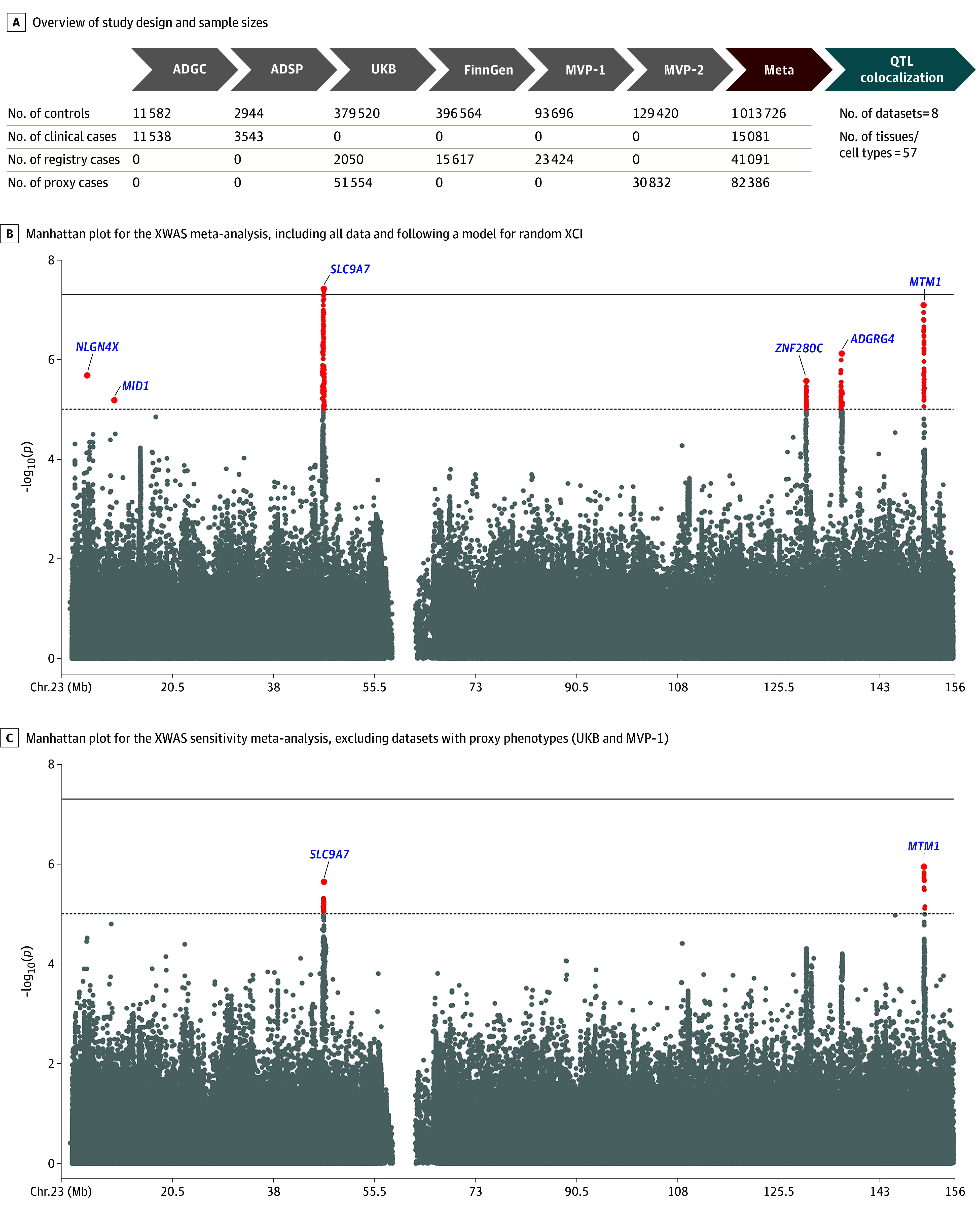
DESIGN, SETTING, AND PARTICIPANTS: This was a meta-analysis of genetic association studies in case-control, family-based, population-based, and longitudinal AD-related cohorts from the US Alzheimer's Disease Genetics Consortium, the Alzheimer's Disease Sequencing Project, the UK Biobank, the Finnish health registry, and the US Million Veterans Program. Risk of AD was evaluated through case-control logistic regression analyses. Data were analyzed between January 2023 and March 2024. Genetic data available from high-density single-nucleotide variant microarrays and whole-genome sequencing and summary statistics for multitissue expression and protein quantitative trait loci available from published studies were included, enabling follow-up genetic colocalization analyses. A total of 1 629 863 eligible participants were selected from referred and volunteer samples, 477 596 of whom were excluded for analysis exclusion criteria. The number of participants who declined to participate in original studies was not available.
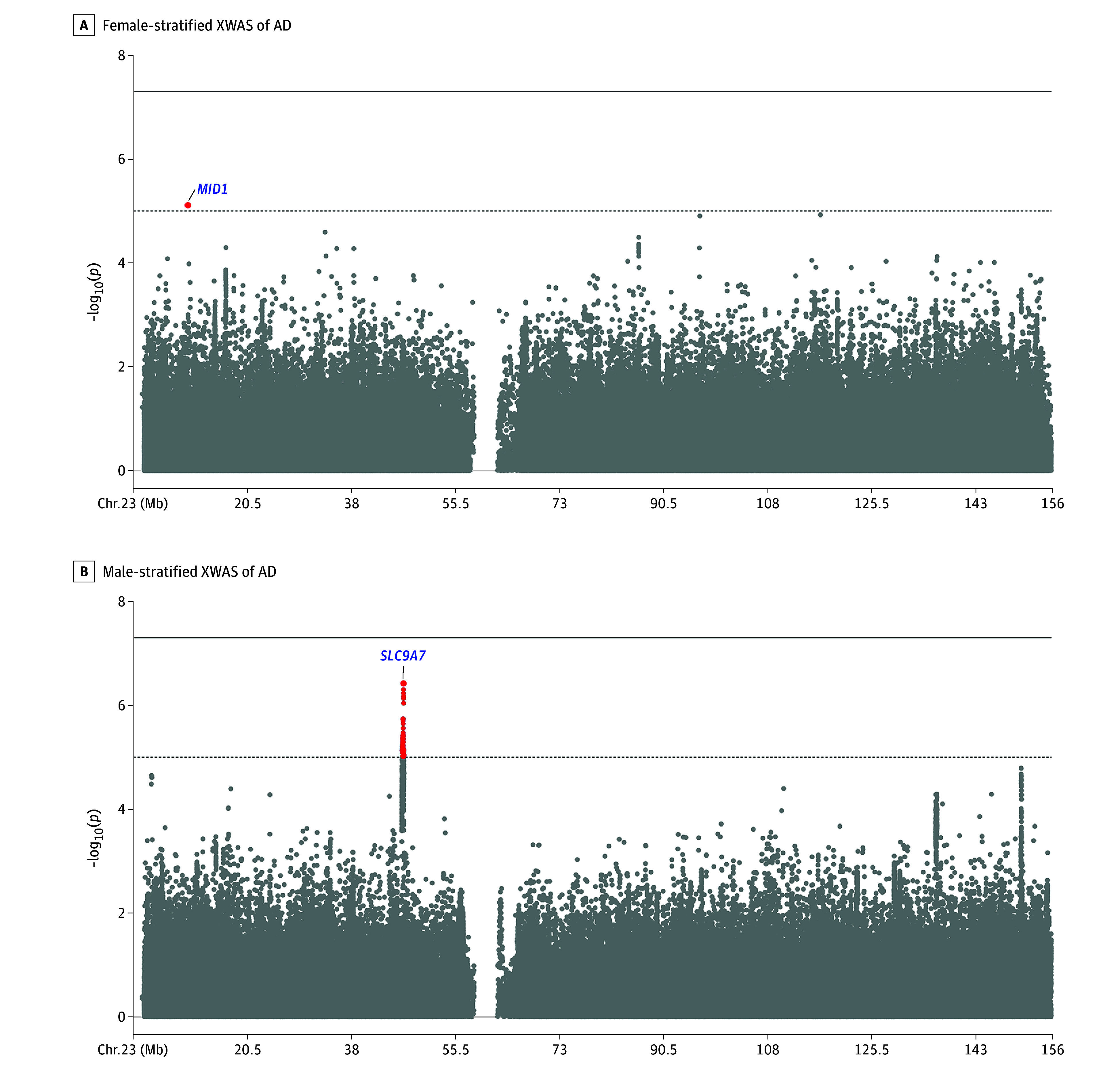
Risk of AD, reported as odds ratios (ORs) with 95% CIs. Associations were considered at X chromosome-wide (P < 1 × 10⁻⁵) and genome-wide (P < 5 × 10⁻⁸) significance. Primary analyses are nonstratified, while secondary analyses evaluate sex-stratified effects.
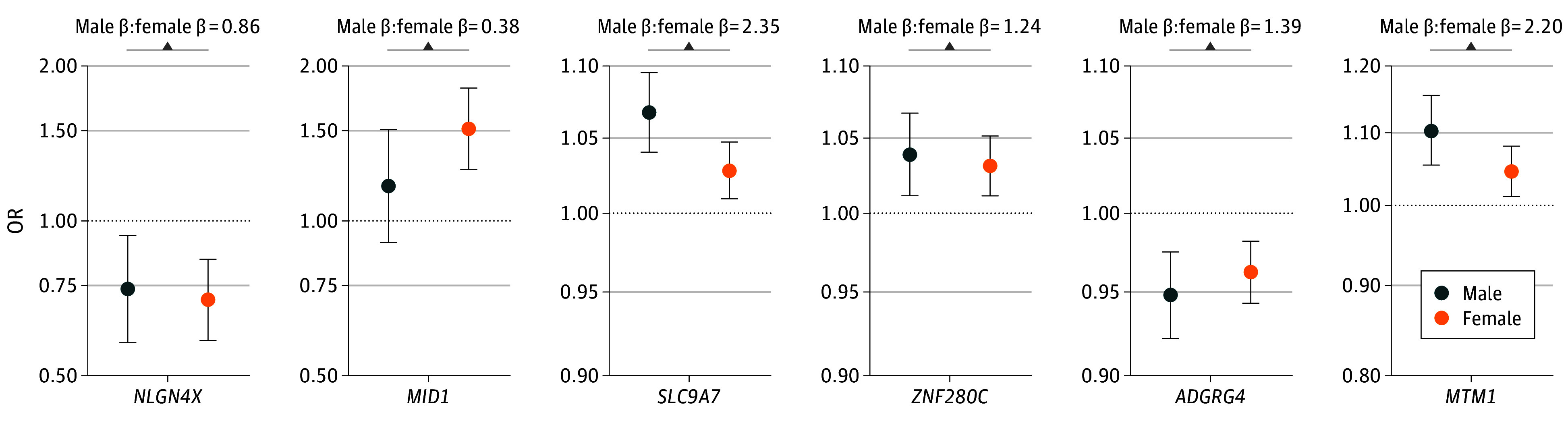
Analyses included 1 152 284 participants of non-Hispanic White, European ancestry (664 403 [57.7%] female and 487 881 [42.3%] male), including 138 558 individuals with AD. Six independent genetic loci passed X chromosome-wide significance, with 4 showing support for links between the genetic signal for AD and expression of nearby genes in brain and nonbrain tissues. One of these 4 loci passed conservative genome-wide significance, with its lead variant centered on an intron of SLC9A7 (OR, 1.03; 95% CI, 1.02-1.04) and colocalization analyses prioritizing both the SLC9A7 and nearby CHST7 genes. Of these 6 loci, 4 displayed evidence for escape from X chromosome inactivation with regard to AD risk.
This large-scale XWAS of AD identified the novel SLC9A7 locus. SLC9A7 regulates pH homeostasis in Golgi secretory compartments and is anticipated to have downstream effects on amyloid β accumulation. Overall, this study advances our knowledge of AD genetics and may provide novel biological drug targets. The results further provide initial insights into elucidating the role of the X chromosome in sex-based differences in AD.
X 染色体在阿尔茨海默病(AD)中一直是一个谜,然而它占基因组的 5%,并且携带大量在大脑中表达的基因,因此它特别有吸引力,可能是 AD 中未探索的遗传变异的潜在来源。
进行 AD 的首次大规模 X 染色体全基因组关联研究(XWAS)。
设计、设置和参与者:这是对来自美国阿尔茨海默病遗传学联合会、阿尔茨海默病测序项目、英国生物银行、芬兰健康登记处和美国百万退伍军人计划的病例对照、基于家庭、基于人群和纵向 AD 相关队列的遗传关联研究的荟萃分析。AD 的风险通过病例对照逻辑回归分析进行评估。数据于 2023 年 1 月至 2024 年 3 月进行分析。纳入了来自高密度单核苷酸变异微阵列和全基因组测序的遗传数据,以及来自已发表研究的多组织表达和蛋白质定量性状基因座的汇总统计数据,从而能够进行后续的遗传共定位分析。从推荐和志愿者样本中选择了 1629863 名符合条件的参与者,其中 477596 名因分析排除标准而被排除。无法获得拒绝参与原始研究的参与者人数。
AD 的风险,以优势比(OR)和 95%置信区间(CI)表示。关联在 X 染色体全基因组范围内(P < 1×10⁻⁵)和全基因组范围内(P < 5×10⁻⁸)具有显著性。主要分析是非分层的,而次要分析则评估性别分层的影响。
分析包括 1152284 名非西班牙裔白人、欧洲血统(664403 [57.7%] 女性和 487881 [42.3%] 男性)参与者,其中包括 138558 名 AD 患者。6 个独立的遗传位点通过 X 染色体全基因组显著性检验,其中 4 个位点显示 AD 的遗传信号与大脑和非大脑组织中附近基因的表达之间存在联系。其中一个位点通过保守的全基因组显著性检验,其先导变异集中在 SLC9A7 的内含子上(OR,1.03;95%CI,1.02-1.04),并且共定位分析优先考虑 SLC9A7 和附近的 CHST7 基因。这 6 个位点中,有 4 个显示出 AD 风险逃避 X 染色体失活的证据。
这项 AD 的大规模 XWAS 确定了新的 SLC9A7 位点。SLC9A7 调节高尔基体分泌隔室中的 pH 动态平衡,预计对淀粉样蛋白β积累有下游影响。总体而言,这项研究增进了我们对 AD 遗传学的认识,并可能为新的生物药物靶点提供依据。该结果进一步提供了阐明 X 染色体在 AD 中性别差异中的作用的初步见解。