
CpG 寡脱氧核苷酸包被的壳聚糖纳米颗粒在体外增强巨噬细胞促炎表型。
CpG oligodeoxynucleotide-coated chitosan nanoparticles enhance macrophage proinflammatory phenotype in vitro.
作者信息
Karami Fatemeh, Namdar Ahmadabad Hassan, Shaheli Marjan
机构信息
Biology, Arsanjan Branch, Azad University, Arsanjan, Iran.
Vector-borne Diseases Research Center, North Khorasan University of Medical Science, Bojnurd, Iran.
出版信息
Clin Exp Immunol. 2025 Jan 21;219(1). doi: 10.1093/cei/uxae081.
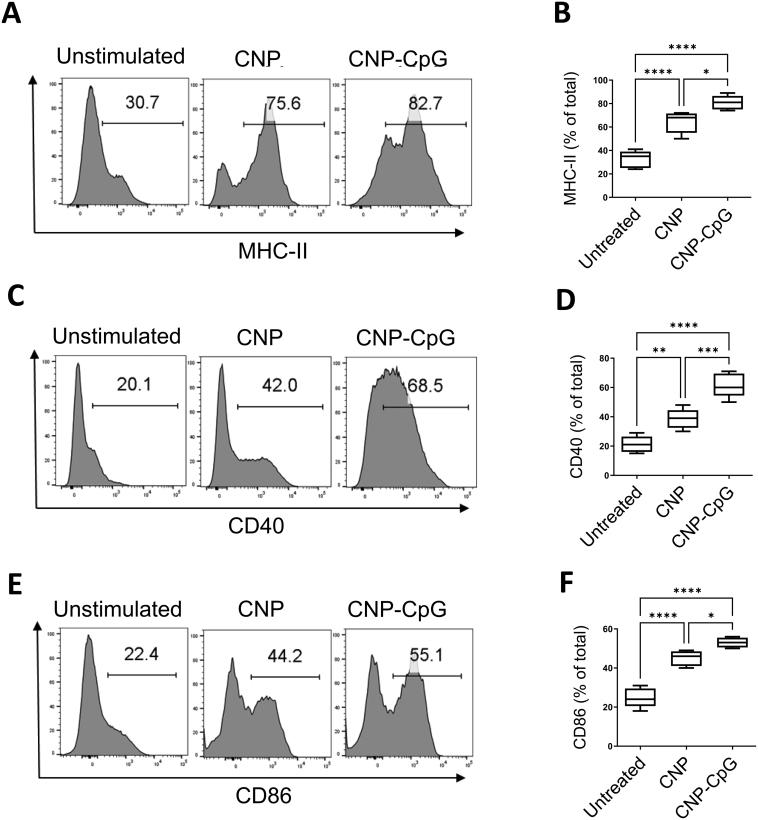
This study aimed to investigate the effects of CpG oligodeoxynucleotide (CpG-ODNs)-coated chitosan nanoparticles (CNP) on the phenotype of murine macrophages and their proinflammatory cytokine profile in vitro. CNP-CpG-ODNs loaded with FITC-scrambled siRNA were prepared using the ionotropic gelation method. Peritoneal macrophages were isolated and exposed to CNP-CpG-ODNs. Treated macrophages were assessed for uptake capacity. Flow cytometry was used to evaluate the expression levels of MHC-II, CD40, and CD86 costimulatory molecules in treated macrophages. Furthermore, the secretion levels of proinflammatory cytokines (TNF-α and IL-6) and the release of nitric oxide (NO) were measured in the culture supernatant of treated macrophages using sandwich ELISA and the Griess reaction, respectively. These in vitro studies showed that CNP-CpG-ODNs had no cytotoxic effect on macrophages and were efficiently taken up by them. Additionally, CNP-CpG-ODNs significantly increased the production of TNF-α, IL-6, and NO in the culture supernatant compared to CNP alone. Moreover, CNP-CpG-ODNs enhanced the expression of MHC-II, CD40, and CD86 costimulatory molecules on macrophages. These findings indicate that incorporating CpG-ODNs into CNPs promotes macrophage maturation and a proinflammatory phenotype. Therefore, CNP-CpG-ODNs may serve as an effective system for targeted gene delivery to macrophages, enhancing immune responses.
本研究旨在体外探究CpG寡脱氧核苷酸(CpG-ODNs)包被的壳聚糖纳米颗粒(CNP)对小鼠巨噬细胞表型及其促炎细胞因子谱的影响。采用离子凝胶法制备负载异硫氰酸荧光素(FITC)-随机干扰RNA的CNP-CpG-ODNs。分离腹膜巨噬细胞并使其暴露于CNP-CpG-ODNs。对处理后的巨噬细胞的摄取能力进行评估。采用流式细胞术评估处理后巨噬细胞中主要组织相容性复合体II类分子(MHC-II)、共刺激分子CD40和CD86的表达水平。此外,分别采用夹心酶联免疫吸附测定法(ELISA)和格里斯反应检测处理后巨噬细胞培养上清液中促炎细胞因子(肿瘤坏死因子-α和白细胞介素-6)的分泌水平以及一氧化氮(NO)的释放量。这些体外研究表明,CNP-CpG-ODNs对巨噬细胞无细胞毒性作用,且能被巨噬细胞有效摄取。此外,与单独的CNP相比,CNP-CpG-ODNs显著增加了培养上清液中肿瘤坏死因子-α、白细胞介素-6和NO的生成。而且,CNP-CpG-ODNs增强了巨噬细胞上MHC-II、CD40和CD86共刺激分子的表达。这些发现表明,将CpG-ODNs掺入CNPs可促进巨噬细胞成熟并使其呈现促炎表型。因此,CNP-CpG-ODNs可能作为一种有效的系统用于向巨噬细胞进行靶向基因递送,增强免疫反应。
 Zotero 插件