Department of Clinical Neuroscience, Karolinska Institutet, Stockholm, Sweden.
Department of Rehabilitation, Furuhöjden Rehab Hospital, Täby, Sweden.
Sci Rep. 2024 Sep 9;14(1):20945. doi: 10.1038/s41598-024-71983-2.
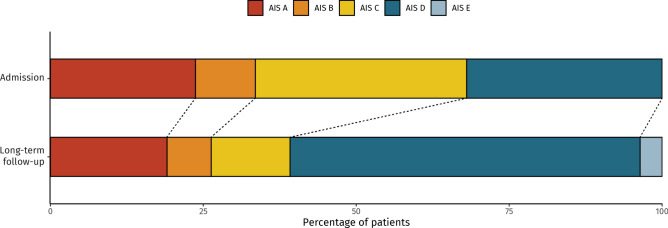
This retrospective study analyzed prognostic factors for neurological improvement and ambulation in 194 adult patients (≥ 15 years) with traumatic cervical spinal cord injuries treated at the neurological SCI unit (SCIU) at the Karolinska University Hospital Stockholm, Sweden, between 2010 and 2020. The primary outcome was American spinal injury association impairment scale (AIS) improvement, with secondary focus on ambulation restoration. Results showed 41% experienced AIS improvement, with 51% regaining ambulation over a median follow-up of 3.7 years. Significant AIS improvement (p < 0.001) and reduced bladder/bowel dysfunction (p < 0.001) were noted. Multivariable analysis identified initial AIS C-D (< 0.001), central cord syndrome (p = 0.016), and C0-C3 injury (p = 0.017) as positive AIS improvement predictors, while lower extremity motor score (LEMS) (p < 0.001) and longer ICU stays (p < 0.001) were negative predictors. Patients with initial AIS C-D (p < 0.001) and higher LEMS (p < 0.001) were more likely to regain ambulation. Finally, older age was a negative prognostic factor (p = 0.003). In conclusion, initial injury severity significantly predicted neurological improvement and ambulation. Recovery was observed even in severe cases, emphasizing the importance of tailored rehabilitation for improved outcomes.
本回顾性研究分析了 194 例成年创伤性颈脊髓损伤患者(≥ 15 岁)在瑞典斯德哥尔摩卡罗林斯卡大学医院神经 SCI 病房(SCIU)接受治疗后的神经改善和行走能力的预后因素,时间范围为 2010 年至 2020 年。主要结局是美国脊髓损伤协会损伤量表(AIS)的改善,次要重点是行走能力的恢复。结果显示,41%的患者 AIS 得到改善,51%的患者在中位随访 3.7 年后恢复行走能力。显著的 AIS 改善(p<0.001)和膀胱/肠道功能障碍减少(p<0.001)被观察到。多变量分析确定初始 AIS C-D(<0.001)、中央脊髓综合征(p=0.016)和 C0-C3 损伤(p=0.017)是 AIS 改善的阳性预测因素,而下肢运动评分(LEMS)(p<0.001)和更长的 ICU 住院时间(p<0.001)是负性预测因素。初始 AIS C-D(p<0.001)和较高的 LEMS(p<0.001)的患者更有可能恢复行走能力。最后,年龄较大是一个负性预后因素(p=0.003)。总之,初始损伤严重程度显著预测神经改善和行走能力。即使在严重的情况下也观察到了恢复,这强调了为改善预后而进行个体化康复的重要性。