Department of Neurosciences, Biomedicine and Movement Sciences, University of Verona.
Department of Health Sciences, University of Piemonte Orientale "A. Avogadro", Novara.
Eur J Histochem. 2024 Sep 9;68(3):4106. doi: 10.4081/ejh.2024.4106.
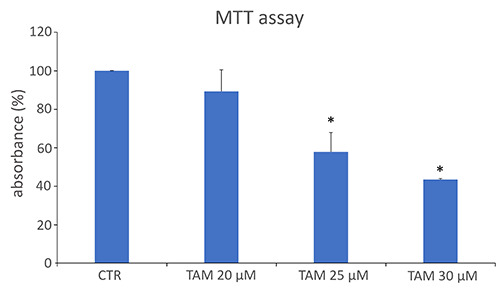
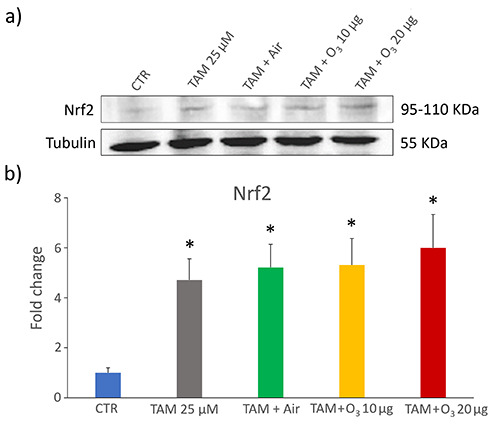
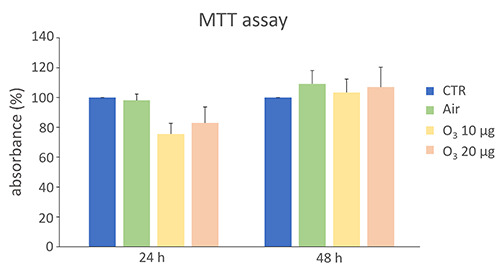
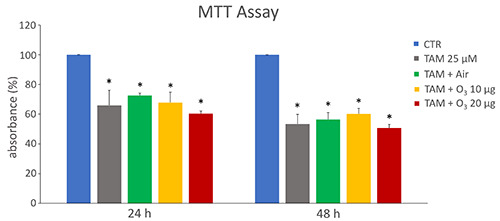
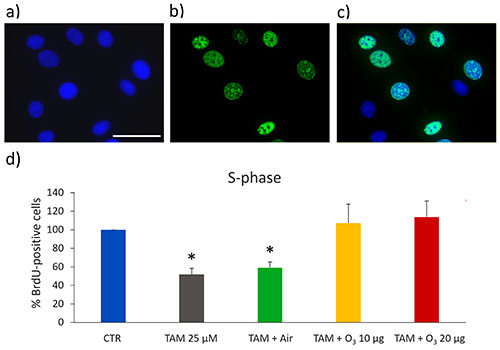
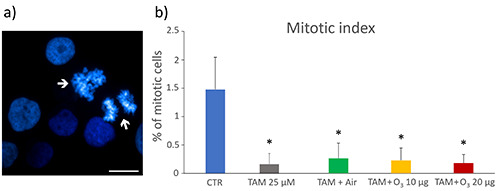
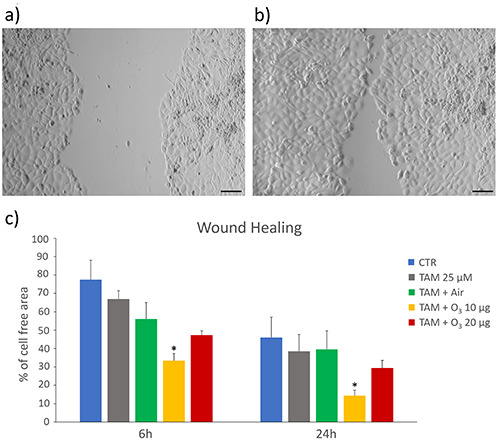
Medical treatment with low ozone concentrations proved to exert therapeutic effects in various diseases by inducing a cytoprotective antioxidant response through the nuclear factor erythroid derived-like 2 (Nrf2) transcription factor pathway. Low ozone doses are increasingly administered to oncological patients as a complementary treatment to mitigate some adverse side-effects of antitumor treatments. However, a widespread concern exists about the possibility that the cytoprotective effect of Nrf2 activation may confer drug resistance to cancer cells or at least reduce the efficacy of antitumor agents. In this study, the effect of low ozone concentrations on tamoxifen-treated MCF7 human breast cancer cells has been investigated in vitro by histochemical and molecular techniques. Results demonstrated that cell viability, proliferation and migration were generally similar in tamoxifen-treated cells as in cells concomitantly treated with tamoxifen and ozone. Notably, low ozone concentrations were unable to overstimulate the antioxidant response through the Nfr2 pathway, thus excluding a possible ozone-driven cytoprotective effect that would lead to increased tumor cell survival during the antineoplastic treatment. These findings, though obtained in an in vitro model, support the hypothesis that low ozone concentrations do not interfere with the tamoxifen-induced effects on breast cancer cells.
低浓度臭氧治疗通过核因子红细胞 2 样 2(Nrf2)转录因子通路诱导细胞保护抗氧化反应,已被证明在各种疾病中具有治疗作用。低浓度臭氧越来越多地用于肿瘤患者作为辅助治疗,以减轻抗肿瘤治疗的一些不良反应。然而,人们普遍担心 Nrf2 激活的细胞保护作用可能会使癌细胞产生耐药性,或者至少降低抗肿瘤药物的疗效。在这项研究中,通过组织化学和分子技术研究了低浓度臭氧对他莫昔芬处理的 MCF7 人乳腺癌细胞的体外影响。结果表明,在他莫昔芬处理的细胞中,细胞活力、增殖和迁移通常与同时用他莫昔芬和臭氧处理的细胞相似。值得注意的是,低浓度臭氧不能通过 Nfr2 通路过度刺激抗氧化反应,从而排除了可能的臭氧驱动的细胞保护作用,这种作用会导致在抗肿瘤治疗期间肿瘤细胞存活增加。这些发现虽然是在体外模型中获得的,但支持了低浓度臭氧不会干扰他莫昔芬对乳腺癌细胞的影响的假设。