Department of Orthopedics, Henan Provincial People's Hospital, Zhengzhou, China.
Department of Anesthesia, People's Hospital of Anyang City, Anyang, China.
Front Cell Infect Microbiol. 2024 Aug 26;14:1388765. doi: 10.3389/fcimb.2024.1388765. eCollection 2024.
To investigate the diagnostic value of metagenomic next-generation sequencing (mNGS) in detecting pathogens from joint infection (JI) synovial fluid (SF) samples with previous antibiotic exposure.
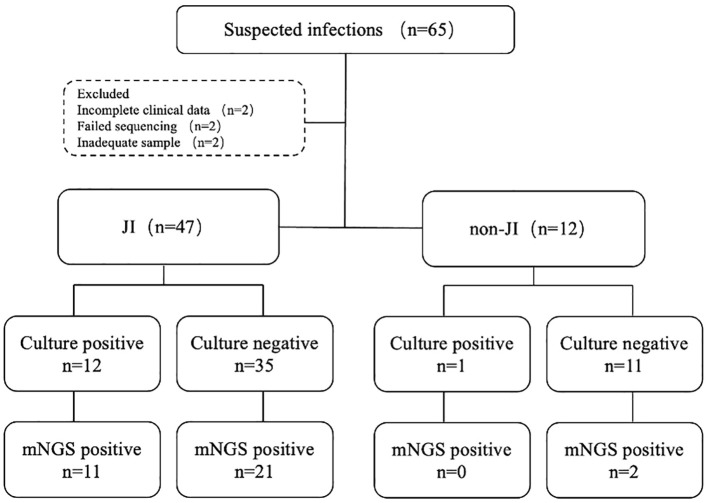
From January 2019 to January 2022, 59 cases with suspected JI were enrolled. All cases had antibiotic exposure within 2 weeks before sample collection. mNGS and conventional culture were performed on SF samples. JI was diagnosed based on history and clinical symptoms in conjunction with MSIS criteria. The diagnostic values, including sensitivity, specificity, positive/negative predictive values (PPV/NPV), and accuracy, were in comparison with mNGS and culture.
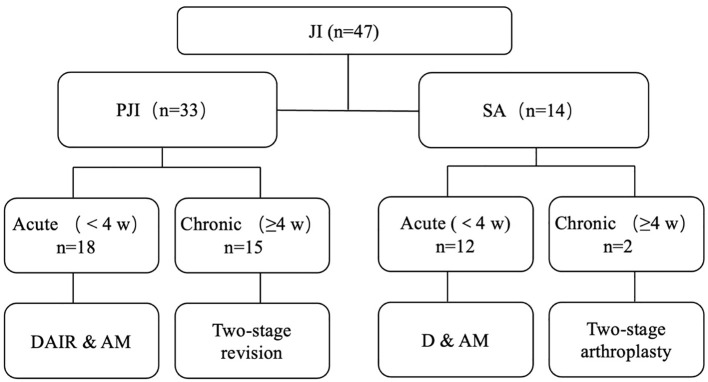
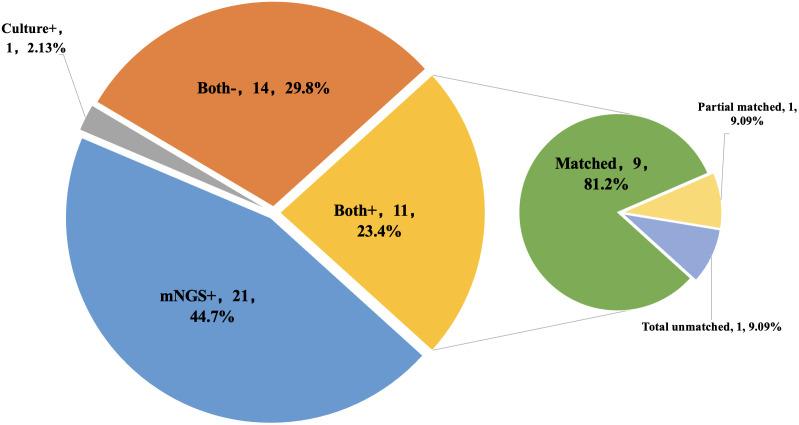
There were 47 of the 59 cases diagnosed with JI, while the remaining 12 were diagnosed with non-infectious diseases. The sensitivity of mNGS was 68.1%, which was significantly higher than that of culture (25.5%, <0.01). The accuracy of mNGS was significantly higher at 71.2% compared to the culture at 39.0% (0.01). Eleven pathogenic strains were detected by mNGS but not by microbiological culture, which included , , , , , , , , , , and Antibiotic therapy was adjusted based on the mNGS results in 32 (68.1%) patients, including 12 (25.5%) and 20 (42.6%) patients, in whom treatment was upgraded and changed, respectively. All JI patients underwent surgery and received subsequent antibiotic therapy. They were followed up for an average of 23 months (20-27 months), and the success rate of treatment was 89.4%. Out of the 33 patients who had positive results for pathogens, reoperation was performed in 1 case (3.03%), while out of the 14 cases with negative results for both mNGS and cultures, reoperation was performed in 4 cases (28.6%).
mNGS has advantages over conventional culture in detecting pathogens in SF samples from JI patients previously treated with antibiotics, potentially improving clinical outcomes.
探究宏基因组下一代测序(mNGS)在检测有抗生素暴露史的关节感染(JI)关节液(SF)样本中病原体的诊断价值。
2019 年 1 月至 2022 年 1 月,共纳入 59 例疑似 JI 的患者。所有患者在采样前 2 周内均有抗生素暴露史。对 SF 样本进行 mNGS 和常规培养。根据病史、临床症状并结合 MSIS 标准诊断 JI。比较 mNGS 和培养的诊断价值,包括敏感性、特异性、阳性/阴性预测值(PPV/NPV)和准确性。
59 例患者中,47 例诊断为 JI,12 例诊断为非传染性疾病。mNGS 的敏感性为 68.1%,明显高于培养(25.5%,<0.01)。mNGS 的准确性为 71.2%,明显高于培养的 39.0%(0.01)。mNGS 检测到 11 株培养未检出的病原菌,包括 、 、 、 、 、 、 、 、 和 。根据 mNGS 结果调整 32 例(68.1%)患者的抗生素治疗,其中 12 例(25.5%)和 20 例(42.6%)患者的治疗升级和改变。所有 JI 患者均接受手术治疗和后续抗生素治疗。平均随访 23 个月(20-27 个月),治疗成功率为 89.4%。在 33 例病原体阳性患者中,1 例(3.03%)进行了再次手术,在 14 例 mNGS 和培养均为阴性的患者中,4 例(28.6%)进行了再次手术。
mNGS 优于传统培养,可检测有抗生素暴露史的 JI 患者 SF 样本中的病原体,可能改善临床结局。