Indelli Pier Francesco, Totlis Trifon, Lovreković Bruno, Engl Michael, Violante Bruno, Skowronek Pawel, Demey Guillaume, Ghirardelli Stefano, Maci Chiara, Castagna Antonella, Schianchi Laura, Din Chiara Tassan, Harty James, Dikmen Goksel, Schaller Christian, Ostojić Marko
European Society of Sports Traumatology, Knee Surgery Arthroscopy (ESSKA) - European Knee Associates (EKA) Board Luxembourg Luxembourg.
European Society of Sports Traumatology, Knee Surgery Arthroscopy (ESSKA) Basic Science Committee Luxembourg Luxembourg.
J Exp Orthop. 2025 May 5;12(2):e70263. doi: 10.1002/jeo2.70263. eCollection 2025 Apr.
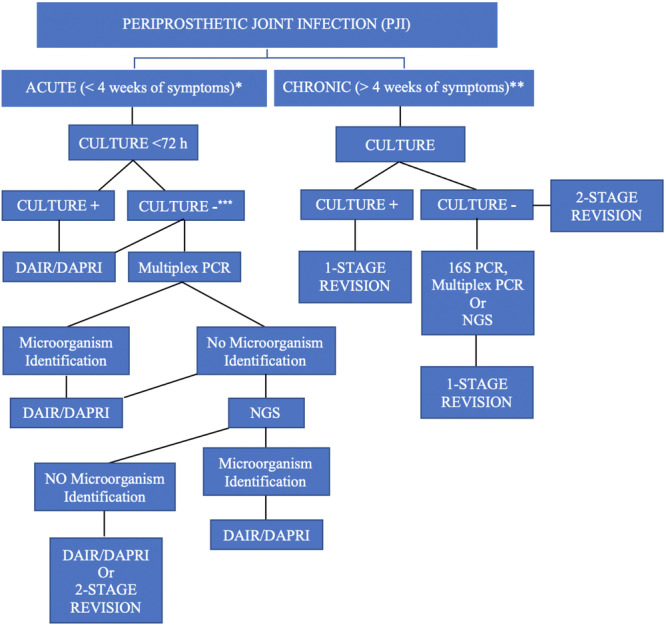
Periprosthetic joint infections (PJI) are among the most feared complications of joint reconstruction. Unfortunately, traditional cultures often fail to identify the aetiological agents of PJI. Molecular diagnostics can overcome the limitations of standard synovial fluid culture by utilising information from DNA/RNA samples to identify microbial species. The authors conducted a scoping review to evaluate the current state regarding the use of molecular diagnostics in the decision-making process for the surgical treatment of PJI and to create a flowchart based on molecular diagnostics.
A scoping review was conducted to provide an overview of the literature on molecular diagnostic techniques for detecting perioperative microbial infections in PJI. The population considered included patients undergoing total hip or knee arthroplasty or replacement, with a focus on molecular diagnostic methods within the perioperative period. The database search encompassed PubMed, Embase, Scopus and the Cochrane Library.
Seventy-five articles were included after a preliminary review of 1315 records. Each article was assigned to one of four categories to fulfil the purpose of this review: (1) Polymerase chain reaction (PCR) related studies: = 18; (2) Next-Generation-Sequencing (NGS) related studies: = 40; (3) comparative studies, including systematic reviews and meta-analyses, between different molecular diagnostic methodologies: = 7; and (4) general reviews on nucleic acid-based strategies to detect PJIs: = 10.
This review confirmed that molecular diagnostics are becoming extremely valuable tools in the decision-making process for PJI treatment. Culture-based techniques still represent the gold standard in PJI microorganism identification, but our review showed that standard culture, in 2025, could be integrated with newer nucleic acid-based strategies.
Level I.
人工关节周围感染(PJI)是关节重建最可怕的并发症之一。不幸的是,传统培养方法常常无法识别PJI的病原体。分子诊断可以通过利用DNA/RNA样本中的信息来识别微生物种类,从而克服标准滑液培养的局限性。作者进行了一项范围综述,以评估分子诊断在PJI手术治疗决策过程中的应用现状,并基于分子诊断创建一个流程图。
进行范围综述以概述检测PJI围手术期微生物感染的分子诊断技术的文献。纳入的人群包括接受全髋关节或膝关节置换术的患者,重点是围手术期的分子诊断方法。数据库检索涵盖了PubMed、Embase、Scopus和Cochrane图书馆。
在对1315条记录进行初步筛选后,纳入了75篇文章。每篇文章被归入四个类别之一以满足本综述的目的:(1)聚合酶链反应(PCR)相关研究:=18篇;(2)下一代测序(NGS)相关研究:=40篇;(3)不同分子诊断方法之间的比较研究,包括系统评价和荟萃分析:=7篇;(4)基于核酸策略检测PJI的综述:=10篇。
本综述证实分子诊断在PJI治疗决策过程中正在成为极其有价值工具。基于培养的技术仍然是PJI微生物鉴定的金标准,但我们的综述表明,到2025年,标准培养可能会与更新的基于核酸的策略相结合。
I级。