Institute of Diagnostic Virology, Friedrich-Loeffler-Institut, Greifswald-Insel Riems, Germany.
Robert Koch Institute, Department of Infectious Diseases, Unit 17 Influenza and Other Respiratory Viruses, National Reference Centre for Influenza, Berlin, Germany.
Nat Commun. 2024 Sep 10;15(1):7908. doi: 10.1038/s41467-024-52192-x.
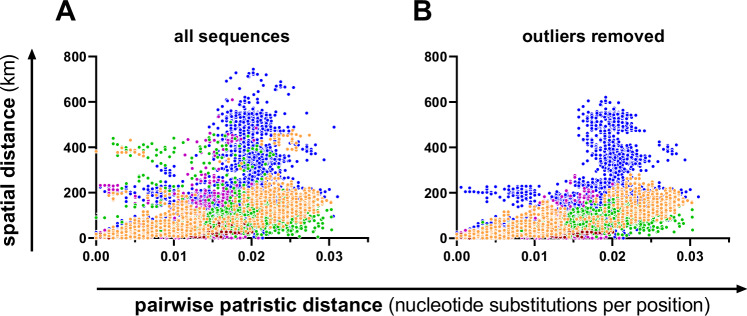
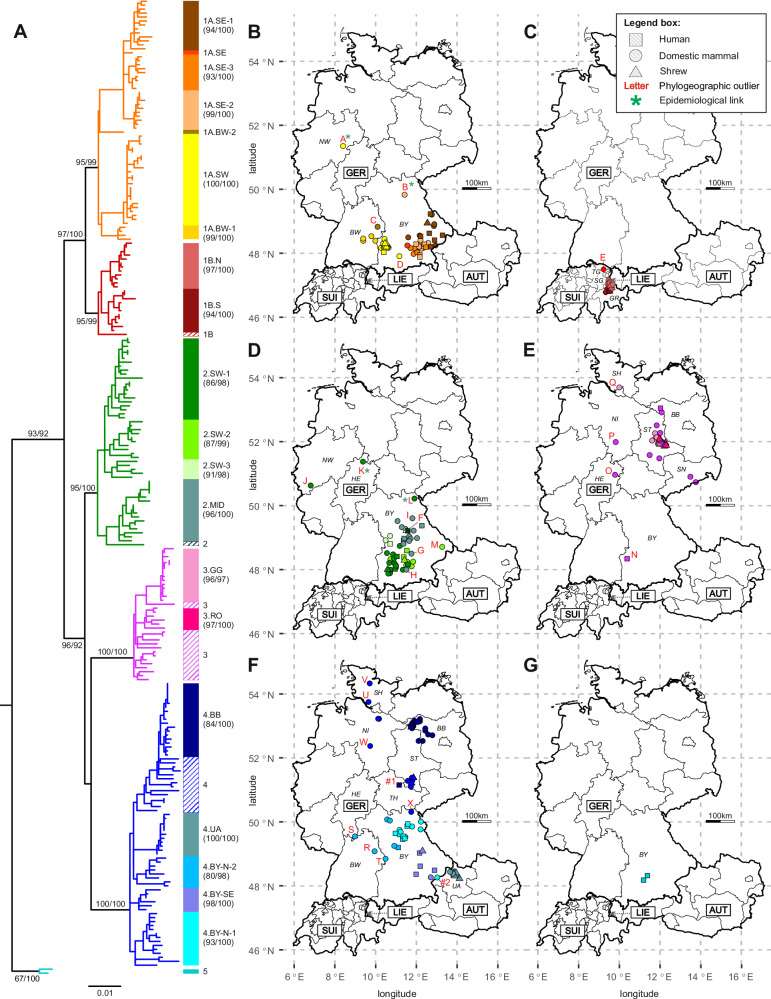
Borna disease virus 1 (BoDV-1) is the causative agent of Borna disease, a fatal neurologic disorder of domestic mammals and humans, resulting from spill-over infection from its natural reservoir host, the bicolored white-toothed shrew (Crocidura leucodon). The known BoDV-1-endemic area is remarkably restricted to parts of Germany, Austria, Switzerland and Liechtenstein. To gain comprehensive data on its occurrence, we analysed diagnostic material from suspected BoDV-1-induced encephalitis cases based on clinical and/or histopathological diagnosis. BoDV-1 infection was confirmed by RT-qPCR in 207 domestic mammals, 28 humans and seven wild shrews. Thereby, this study markedly raises the number of published laboratory-confirmed human BoDV-1 infections and provides a first comprehensive summary. Generation of 136 new BoDV-1 genome sequences from animals and humans facilitated an in-depth phylogeographic analysis, allowing for the definition of risk areas for zoonotic BoDV-1 transmission and facilitating the assessment of geographical infection sources. Consistent with the low mobility of its reservoir host, BoDV-1 sequences showed a remarkable geographic association, with individual phylogenetic clades occupying distinct areas. The closest genetic relatives of most human-derived BoDV-1 sequences were located at distances of less than 40 km, indicating that spill-over transmission from the natural reservoir usually occurs in the patient´s home region.
博尔纳病病毒 1 型(BoDV-1)是博尔纳病的病原体,博尔纳病是一种致命的家畜和人类神经系统疾病,是由其自然储存宿主——双色白齿鼩(Crocidura leucodon)溢出感染引起的。已知的 BoDV-1 流行地区非常局限于德国、奥地利、瑞士和列支敦士登的部分地区。为了全面了解其发生情况,我们根据临床和/或组织病理学诊断,对疑似 BoDV-1 引起的脑炎病例的诊断材料进行了分析。在 207 种家畜、28 名人类和 7 只野生鼩鼱中,通过 RT-qPCR 确认了 BoDV-1 感染。因此,这项研究显著增加了已发表的实验室确认的人类 BoDV-1 感染病例数,并提供了首次全面总结。从动物和人类中生成的 136 个新的 BoDV-1 基因组序列,促进了深入的系统地理学分析,定义了人畜共患 BoDV-1 传播的风险区域,并有助于评估地理感染源。与其自然储存宿主的低迁移性一致,BoDV-1 序列表现出显著的地理关联,个体系统发育枝占据不同的区域。大多数人类来源的 BoDV-1 序列的最接近的遗传亲属位于不到 40 公里的距离内,表明溢出传播通常发生在患者的家乡地区。