College of Nursing & Health Sciences, University of Massachusetts Dartmouth, Dartmouth, Massachusetts, USA.
Center for Health + Technology, University of Rochester Medical Center, Rochester, NY, USA.
Sci Rep. 2024 Sep 11;14(1):21171. doi: 10.1038/s41598-024-71555-4.
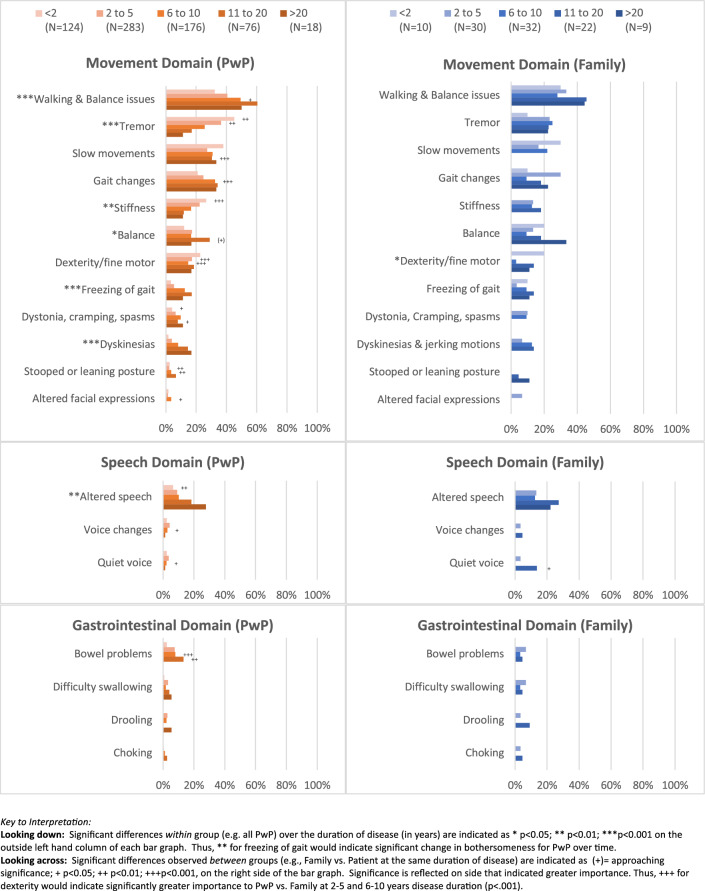
Understanding what matters to people with Parkinson's and their family is essential to derive relevant clinical outcome measures and guide clinical care. The purpose of this study was to explore what is important to people with Parkinson's disease vs. family over time. A qualitative content-analysis of online survey data collected by Parkinson's UK was conducted to identify types and frequencies of important symptoms and impacts of Parkinson's for people with the disease vs. family of people with Parkinson's. Independent T-tests were used to identify significance of between group differences for patients vs. family at < 2, 2-5, 6-10, 11-20, > 20-year durations. ANOVA was used to assess for within group differences by disease duration. We found that symptom priority changed significantly over time with longer disease duration. Tremor was reported less often later on, whereas mobility, dyskinesias, gait and speech/communication symptoms gained priority. In general, patients identified movement-related symptoms (e.g., walking, bradykinesia) as the most bothersome at all durations while family more strongly prioritized the physical and psychosocial impacts of disease (e.g., mobility, safety, interpersonal interactions, independence, and family impact). We conclude that important differences exist between family and patient perspectives of what matters and change over time with longer duration of disease.
了解帕金森病患者及其家属关心的问题对于得出相关的临床结果测量指标和指导临床护理至关重要。本研究旨在探讨随着时间的推移,帕金森病患者和患者家属关注的重要问题有何不同。通过对帕金森英国(Parkinson's UK)在线调查数据进行定性内容分析,以确定帕金森病患者和患者家属各自认为的重要症状类型和频率,以及帕金森病对他们的影响。采用独立样本 T 检验,比较患者与患者家属在疾病持续时间<2 年、2-5 年、6-10 年、11-20 年、>20 年时的组间差异显著性。采用方差分析,评估不同疾病持续时间的组内差异。我们发现,随着疾病持续时间的延长,症状的优先顺序发生了显著变化。震颤在后期出现的频率较低,而运动、运动障碍、步态和言语/交流症状的优先级上升。总的来说,患者在所有疾病持续时间内都认为与运动相关的症状(如行走、运动迟缓)最令人困扰,而家属则更强烈地关注疾病的身体和心理社会影响(如行动能力、安全性、人际互动、独立性和家庭影响)。我们的研究结果表明,患者和家属对重要问题的看法存在显著差异,并且随着疾病持续时间的延长而发生变化。