Duboff Lilah A, Dipasquale Sarah, Ives Stephen J
Department of Health and Human Physiological Sciences, Skidmore College, Saratoga Springs, NY, USA.
Department of Dance, Skidmore College, Saratoga Springs NY, USA.
Int J Exerc Sci. 2024 Aug 1;17(1):1056-1067. doi: 10.70252/XQXM1028. eCollection 2024.
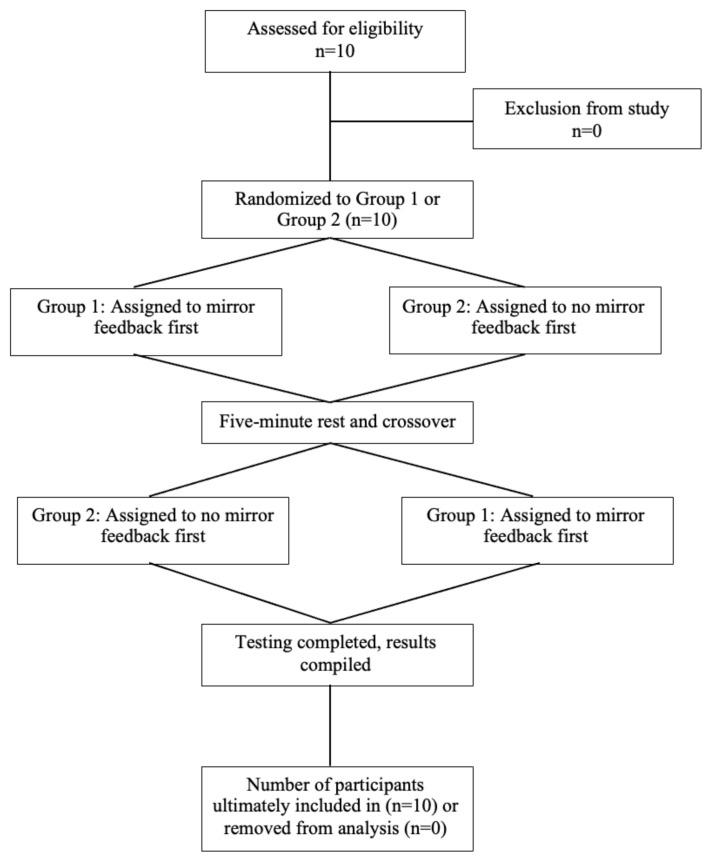
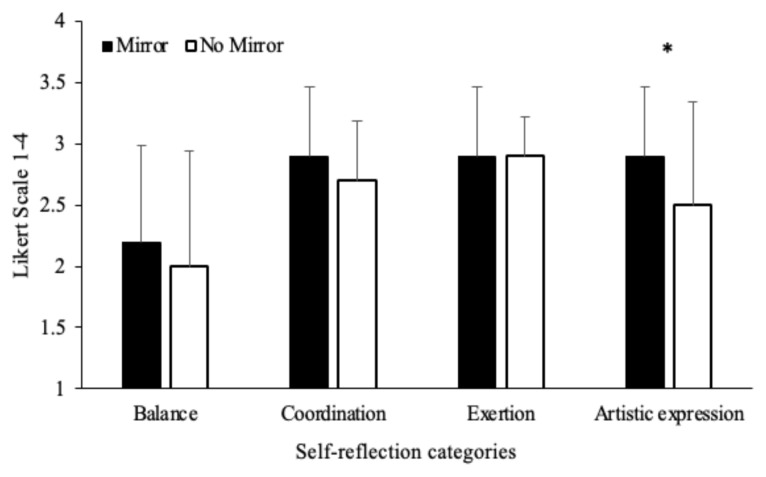
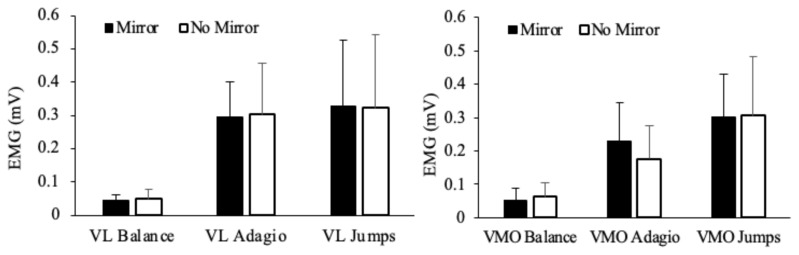
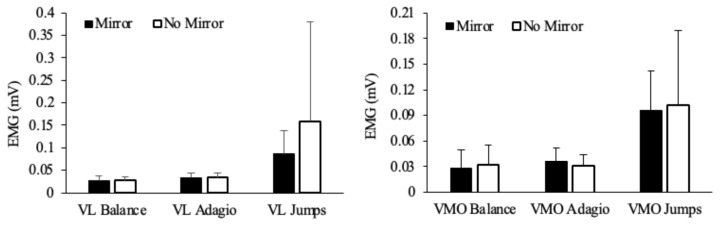
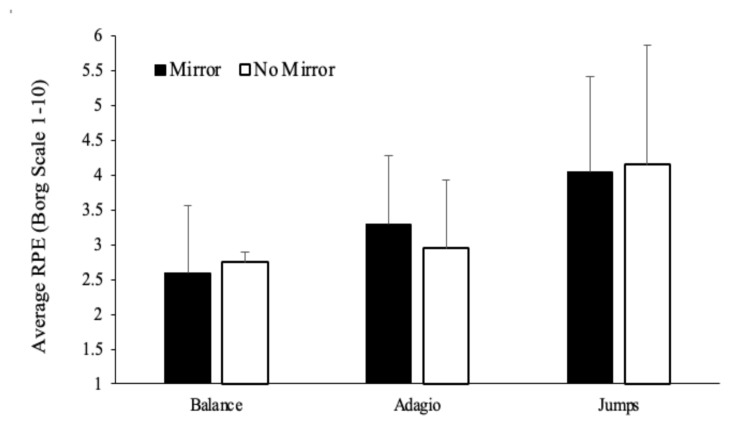
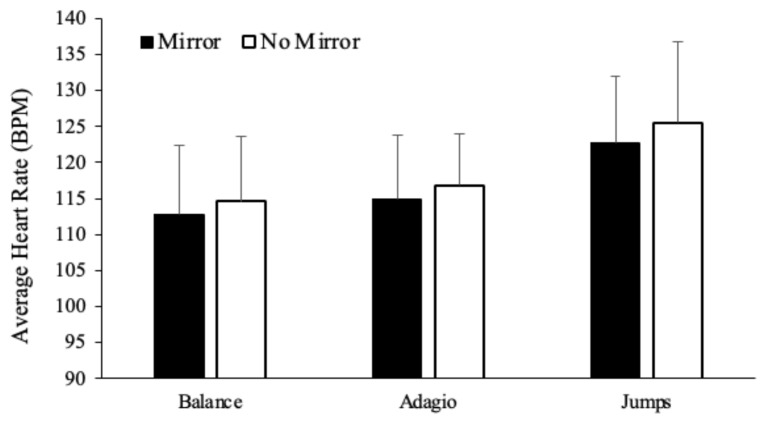
Extreme postures and imbalances in neuromuscular activity may place classical ballet dancers at higher risk of injury. Dance studio mirrors provide visual feedback by which a dancer can self-correct their body position and alignment, but have been suggested to negatively impact kinesthetic abilities and decrease performance capabilities. Thus, we investigated the effects of a mirror on muscle activity of the quadriceps, heart rate (HR), rating of perceived exertion (RPE), and qualitative performance. A lack of visual feedback would increase muscle activity of the quadriceps, HR, and RPE, and decrease self-reported perception of technical quality. 10 female participants completed a single leg balance, an adagio, and a jump task twice - once in each condition. Muscle activity of the vastus lateralis (VL) and vastus medialis oblique (VMO), as well as HR and RPE were assessed during each combination. Qualitative performance was assessed with an exit survey. No significant differences were found between conditions for RPE or HR in all three tasks (RPE: Balance = 0.468, Adagio = 0.191, Jumps = 0.769; HR: Balance = 0.409, Adagio = 0.424, Jumps = 0.244). No significant differences were found between conditions/tasks for peak, mean, and RMS sEMG. Dancers significantly ranked their artistic expression lower in a non-mirror condition ( = 0.018, Cohen's = 0.775). No differences in muscle activity of the VMO and VL or vital signs of fatigue were found. Psychological implications of visual feedback, including dancer's perceived decrease in artistic expression without a mirror present, should be further explored in future studies.
极端的姿势和神经肌肉活动的不平衡可能使古典芭蕾舞演员面临更高的受伤风险。舞蹈工作室的镜子提供视觉反馈,舞者可以借此自我纠正身体姿势和 alignment,但有人认为这会对动觉能力产生负面影响并降低表演能力。因此,我们研究了镜子对股四头肌肌肉活动、心率(HR)、主观用力程度(RPE)和定性表现的影响。缺乏视觉反馈会增加股四头肌的肌肉活动、心率和主观用力程度,并降低自我报告的技术质量感知。10名女性参与者完成了单腿平衡、慢板和跳跃任务各两次——每种条件下各一次。在每个组合过程中评估股外侧肌(VL)和股内侧斜肌(VMO)的肌肉活动,以及心率和主观用力程度。通过出口调查评估定性表现。在所有三项任务中,两种条件下的主观用力程度或心率均未发现显著差异(主观用力程度:平衡=0.468,慢板=0.191,跳跃=0.769;心率:平衡=0.409,慢板=0.424,跳跃=0.244)。两种条件/任务之间的肌电图峰值、平均值和均方根值均未发现显著差异。舞者在无镜子条件下对其艺术表现力的评价显著较低(=0.018,科恩氏=0.775)。未发现股内侧斜肌和股外侧肌的肌肉活动或疲劳生命体征存在差异。视觉反馈的心理影响,包括舞者在没有镜子时感觉艺术表现力下降,应在未来研究中进一步探讨。