Mitchel Marissa Weyer, Turner Stefanie, Walsh Lauren K, Torene Rebecca I, Myers Scott M, Taylor Cora M
Autism & Developmental Medicine Institute Geisinger.
Geisinger.
Res Sq. 2024 Aug 28:rs.3.rs-4790993. doi: 10.21203/rs.3.rs-4790993/v1.
-related disorder is associated with intellectual disability, motor delay, and speech deficits. Previous studies have focused on broad clinical descriptions of individuals, but limited information regarding specific speech diagnoses and results of direct testing has been published to date. We conducted deep phenotyping to characterize the speech, language, motor, cognitive, and adaptive phenotypes of individuals with -related disorder.
In this cross-sectional study, we administered standardized articulation, language, motor, and cognitive testing to 17 children and adolescents (mean age 9y 9m; SD 4y 5m; range 4y 2m to 19y 7m). In-person testing was supplemented with broad developmental, medical, and behavioral information collected virtually from a cohort of 67 individuals.
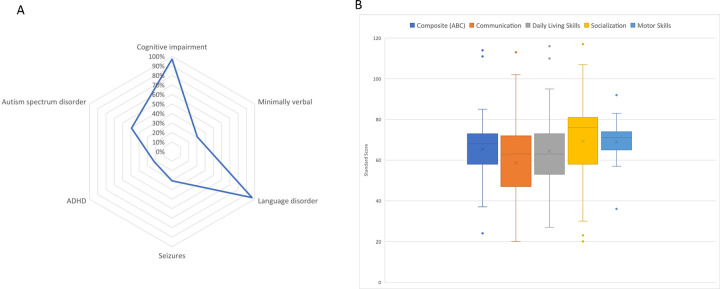
All individuals who completed in-person articulation testing met diagnostic criteria for speech apraxia, dysarthria, or both. Language impairment was present in all of the in-person cohort and almost all (97%) of the virtual cohort. Those who were able to complete motor testing demonstrated significant deficits in visual motor integration (mean 57.08, SD 9.26). Full scale IQs fell in the borderline to intellectual disability range, consistent with reported cognitive impairment in 97% of the virtual cohort. Notable medical features included hypotonia (83%), vision problems (72%), recurrent otitis media (58%), gastrointestinal problems (57%), and seizures (31%).
-related disorder is characterized by a high rate of motor speech disorders that occur in the context of globally impaired motor, language, and cognitive skills. Children would benefit from intensive, individualized speech therapy and the early adoption of augmentative communication strategies.
-相关障碍与智力残疾、运动发育迟缓及言语缺陷有关。既往研究主要聚焦于对个体的宽泛临床描述,但迄今为止,关于具体言语诊断及直接测试结果的信息报道有限。我们进行了深入表型分析,以刻画-相关障碍个体的言语、语言、运动、认知及适应性表型。
在这项横断面研究中,我们对17名儿童和青少年(平均年龄9岁9个月;标准差4岁5个月;范围4岁2个月至19岁7个月)进行了标准化的发音、语言、运动和认知测试。现场测试辅以从67名个体队列中虚拟收集的广泛发育、医学和行为信息。
所有完成现场发音测试的个体均符合言语失用症、构音障碍或两者的诊断标准。所有现场队列个体及几乎所有(97%)虚拟队列个体均存在语言障碍。能够完成运动测试的个体在视觉运动整合方面存在显著缺陷(平均57.08,标准差9.26)。全量表智商处于临界至智力残疾范围,与97%虚拟队列中报告的认知障碍一致。显著的医学特征包括肌张力低下(83%)、视力问题(72%)、复发性中耳炎(58%)、胃肠道问题(57%)和癫痫发作(31%)。
-相关障碍的特征是在整体运动、语言和认知技能受损的背景下,运动性言语障碍发生率较高。儿童将受益于强化的个体化言语治疗及早期采用辅助沟通策略。