Xu Yaqi, Sui Xinyao, Li Jinhong, Zhang Liyi, Wang Pengpeng, Liu Yang, Shi Huijing, Zhang Yunhui
Key Lab of Health Technology Assessment, National Health Commission of the People's Republic of China, Fudan University, Shanghai 200032, China.
Key Laboratory of Public Health Safety, Ministry of Education, School of Public Health, Fudan University, Shanghai 200032, China.
Eco Environ Health. 2024 May 8;3(3):308-316. doi: 10.1016/j.eehl.2024.04.007. eCollection 2024 Sep.
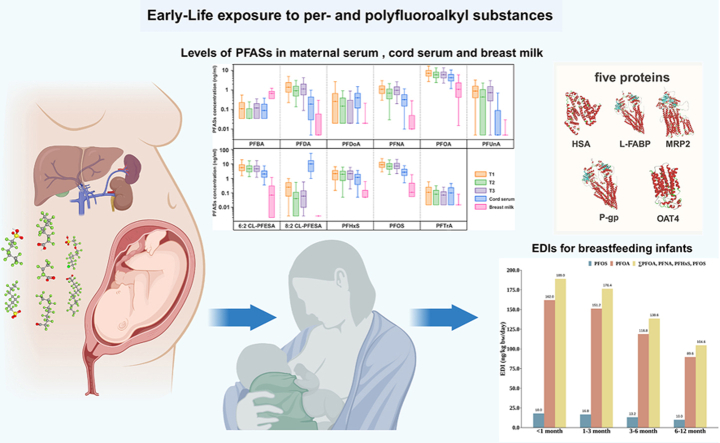
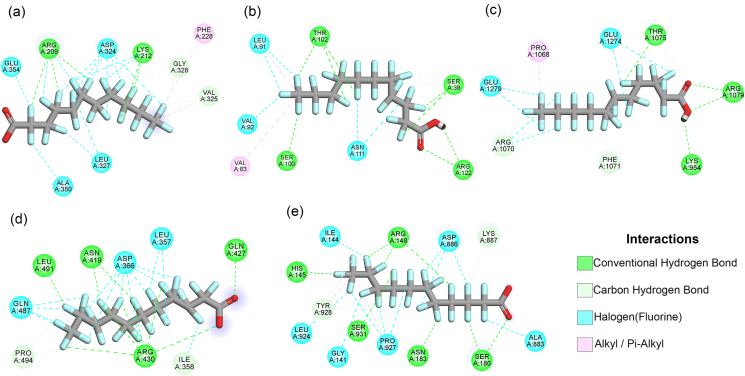
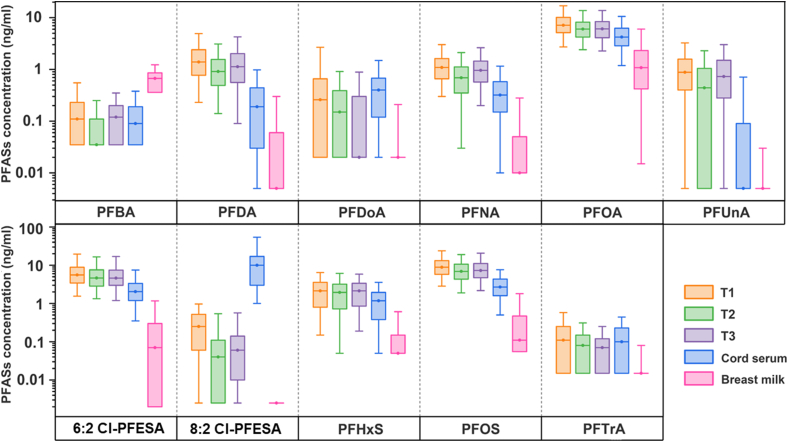
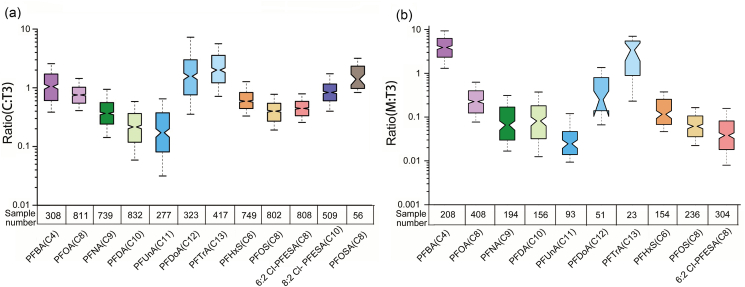
Per- and polyfluoroalkyl substances (PFAS) can pass through the placenta and adversely affect fetal development. However, there is a lack of comparison of legacy and emerging PFAS levels among different biosamples in pregnant women and their offspring. This study, based on the Shanghai Maternal-Child Pairs Cohort, analyzed the concentrations of 16 PFAS in the maternal serum, cord serum, and breast milk samples from 1,076 mother-child pairs. The placental and breastfeeding transfer efficiencies of PFAS were determined in maternal-cord and maternal-milk pairs, respectively. The binding affinities of PFAS to five transporters were simulated using molecular docking. The results suggested that PFAS were frequently detected in different biosamples. The median concentration of perfluorooctane sulfonate (PFOS) was the highest at 8.85 ng/mL, followed by perfluorooctanoic acid (PFOA) at 7.13 ng/mL and 6:2 chlorinated polyfluorinated ether sulfonate at 5.59 ng/mL in maternal serum. The median concentrations of PFOA were highest in cord serum (4.23 ng/mL) and breast milk (1.08 ng/mL). PFAS demonstrated higher placental than breastfeeding transfer efficiencies. The transfer efficiencies and the binding affinities of most PFAS to proteins exhibited alkyl chain length-dependent patterns. Furthermore, we comprehensively assessed the estimated daily intakes (EDIs) of PFAS in breastfeeding infants of different age groups and used the hazard quotient (HQ) to characterize the potential health risk. EDIs decreased with infant age, and PFOS had higher HQs than PFOA. These findings highlight the significance of considering PFAS exposure, transfer mechanism, and health risks resulting from breast milk intake in early life.
全氟和多氟烷基物质(PFAS)可穿过胎盘并对胎儿发育产生不利影响。然而,孕妇及其后代不同生物样本中传统和新兴PFAS水平的比较尚显不足。本研究以上海母婴队列研究为基础,分析了1076对母婴的母血、脐血和母乳样本中16种PFAS的浓度。分别在母-脐和母-乳配对中测定了PFAS的胎盘转运效率和母乳转运效率。使用分子对接模拟了PFAS与五种转运蛋白的结合亲和力。结果表明,不同生物样本中经常检测到PFAS。母血中全氟辛烷磺酸(PFOS)的中位数浓度最高,为8.85 ng/mL,其次是全氟辛酸(PFOA),为7.13 ng/mL,以及6:2氯代多氟醚磺酸,为5.59 ng/mL。脐血(4.23 ng/mL)和母乳(1.08 ng/mL)中PFOA的中位数浓度最高。PFAS的胎盘转运效率高于母乳转运效率。大多数PFAS与蛋白质的转运效率和结合亲和力呈现出烷基链长度依赖性模式。此外,我们全面评估了不同年龄组母乳喂养婴儿的PFAS估计每日摄入量(EDI),并使用危害商(HQ)来表征潜在健康风险。EDI随婴儿年龄增长而降低,PFOS的HQ高于PFOA。这些发现凸显了考虑PFAS暴露、转运机制以及早期生命中母乳摄入所导致的健康风险的重要性。