Department of Family Medicine, Daegu Catholic University School of Medicine, Daegu, Korea.
Medicine (Baltimore). 2024 May 31;103(22):e38328. doi: 10.1097/MD.0000000000038328.
Smoking is an important risk factor for various metabolic and cardiovascular disorders, and smoking cessation reduces the risk of these conditions. However, weight gain is commonly observed when individuals quit smoking, which often leads to hesitation in pursuing smoking cessation. Weight gain increases the risk of metabolic syndrome (MS). However, previous studies that investigated the relationship between smoking cessation and MS have yielded inconsistent results. Therefore, we conducted a meta-analysis to evaluate the association between smoking cessation and MS.
Medline, Embase, Cochrane Library and CINAHL databases, were comprehensively searched from inception to April 2023, to identify relevant studies examining the relationship between smoking cessation and MS, comparing such relationship to that with active smoking. The methodological quality of the selected studies was assessed using the Newcastle-Ottawa Quality Assessment Scale. A random-effects model was used for meta-analysis.
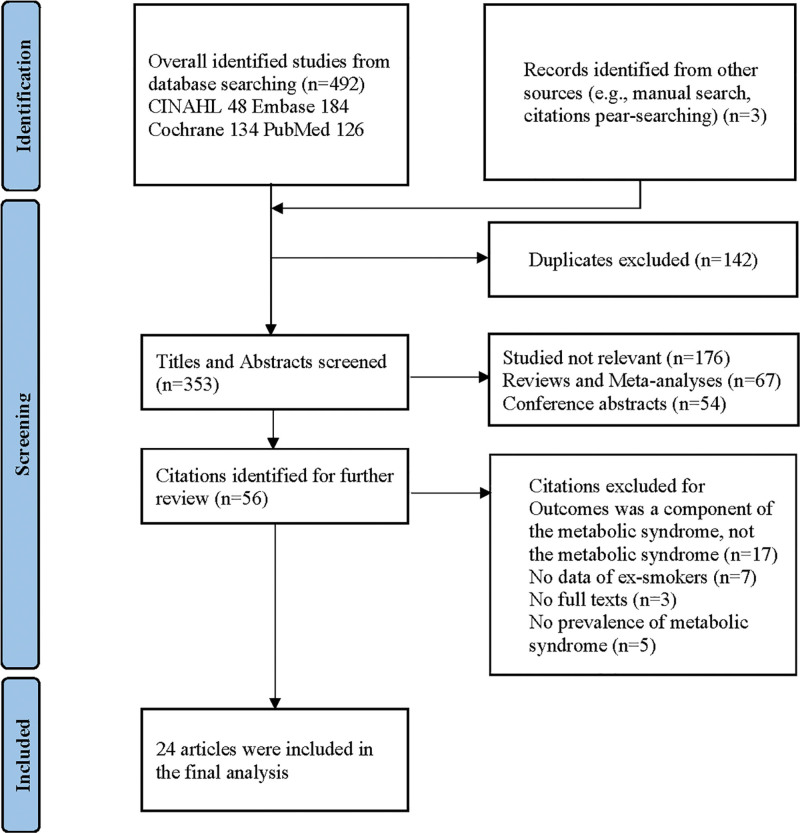
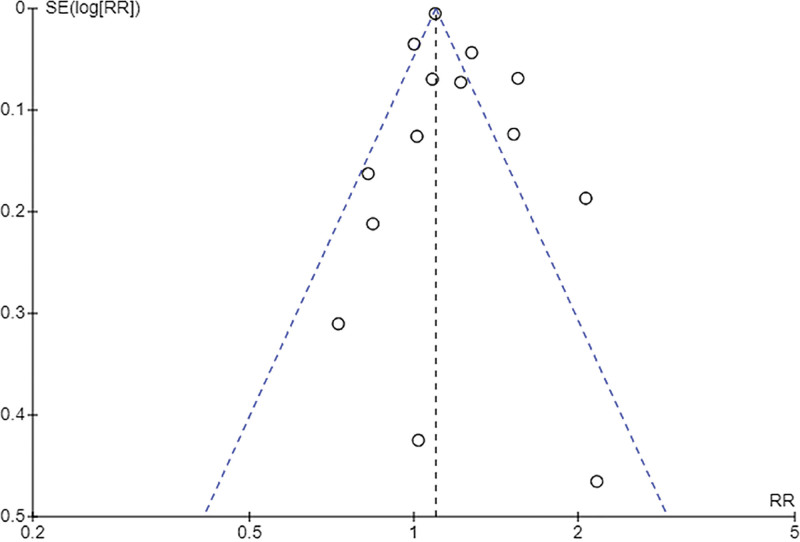
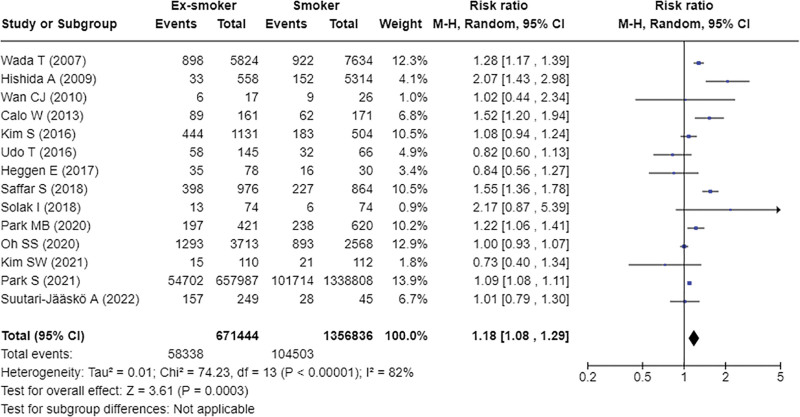
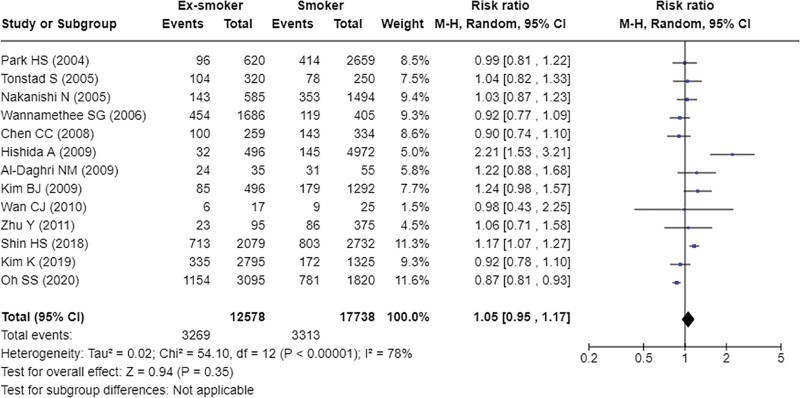
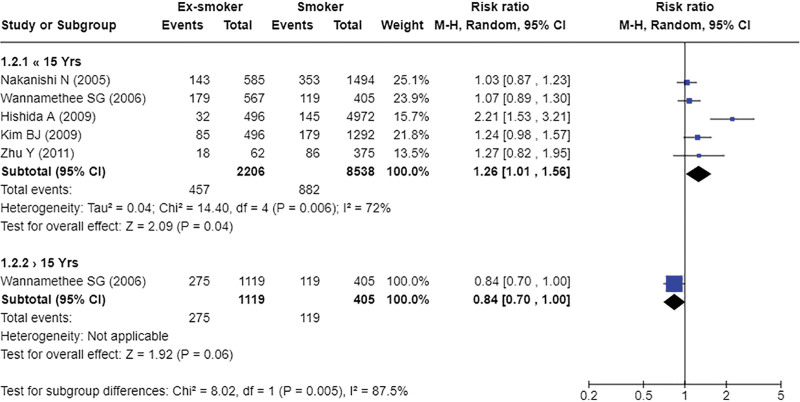
Of 495 identified studies, 24 were reviewed. The risk of selection bias was identified in all the studies. The overall analysis of 14 studies, including data of combined results for both men and women, revealed an increased risk of MS among ex-smokers compared with that among active smokers (pooled relative risk [RR] 1.18, 95% confidence interval [CI]: 1.08-1.29). From the selected studies, 13 studies analyzing men were extracted for subgroup analysis. Among men, no significant difference in the risk of developing MS was observed between ex-smokers and smokers (pooled RR: 1.05, 95% CI: 0.95-1.17). In men, the risk of MS increased if the cessation period was ≤15 years in men (pooled RR 1.26, 95% CI: 1.01-1.56) and slightly decreased if the cessation period was > 15 years (RR 0.84, 95% CI: 0.70-1.00) in ex-smokers compared with that in current smokers.
An increased risk of MS was observed in the early stages of smoking cessation compared with current smoking. As the longer duration of smoking cessation, the risk of MS becomes less significant.
吸烟是多种代谢和心血管疾病的重要危险因素,戒烟可降低这些疾病的风险。然而,当个体戒烟时,通常会观察到体重增加,这往往导致他们对戒烟犹豫不决。体重增加会增加代谢综合征(MS)的风险。然而,先前研究戒烟与 MS 之间关系的研究结果不一致。因此,我们进行了一项荟萃分析,以评估戒烟与 MS 之间的关系。
从建库至 2023 年 4 月,我们全面检索了 Medline、Embase、Cochrane 图书馆和 CINAHL 数据库,以确定评估戒烟与 MS 之间关系的相关研究,将这种关系与主动吸烟进行比较。使用纽卡斯尔-渥太华质量评估量表评估所选研究的方法学质量。使用随机效应模型进行荟萃分析。
在 495 项已确定的研究中,有 24 项进行了综述。所有研究均存在选择偏倚风险。对包括男性和女性综合结果在内的 14 项研究的总体分析显示,与吸烟者相比,戒烟者发生 MS 的风险增加(汇总相对风险 [RR] 1.18,95%置信区间 [CI]:1.08-1.29)。从选定的研究中,提取了 13 项针对男性的研究进行亚组分析。在男性中,戒烟者和吸烟者发生 MS 的风险无显著差异(汇总 RR:1.05,95% CI:0.95-1.17)。在男性中,如果戒烟者的戒烟期≤15 年,则 MS 的风险增加(汇总 RR 1.26,95% CI:1.01-1.56),如果戒烟期>15 年,则 MS 的风险略有下降(RR 0.84,95% CI:0.70-1.00),与当前吸烟者相比。
与当前吸烟相比,戒烟早期 MS 的风险增加。随着戒烟时间的延长,MS 的风险变得不那么显著。