Centre for Genomics Research, Discovery Sciences, BioPharmaceuticals R&D, AstraZeneca, Cambridge, UK.
Department of Haematology, University of Cambridge, Cambridge, UK.
Nat Genet. 2024 Sep;56(9):1821-1831. doi: 10.1038/s41588-024-01898-1. Epub 2024 Sep 11.
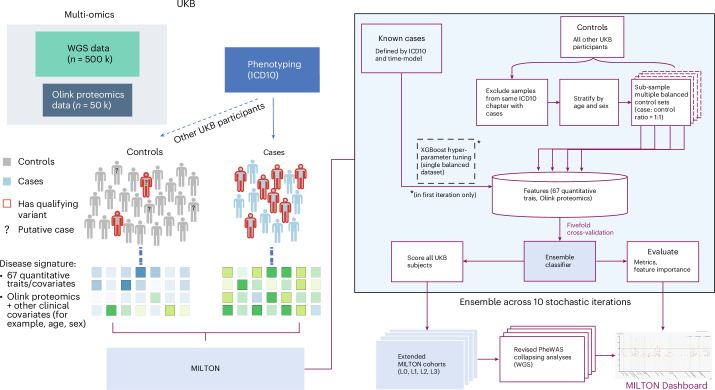
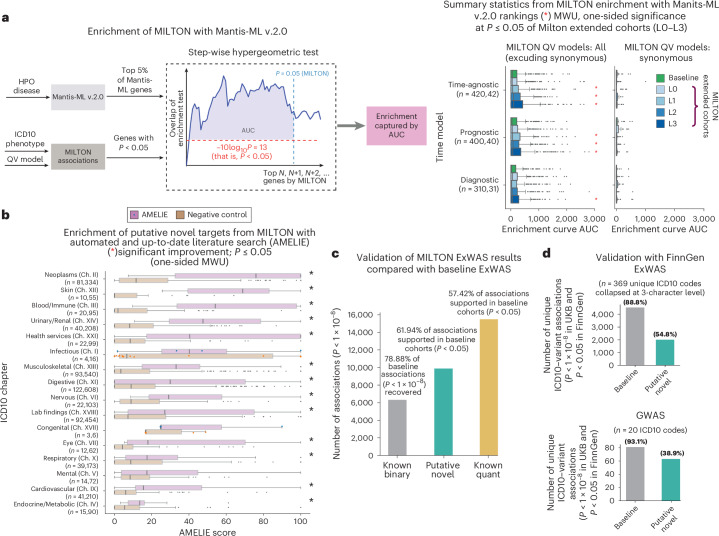
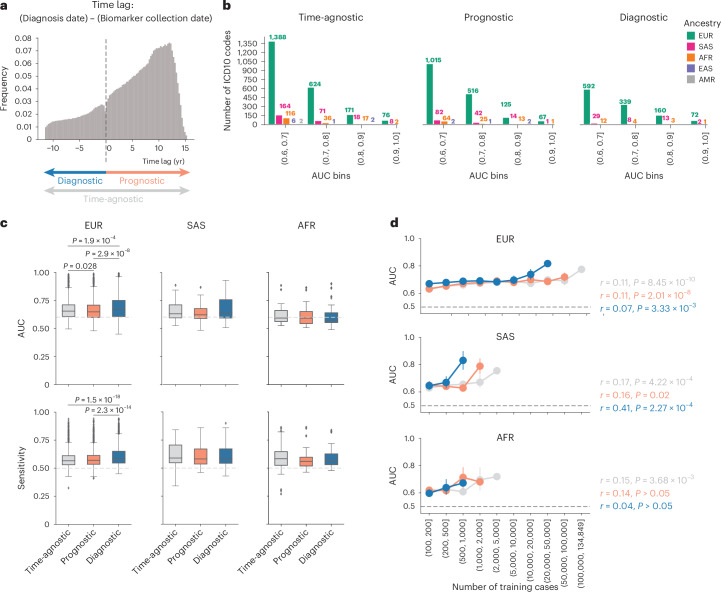
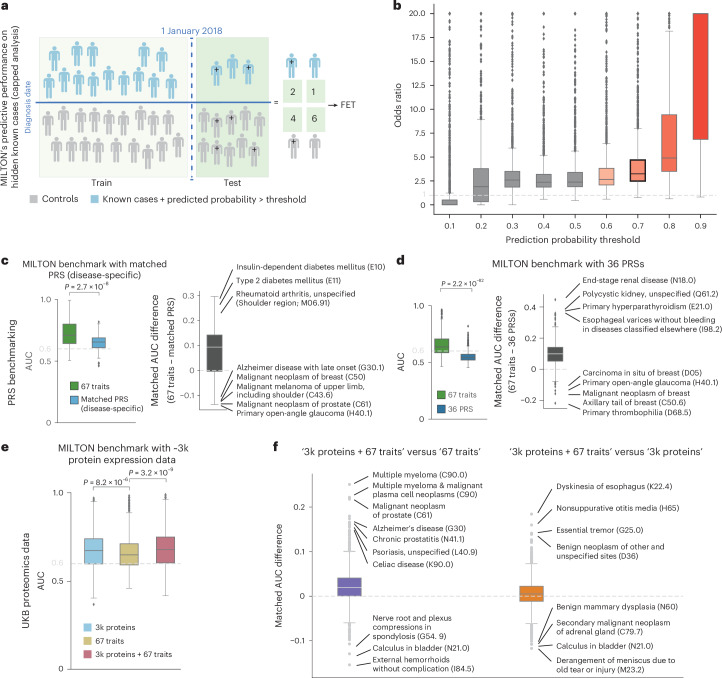
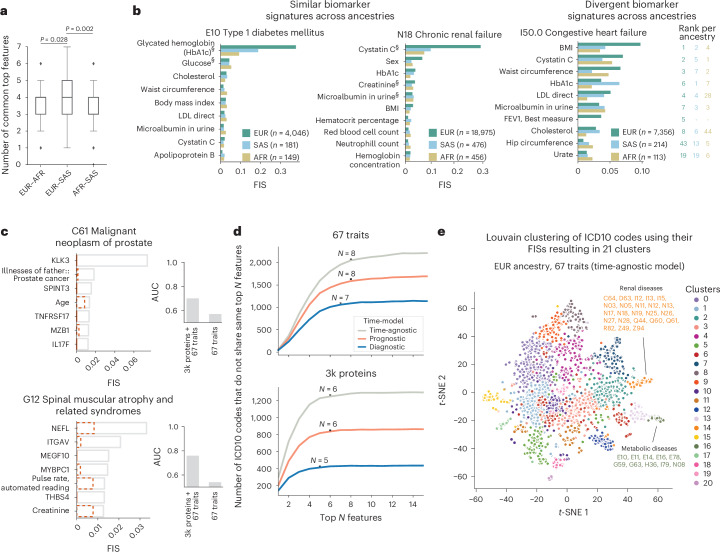
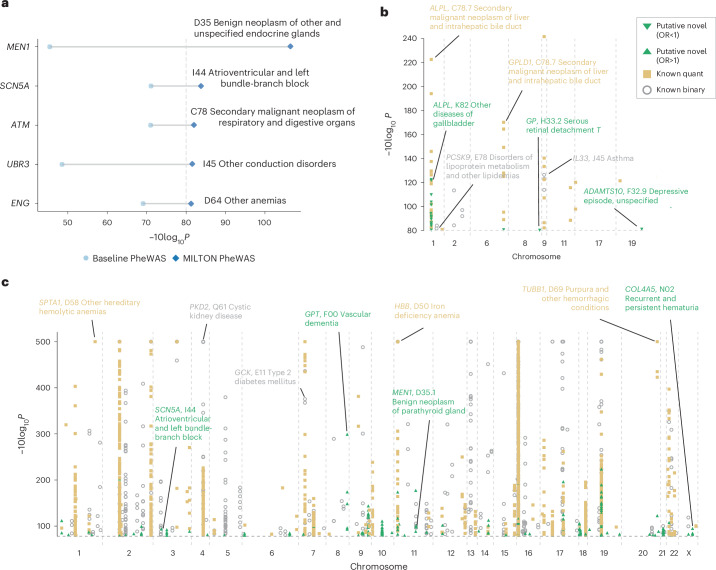
The emergence of biobank-level datasets offers new opportunities to discover novel biomarkers and develop predictive algorithms for human disease. Here, we present an ensemble machine-learning framework (machine learning with phenotype associations, MILTON) utilizing a range of biomarkers to predict 3,213 diseases in the UK Biobank. Leveraging the UK Biobank's longitudinal health record data, MILTON predicts incident disease cases undiagnosed at time of recruitment, largely outperforming available polygenic risk scores. We further demonstrate the utility of MILTON in augmenting genetic association analyses in a phenome-wide association study of 484,230 genome-sequenced samples, along with 46,327 samples with matched plasma proteomics data. This resulted in improved signals for 88 known (P < 1 × 10) gene-disease relationships alongside 182 gene-disease relationships that did not achieve genome-wide significance in the nonaugmented baseline cohorts. We validated these discoveries in the FinnGen biobank alongside two orthogonal machine-learning methods built for gene-disease prioritization. All extracted gene-disease associations and incident disease predictive biomarkers are publicly available ( http://milton.public.cgr.astrazeneca.com ).
生物库级数据集的出现为发现新的生物标志物和开发人类疾病预测算法提供了新的机会。在这里,我们提出了一个集成机器学习框架(基于表型关联的机器学习,MILTON),利用一系列生物标志物来预测英国生物库中的 3213 种疾病。利用英国生物库的纵向健康记录数据,MILTON 预测了招募时未诊断出的疾病病例,其表现大大优于现有的多基因风险评分。我们进一步证明了 MILTON 在增强全基因组关联研究中的效用,该研究对 484230 个全基因组测序样本和 46327 个具有匹配血浆蛋白质组学数据的样本进行了表型关联研究。这导致了 88 个已知(P<1×10)基因-疾病关系的信号得到改善,同时还有 182 个基因-疾病关系在未增强的基线队列中没有达到全基因组显著水平。我们在 FinnGen 生物库中对这些发现进行了验证,并与为基因-疾病优先级排序而构建的两种正交机器学习方法进行了比较。所有提取的基因-疾病关联和预测疾病的生物标志物都可以公开获得(http://milton.public.cgr.astrazeneca.com)。