Mater Research Institute, The University of Queensland, Brisbane, QLD, Australia.
Institute for Molecular Bioscience, The University of Queensland, Brisbane, QLD, Australia.
Mol Autism. 2021 Feb 10;12(1):12. doi: 10.1186/s13229-020-00407-5.
Autism spectrum disorder (ASD) is a complex neurodevelopmental condition whose biological basis is yet to be elucidated. The Australian Autism Biobank (AAB) is an initiative of the Cooperative Research Centre for Living with Autism (Autism CRC) to establish an Australian resource of biospecimens, phenotypes and genomic data for research on autism.
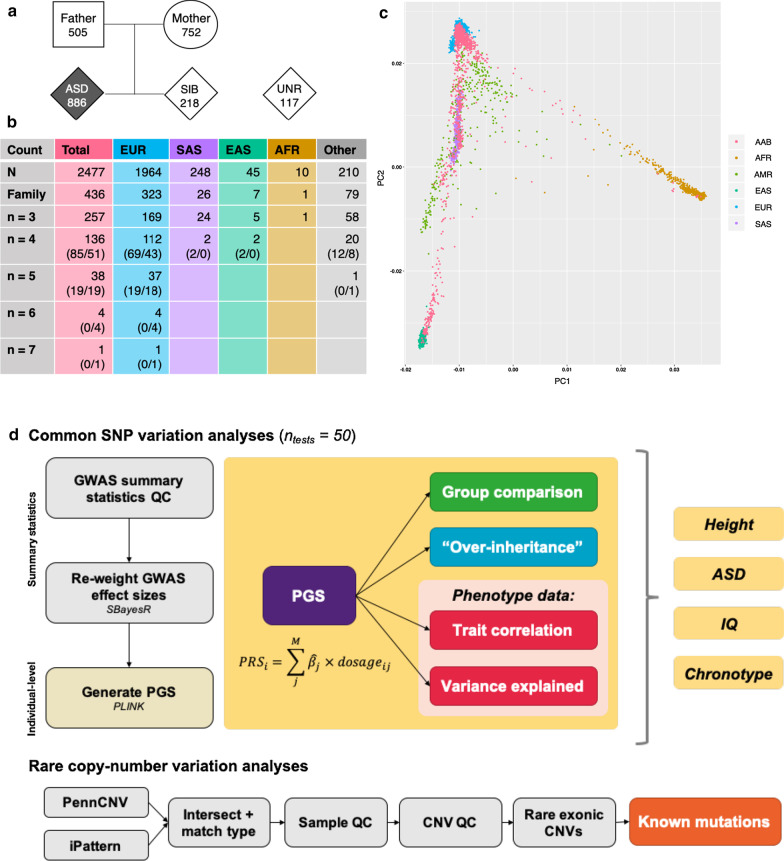
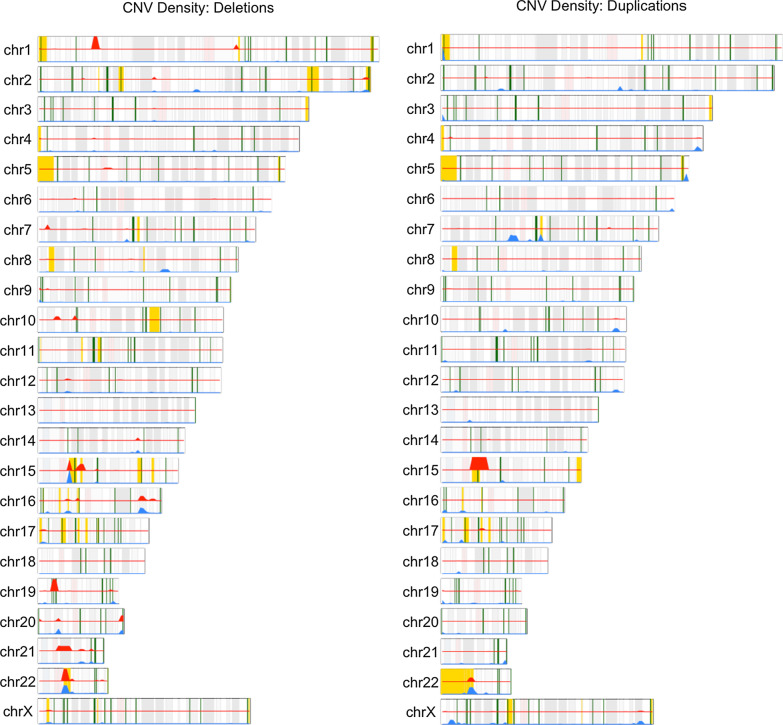
Genome-wide single-nucleotide polymorphism genotypes were available for 2,477 individuals (after quality control) from 546 families (436 complete), including 886 participants aged 2 to 17 years with diagnosed (n = 871) or suspected (n = 15) ASD, 218 siblings without ASD, 1,256 parents, and 117 unrelated children without an ASD diagnosis. The genetic data were used to confirm familial relationships and assign ancestry, which was majority European (n = 1,964 European individuals). We generated polygenic scores (PGS) for ASD, IQ, chronotype and height in the subset of Europeans, and in 3,490 unrelated ancestry-matched participants from the UK Biobank. We tested for group differences for each PGS, and performed prediction analyses for related phenotypes in the AAB. We called copy-number variants (CNVs) in all participants, and intersected these with high-confidence ASD- and intellectual disability (ID)-associated CNVs and genes from the public domain.
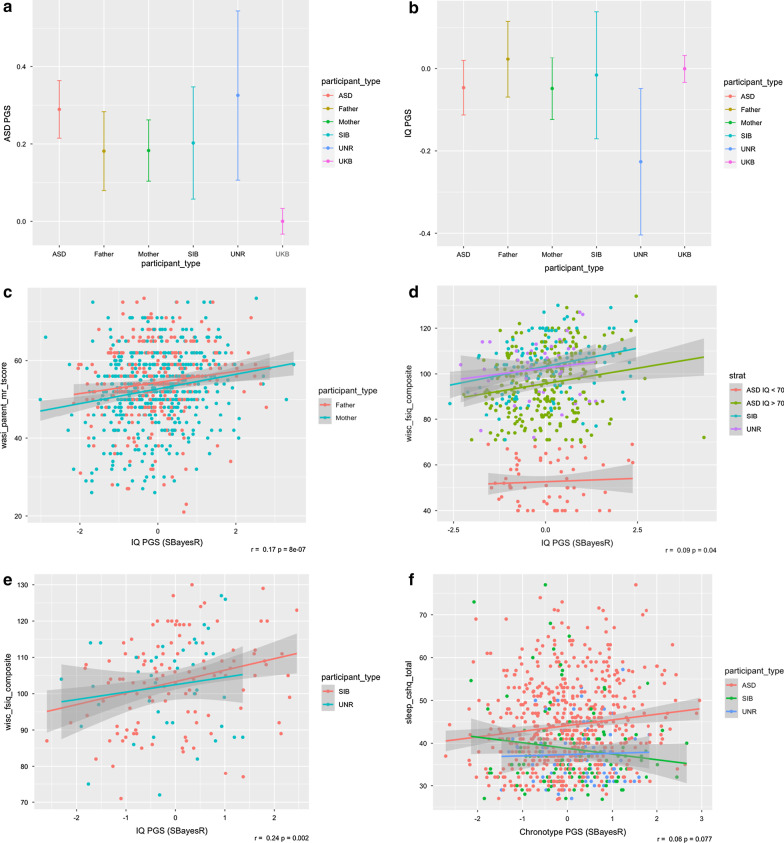
The ASD (p = 6.1e-13), sibling (p = 4.9e-3) and unrelated (p = 3.0e-3) groups had significantly higher ASD PGS than UK Biobank controls, whereas this was not the case for height-a control trait. The IQ PGS was a significant predictor of measured IQ in undiagnosed children (r = 0.24, p = 2.1e-3) and parents (r = 0.17, p = 8.0e-7; 4.0% of variance), but not the ASD group. Chronotype PGS predicted sleep disturbances within the ASD group (r = 0.13, p = 1.9e-3; 1.3% of variance). In the CNV analysis, we identified 13 individuals with CNVs overlapping ASD/ID-associated CNVs, and 12 with CNVs overlapping ASD/ID/developmental delay-associated genes identified on the basis of de novo variants.
This dataset is modest in size, and the publicly-available genome-wide-association-study (GWAS) summary statistics used to calculate PGS for ASD and other traits are relatively underpowered.
We report on common genetic variation and rare CNVs within the AAB. Prediction analyses using currently available GWAS summary statistics are largely consistent with expected relationships based on published studies. As the size of publicly-available GWAS summary statistics grows, the phenotypic depth of the AAB dataset will provide many opportunities for analyses of autism profiles and co-occurring conditions, including when integrated with other omics datasets generated from AAB biospecimens (blood, urine, stool, hair).
自闭症谱系障碍(ASD)是一种复杂的神经发育疾病,其生物学基础尚未阐明。澳大利亚自闭症生物银行(AAB)是自闭症合作研究中心(Autism CRC)的一项倡议,旨在建立一个澳大利亚生物样本、表型和基因组数据资源,用于自闭症研究。
对来自 546 个家庭(436 个完整家庭)的 2477 名个体(经过质量控制后)的全基因组单核苷酸多态性基因型进行了分析,包括 886 名年龄在 2 至 17 岁的被诊断患有(n=871)或疑似患有(n=15)自闭症的参与者、218 名无自闭症的兄弟姐妹、1256 名父母和 117 名无自闭症诊断的无关儿童。遗传数据用于确认亲属关系并确定祖先,其中大部分为欧洲人(n=1964 名欧洲个体)。我们在欧洲亚组中为 ASD、智商、睡眠时相和身高生成了多基因评分(PGS),并在 UK Biobank 中的 3490 名无关的、匹配祖先的参与者中进行了测试。我们对每个 PGS 进行了组间差异检验,并对 AAB 中的相关表型进行了预测分析。我们对所有参与者进行了拷贝数变异(CNVs)的检测,并与公共领域中高可信度的 ASD 和智力障碍(ID)相关的 CNVs 和基因进行了交叉。
ASD(p=6.1e-13)、兄弟姐妹(p=4.9e-3)和无关个体(p=3.0e-3)组的 ASD PGS 显著高于 UK Biobank 对照组,而身高则不是这种情况-控制性状。智商 PGS 是未诊断儿童(r=0.24,p=2.1e-3)和父母(r=0.17,p=8.0e-7;4.0%的方差)测量智商的显著预测因子,但 ASD 组则不然。睡眠时相 PGS 预测 ASD 组的睡眠障碍(r=0.13,p=1.9e-3;1.3%的方差)。在 CNV 分析中,我们确定了 13 名个体的 CNVs 与 ASD/ID 相关的 CNVs 重叠,12 名个体的 CNVs 与基于新生变异确定的 ASD/ID/发育迟缓相关基因重叠。
该数据集规模较小,用于计算 ASD 和其他特征的 PGS 的公开全基因组关联研究(GWAS)汇总统计数据相对较弱。
我们报告了 AAB 中的常见遗传变异和罕见的 CNVs。使用当前可用的 GWAS 汇总统计数据进行的预测分析在很大程度上与基于已发表研究的预期关系一致。随着公开可用的 GWAS 汇总统计数据的规模不断增加,AAB 数据集的表型深度将为自闭症特征和并发疾病的分析提供许多机会,包括当与 AAB 生物样本(血液、尿液、粪便、头发)生成的其他组学数据集成时。