Department of Endocrinology & Metabolic Diseases, Polish Mother's Memorial Hospital Research Institute, Lodz, Poland.
Faculty of Mathematics and Computer Science, University of Lodz, Lodz, Poland.
Front Endocrinol (Lausanne). 2024 Aug 28;15:1448467. doi: 10.3389/fendo.2024.1448467. eCollection 2024.
The glucagon stimulation test (GST) is widely used to assess growth hormone (GH) and cortisol secretion, nevertheless the precise mechanisms underpinning these hormonal responses remain unclear. We have endeavoured to explore the relationship between glucose and insulin fluctuations during GST and their impact on GH and cortisol secretion.
We retrospectively studied 139 subjects (mean age 35.5 ± 15.1 years, BMI 26.6 ± 6.61 kg/m²), including 62 individuals with a history of pituitary disease (27 with an intact adrenal axis) and 77 healthy controls. Standard dose intramuscular GST was performed in all subjects.
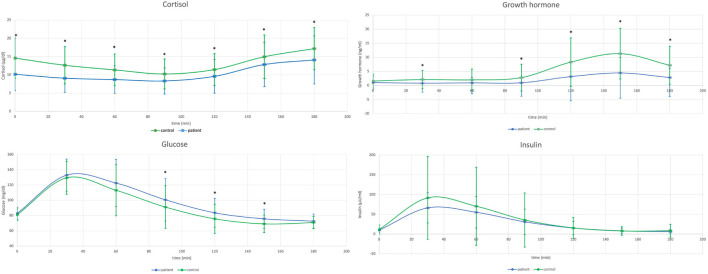
Once BMI and age were excluded from multivariate model, the nadir of glucose concentration during GST was the sole variable associated with maximal GH secretion (ΔGH, p<0.0003), while neither glucose/insulin peak, nor Δglucose/Δinsulin concentrations contributed to ΔGH. 100% pass rate for GH secretion above 3 ng/ml or 1.07 ng/ml cut-offs was observed for glucose concentrations at, or below 60 mg/dl (3.33 mmol/l) (for Controls), or 62 mg/dl (3.44 mmol/l) (for Controls and patients with an intact adrenocortical axis). Such low glucose concentrations were obtained, however, only in about 30% of studied individuals. Conversely, cortisol secretion did not correlate with glucose or insulin fluctuations, suggesting alternative regulatory mechanisms.
This study reveals that glucose nadir below 3.33 mmol/l is the only biochemical biovariable linked with optimal GH secretion during GST, whereas mechanisms responsible for cortisol secretion remain unclear. We emphasize the importance of glucose monitoring during GST to validate GH stimulation and support clinical decisions in GH deficiency management.
胰高血糖素刺激试验(GST)被广泛用于评估生长激素(GH)和皮质醇的分泌,但这些激素反应的确切机制仍不清楚。我们试图探讨 GST 期间葡萄糖和胰岛素波动与 GH 和皮质醇分泌之间的关系。
我们回顾性研究了 139 名受试者(平均年龄 35.5 ± 15.1 岁,BMI 26.6 ± 6.61 kg/m²),包括 62 名垂体疾病患者(27 名肾上腺轴完整)和 77 名健康对照者。所有受试者均进行标准剂量肌内 GST。
在排除 BMI 和年龄的多变量模型后,GST 期间葡萄糖浓度的最低点是与最大 GH 分泌相关的唯一变量(ΔGH,p<0.0003),而葡萄糖/胰岛素峰值或 Δglucose/Δinsulin 浓度均与 ΔGH 无关。对于 GH 分泌超过 3 ng/ml 或 1.07 ng/ml 切点的 100%通过率,观察到葡萄糖浓度在 60 mg/dl(3.33 mmol/l)(对照组)或 62 mg/dl(3.44 mmol/l)(对照组和肾上腺皮质轴完整的患者)以下或以下时。然而,仅在大约 30%的研究个体中获得了如此低的葡萄糖浓度。相反,皮质醇分泌与葡萄糖或胰岛素波动无关,表明存在替代调节机制。
本研究表明,GST 期间葡萄糖最低点低于 3.33 mmol/l 是唯一与 GH 分泌最佳相关的生化生物变量,而皮质醇分泌的机制仍不清楚。我们强调在 GST 期间进行血糖监测以验证 GH 刺激的重要性,并支持 GH 缺乏症管理中的临床决策。