Zhan Yunfan, Zhang Yujie, Liu Kaoqiang, Zhao Ye, Ning Jiawei, Chai Yongli, Kong Lingjun, Yuan Weian
Shuguang Hospital Affiliated with Shanghai University of TCM, Shanghai, 201203, China.
Longhua Hospital Shanghai University of Traditional Chinese Medicine, Shanghai, 200032, China.
Contemp Clin Trials Commun. 2024 Aug 18;41:101349. doi: 10.1016/j.conctc.2024.101349. eCollection 2024 Oct.
Cervicogenic dizziness is a clinical syndrome characterized by neck pain and dizziness, which has a rising incidence in recent years. In China, manual therapy has been widely used in the treatment of cervicogenic dizziness, but there is no high-quality medical evidence to support its effectiveness and safety. The purpose of this study was to assess the safety and efficacy of Shi's manual therapy (SMT) on the treatment of cervicogenic dizziness.
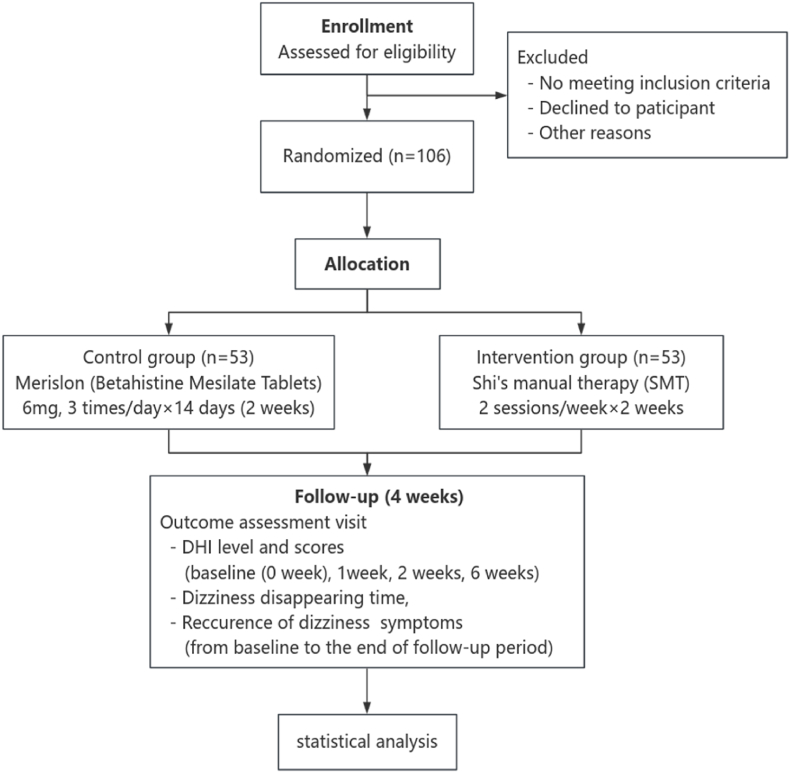
A multicenter randomized controlled trial (RCT) will perform on 106 patients (18≤ages≤65) who meet the diagnostic criteria of cervicogenic dizziness. Patients will be randomly allocated to the intervention group and the control group at a ratio of 1:1. Participants in the control group will be treated with Merislon (Betahistine Mesilate Tablets). Participants in the intervention group will be treated with SMT. The primary outcome is the response rate at week 2, which is defined as the proportion of patients who reduce their disability level measured by the Dizziness Handicap Inventory (DHI) score relative to baseline. Key secondary outcomes include DHI scores at weeks 1, 2, and 6 and changes from baseline, time to disappearance of dizziness symptoms, and recurrence rate of dizziness symptoms. Safety will be assessed by adverse events, physical examination and vital signs.
This trial aims to provide high-quality evidence-based medical data to demonstrate that SMT can reduce dizziness in patients with cervicogenic dizziness effectively and safely.
Clinical Trial Registration Center NCT05604937. Registered on Nov 3, 2022.
1.0, November 20, 2022.
颈源性头晕是一种以颈部疼痛和头晕为特征的临床综合征,近年来发病率呈上升趋势。在中国,手法治疗已广泛应用于颈源性头晕的治疗,但尚无高质量的医学证据支持其有效性和安全性。本研究旨在评估施氏手法治疗(SMT)对颈源性头晕的安全性和疗效。
将对106例年龄在18至65岁之间、符合颈源性头晕诊断标准的患者进行一项多中心随机对照试验(RCT)。患者将按1:1的比例随机分配到干预组和对照组。对照组患者将接受敏使朗(甲磺酸倍他司汀片)治疗。干预组患者将接受施氏手法治疗。主要结局是第2周时的有效率,定义为与基线相比,通过头晕残障量表(DHI)评分测量的残疾水平降低的患者比例。关键次要结局包括第1、2和6周时的DHI评分及其相对于基线的变化、头晕症状消失的时间以及头晕症状的复发率。将通过不良事件、体格检查和生命体征评估安全性。
本试验旨在提供高质量的循证医学数据,以证明施氏手法治疗能有效且安全地减轻颈源性头晕患者的头晕症状。
临床试验注册中心NCT05604937。于2022年11月3日注册。
2022年11月20日第1.0版。