Go Se-Il, Yang Jung Wook, Jeong Eun Jeong, Lee Woo Je, Park Sungwoo, Song Dae Hyun, Lee Gyeong-Won
Department of Internal Medicine, Gyeongsang National University Changwon Hospital, Institute of Medical Science, Gyeongsang National University College of Medicine, Changwon, Korea.
Department of Pathology, Gyeongsang National University Hospital, Institute of Medical Science, Gyeongsang National University College of Medicine, Jinju, Korea.
Transl Lung Cancer Res. 2024 Aug 31;13(8):1768-1779. doi: 10.21037/tlcr-24-317. Epub 2024 Aug 17.
Molecular and transcription factor subtyping were recently introduced to identify patients with unique clinical features in small cell lung cancer (SCLC). However, its prognostic relevance is yet to be established. This study aims to investigate the clinical implications and prognostic significance of transcription factor subtyping in SCLC using immunohistochemistry.
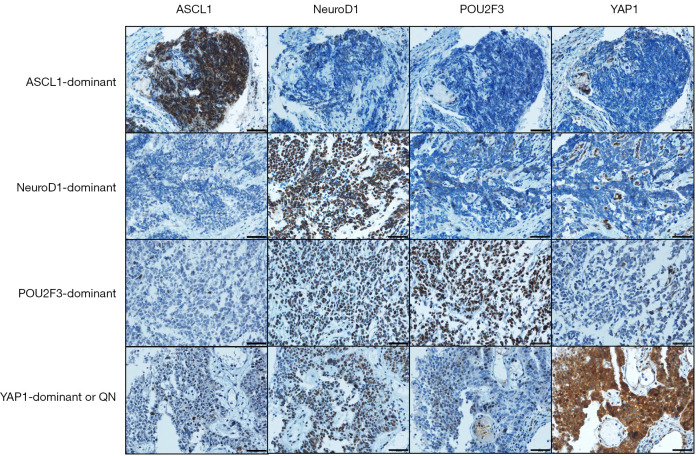
One hundred and ninety consecutive SCLC patients treated with platinum-based chemotherapy at a single institution were retrospectively reviewed. Expression of ASCL1, NeuroD1, POU2F3, and YAP1 was assessed by immunohistochemical staining and applied to determine the transcription factor subtype of each case.
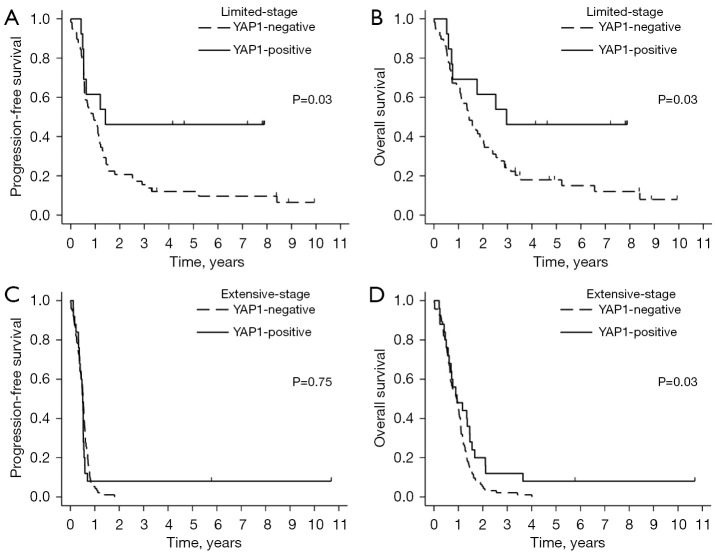
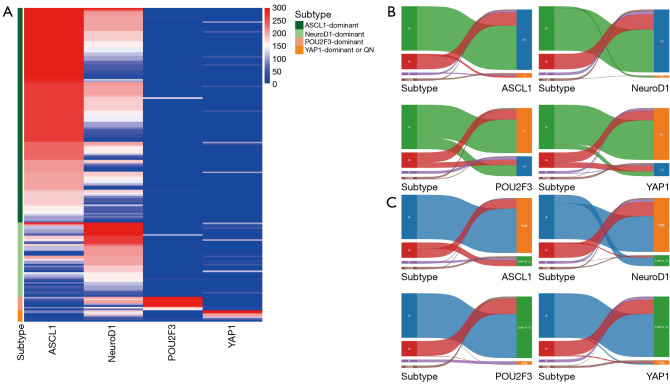
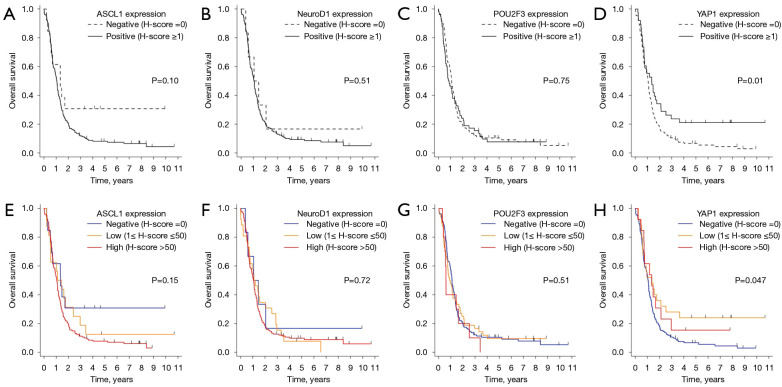
The association among transcription factors was not entirely mutually exclusive. YAP1 expression was the most significant prognostic indicator compared with other transcription factors or their related subtypes. Among patients with limited-stage disease (LD), complete response (CR) rates were 46.2% and 22.4% in the YAP1-positive and YAP1-negative groups, respectively. The median duration of response among patients who achieved CR was 64.8 and 36.4 months in the YAP1-positive and YAP1-negative groups, respectively (P=0.06). Median overall survival (OS) in LD was 35.6 and 16.9 months in the YAP1-positive and YAP1-negative groups, respectively (P=0.03). In extensive-stage disease (ED), the median OS was 11.3 months for the YAP1-positive group and 11 months for the YAP1-negative group (P=0.03).
Positive expression of YAP1 can be associated with durable CR and favorable survival outcomes in patients with SCLC, especially in LD.
分子和转录因子亚型分类法最近被引入用于识别小细胞肺癌(SCLC)中具有独特临床特征的患者。然而,其预后相关性尚未确立。本研究旨在使用免疫组织化学研究转录因子亚型分类法在SCLC中的临床意义和预后意义。
回顾性分析在单一机构接受铂类化疗的190例连续SCLC患者。通过免疫组织化学染色评估ASCL1、NeuroD1、POU2F3和YAP1的表达,并应用于确定每个病例的转录因子亚型。
转录因子之间的关联并非完全相互排斥。与其他转录因子或其相关亚型相比,YAP1表达是最显著的预后指标。在局限期疾病(LD)患者中,YAP1阳性组和YAP1阴性组的完全缓解(CR)率分别为46.2%和22.4%。达到CR的患者中,YAP1阳性组和YAP1阴性组的中位缓解持续时间分别为64.8个月和36.4个月(P=0.06)。LD患者中,YAP1阳性组和YAP1阴性组的中位总生存期(OS)分别为35.6个月和16.9个月(P=0.03)。在广泛期疾病(ED)中,YAP1阳性组的中位OS为11.3个月,YAP1阴性组为11个月(P=0.03)。
YAP1的阳性表达可能与SCLC患者持久的CR和良好的生存结果相关,尤其是在LD患者中。