Chieochansin Thaweesak, Sanachai Kamonpan, Darai Nitchakan, Chiraphapphaiboon Wannasiri, Choomee Kornkan, Yenchitsomanus Pa-Thai, Thuwajit Chanitra, Rungrotmongkol Thanyada
Siriraj Center of Research Excellence for Cancer Immunotherapy (SiCORE-CIT), Research Department, Faculty of Medicine Siriraj Hospital, Mahidol University, Bangkok, Thailand.
Division of Molecular Medicine, Research Department, Faculty of Medicine Siriraj Hospital, Mahidol University, Bangkok, Thailand.
Heliyon. 2024 Aug 22;10(17):e36654. doi: 10.1016/j.heliyon.2024.e36654. eCollection 2024 Sep 15.
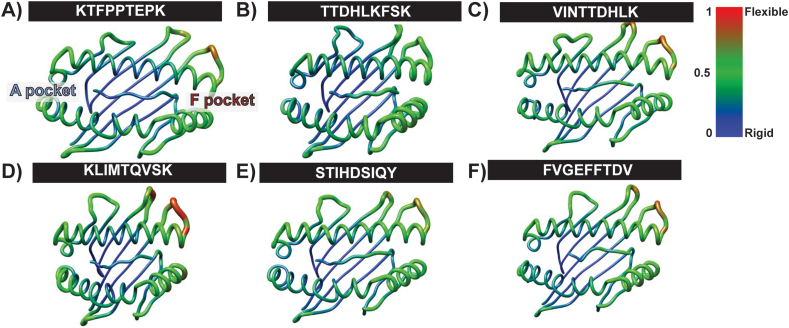
Our study employed molecular dynamics (MD) simulations to assess the binding affinity between short peptides derived from the tumor-associated antigen glypican 3 (GPC3) and the major histocompatibility complex (MHC) molecule HLA-A11:01 in hepatocellular carcinoma. We aimed to improve the reliability of predictions of peptide-MHC interactions, which are crucial for developing targeted cancer therapies. We used five algorithms to discover four peptides (TTDHLKFSK, VINTTDHLK, KLIMTQVSK, and STIHDSIQY), demonstrating the substantial potential for HLA-A11:01 presentation. The Anchored Peptide-MHC Ensemble Generator (APE-Gen) was used to create the initial structure of the peptide-MHC complex. This was followed by a 200 ns molecular dynamics (MD) simulation using AMBER22, which verified the precise positioning of the peptides in the binding groove of HLA-A11:01, specifically at the A and F pockets. Notably, the 2nd residue, which serves as a critical anchor within the 2nd pocket, played a pivotal role in stabilising the binding interactions.VINTTDHLK (Δ = -14.46 ± 0.53 kcal/mol and Δ = -30.79 ± 0.49 kcal/mol) and STIHDSIQY (Δ and Δ = -14.55 ± 0.16 and -23.21 ± 2.23 kcal/mol) exhibited the most effective binding potential among the examined peptides, as indicated by both their binding free energies and its binding affinity on the T2 cell line (VINTTDHLK: IC = 0.45 nM; STIHDSIQY: IC = 0.35 nM). The remarkable concordance between and binding affinity results was of particular significance, indicating that MD simulation is a potent instrument capable of bolstering confidence in peptide predictions. By employing MD simulation as a method, our study provides a promising avenue for improving the prediction of potential peptide-MHC interactions, thereby facilitating the development of more effective and targeted cancer therapies.
我们的研究采用分子动力学(MD)模拟来评估源自肿瘤相关抗原磷脂酰肌醇蛋白聚糖3(GPC3)的短肽与肝细胞癌中主要组织相容性复合体(MHC)分子HLA - A11:01之间的结合亲和力。我们旨在提高肽 - MHC相互作用预测的可靠性,这对于开发靶向癌症治疗至关重要。我们使用五种算法发现了四种肽(TTDHLKFSK、VINTTDHLK、KLIMTQVSK和STIHDSIQY),证明了HLA - A11:01呈递的巨大潜力。使用锚定肽 - MHC复合体生成器(APE - Gen)创建肽 - MHC复合体的初始结构。随后使用AMBER22进行了200纳秒的分子动力学(MD)模拟,验证了肽在HLA - A11:01结合槽中的精确定位,特别是在A和F口袋处。值得注意的是,作为第二个口袋内关键锚定的第二个残基在稳定结合相互作用中起关键作用。VINTTDHLK(Δ = -14.46 ± 0.53千卡/摩尔和Δ = -30.79 ± 0.49千卡/摩尔)和STIHDSIQY(Δ 和Δ = -14.55 ± 0.16和 -23.21 ± 2.23千卡/摩尔)在所检测的肽中表现出最有效的结合潜力,这从它们的结合自由能及其对T2细胞系的结合亲和力(VINTTDHLK:IC = 0.45纳摩尔;STIHDSIQY:IC = 0.35纳摩尔)可以看出。Δ 和结合亲和力结果之间的显著一致性具有特别重要的意义,表明MD模拟是一种能够增强对肽预测信心的有力工具。通过将MD模拟作为一种方法,我们的研究为改进潜在肽 - MHC相互作用的预测提供了一条有前景的途径,从而促进更有效和靶向的癌症治疗的发展。