Verburg Ilse, Hernández Leal Lucia, Waar Karola, Rossen John W A, Schmitt Heike, García-Cobos Silvia
Wetsus, European Centre of Excellence for Sustainable Water Technology, 8900, CC, Leeuwarden, the Netherlands.
Department of Medical Microbiology and Infection Prevention, University Medical Center Groningen, University of Groningen, 9713, GZ, Groningen, the Netherlands.
One Health. 2024 Aug 17;19:100880. doi: 10.1016/j.onehlt.2024.100880. eCollection 2024 Dec.
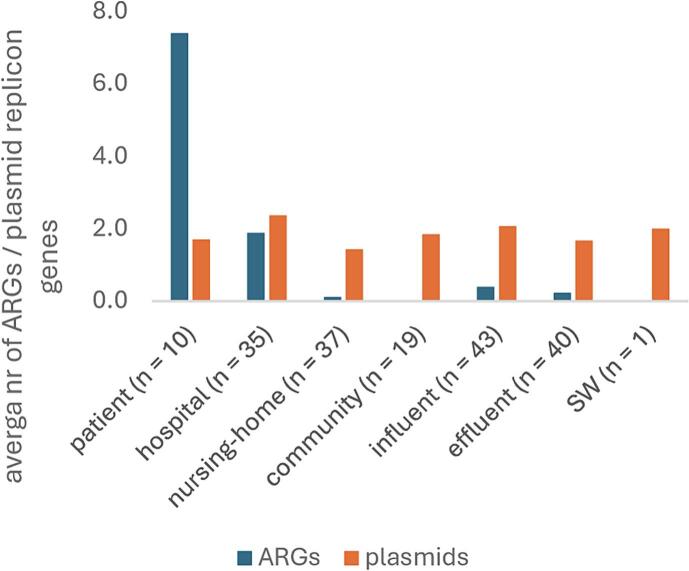
plays a significant role in nosocomial infections and spreading antibiotic resistance, and therefore forms a major threat to public health. In this study, we investigated the role of the wastewater pathway in the spread of pathogenic bacteria and more specifically, in the spread of antibiotic resistant subspecies. Whole-genome sequencing was performed of 185 isolates collected from hospital, nursing home, and community wastewater, the receiving wastewater treatment plant (WWTP), and clinical isolates from the investigated hospital. isolates from different sources were not genetically related, except for WWTP influent (46.5%) and effluent (62.5%), revealing survival of bacteria from wastewater treatment. The content of antibiotic resistance (ARGs), virulence, and plasmid replicon genes differed between subspecies and their origin. While chromosomal genes were specific for each subspecies, genes predicted in plasmid contigs were found in several subspecies, implying possible gene transfer between subspecies. Transferable ARGs were most abundant in patients and hospital isolates (70%), but the average number of plasmid replicon genes per isolate was similar across all sources, showing plasmid content being more relevant than plasmid quantity. Most patient (90%) and hospital wastewater (34%) isolates were subsp. , and the yersiniabactin cluster genes and were only found in this subspecies, as were the IncFII(pECLA), IncHI2A, and IncHI2 plasmid replicon genes, suggesting the clinical origin of these type of plasmids.
在医院感染和传播抗生素耐药性方面发挥着重要作用,因此对公共卫生构成重大威胁。在本研究中,我们调查了废水途径在病原菌传播中的作用,更具体地说,是在抗生素耐药亚种传播中的作用。对从医院、疗养院和社区废水中收集的185株分离株、接收的污水处理厂(WWTP)以及被调查医院的临床分离株进行了全基因组测序。除了污水处理厂进水(46.5%)和出水(62.5%)外,不同来源的分离株在基因上没有相关性,这表明废水处理中的细菌能够存活。抗生素耐药基因(ARGs)、毒力和质粒复制子基因的含量在亚种及其来源之间存在差异。虽然染色体基因对每个亚种具有特异性,但在质粒重叠群中预测的基因在几个亚种中都有发现,这意味着亚种之间可能存在基因转移。可转移的ARGs在患者和医院分离株中最为丰富(70%),但每个分离株的质粒复制子基因平均数量在所有来源中相似,表明质粒含量比质粒数量更重要。大多数患者(90%)和医院废水(34%)分离株为亚种,耶尔森菌素簇基因和仅在该亚种中发现,IncFII(pECLA)、IncHI2A和IncHI2质粒复制子基因也是如此,这表明这些类型质粒的临床来源。