Jiang Sijun, Wu Xingcai, Wang Qi, Pei Zhixun, Wang Yuxiang, Jin Jian, Guo Ying, Song RunJiang, Zang Liansheng, Liu Yong-Jin, Hao Gefei
State Key Laboratory of Public Big Data, College of Computer Science and Technology, Guizhou University, Guiyang, China.
Department of Computer Science and Technology, Tsinghua University, Beijing, China.
Plant Phenomics. 2024 Sep 11;6:0245. doi: 10.34133/plantphenomics.0245. eCollection 2024.
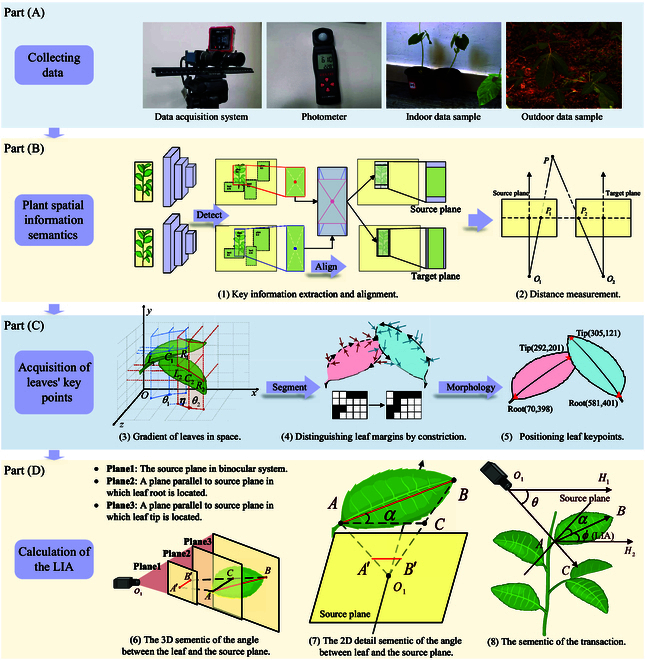
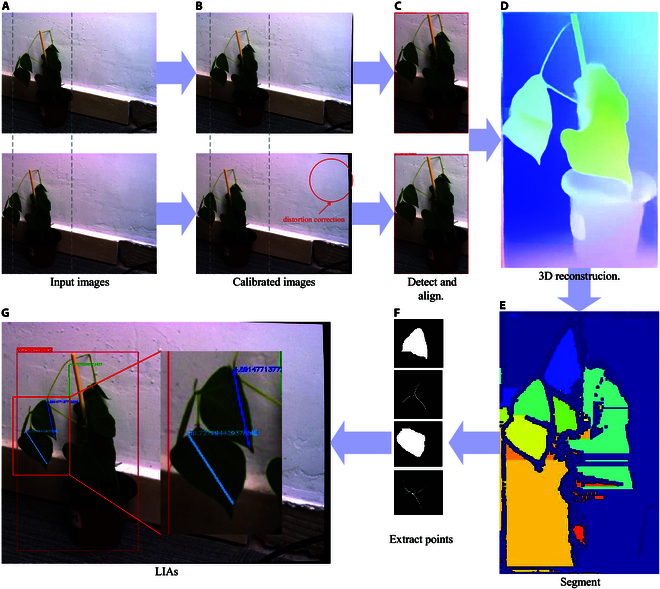
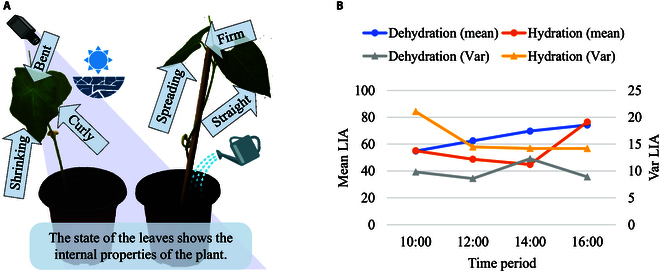
Plant sensors are commonly used in agricultural production, landscaping, and other fields to monitor plant growth and environmental parameters. As an important basic parameter in plant monitoring, leaf inclination angle (LIA) not only influences light absorption and pesticide loss but also contributes to genetic analysis and other plant phenotypic data collection. The measurements of LIA provide a basis for crop research as well as agricultural management, such as water loss, pesticide absorption, and illumination radiation. On the one hand, existing efficient solutions, represented by light detection and ranging (LiDAR), can provide the average leaf angle distribution of a plot. On the other hand, the labor-intensive schemes represented by hand measurements can show high accuracy. However, the existing methods suffer from low automation and weak leaf-plant correlation, limiting the application of individual plant leaf phenotypes. To improve the efficiency of LIA measurement and provide the correlation between leaf and plant, we design an image-phenotype-based noninvasive and efficient optical sensor measurement system, which combines multi-processes implemented via computer vision technologies and RGB images collected by physical sensing devices. Specifically, we utilize object detection to associate leaves with plants and adopt 3-dimensional reconstruction techniques to recover the spatial information of leaves in computational space. Then, we propose a spatial continuity-based segmentation algorithm combined with a graphical operation to implement the extraction of leaf key points. Finally, we seek the connection between the computational space and the actual physical space and put forward a method of leaf transformation to realize the localization and recovery of the LIA in physical space. Overall, our solution is characterized by noninvasiveness, full-process automation, and strong leaf-plant correlation, which enables efficient measurements at low cost. In this study, we validate Auto-LIA for practicality and compare the accuracy with the best solution that is acquired with an expensive and invasive LiDAR device. Our solution demonstrates its competitiveness and usability at a much lower equipment cost, with an accuracy of only 2. 5° less than that of the widely used LiDAR. As an intelligent processing system for plant sensor signals, Auto-LIA provides fully automated measurement of LIA, improving the monitoring of plant physiological information for plant protection. We make our code and data publicly available at http://autolia.samlab.cn.
植物传感器常用于农业生产、园林绿化及其他领域,以监测植物生长和环境参数。作为植物监测中的一个重要基础参数,叶片倾角(LIA)不仅影响光吸收和农药流失,还对遗传分析及其他植物表型数据收集有重要作用。LIA的测量为作物研究以及农业管理(如水流失、农药吸收和光照辐射)提供了依据。一方面,以光探测和测距(LiDAR)为代表的现有高效解决方案能够提供地块的平均叶片角度分布。另一方面,以手工测量为代表的劳动密集型方案能够显示出较高的精度。然而,现有方法存在自动化程度低和叶片与植株相关性弱的问题,限制了单株植物叶片表型的应用。为提高LIA测量效率并提供叶片与植株之间的相关性,我们设计了一种基于图像表型的无创高效光学传感器测量系统,该系统结合了通过计算机视觉技术实现的多流程以及由物理传感设备采集的RGB图像。具体而言,我们利用目标检测将叶片与植株关联起来,并采用三维重建技术在计算空间中恢复叶片的空间信息。然后,我们提出一种基于空间连续性的分割算法并结合图形操作来实现叶片关键点的提取。最后,我们寻找计算空间与实际物理空间之间的联系,提出一种叶片变换方法以实现物理空间中LIA的定位和恢复。总体而言,我们的解决方案具有无创性、全流程自动化和强叶片与植株相关性的特点,能够以低成本实现高效测量。在本研究中,我们验证了Auto-LIA的实用性,并将其精度与使用昂贵且有创的LiDAR设备获得的最佳解决方案进行比较。我们的解决方案在设备成本低得多的情况下展现出了竞争力和可用性,其精度仅比广泛使用的LiDAR低了2.5°。作为一种植物传感器信号智能处理系统,Auto-LIA提供了LIA的全自动测量,改善了用于植物保护的植物生理信息监测。我们将代码和数据公开在http://autolia.samlab.cn 。