Roy Asim, Stern Thomas, Harsh John, Hudson J Douglas, Ajayi Akinyemi O, Corser Bruce C, Mignot Emmanuel, Santamaria Adrian, Morse Anne Marie, Abaluck Brian, Ibrahim Sally, Schweitzer Paula K, Lancaster Katie, Dubow Jordan, Gudeman Jennifer
Ohio Sleep Medicine Institute, Dublin, OH, USA.
Advanced Respiratory and Sleep Medicine, PLLC, Huntersville, NC, USA.
Sleep Med X. 2024 Aug 15;8:100122. doi: 10.1016/j.sleepx.2024.100122. eCollection 2024 Dec 15.
OBJECTIVE/BACKGROUND: Preference for extended-release, once-nightly sodium oxybate (ON-SXB, FT218) vs twice-nightly immediate-release (IR) oxybate was assessed in participants switching from IR oxybate to ON-SXB in an open-label/switch study, RESTORE (NCT04451668).
PATIENTS/METHODS: Participants aged ≥16 years with narcolepsy who completed the phase 3 REST-ON trial, were oxybate-naive, or were on a stable IR oxybate dose (≥1 month) were eligible for RESTORE. For participants who switched from twice-nightly dosing to ON-SXB, initial doses were closest or equivalent to their previous nightly IR oxybate dose. These participants completed a questionnaire at baseline about nocturnal adverse events associated with the middle-of-the-night IR oxybate dose in the preceding 3 months, a preference questionnaire after 3 months of stable-dose ON-SXB, and an end-of-study (EOS) questionnaire.
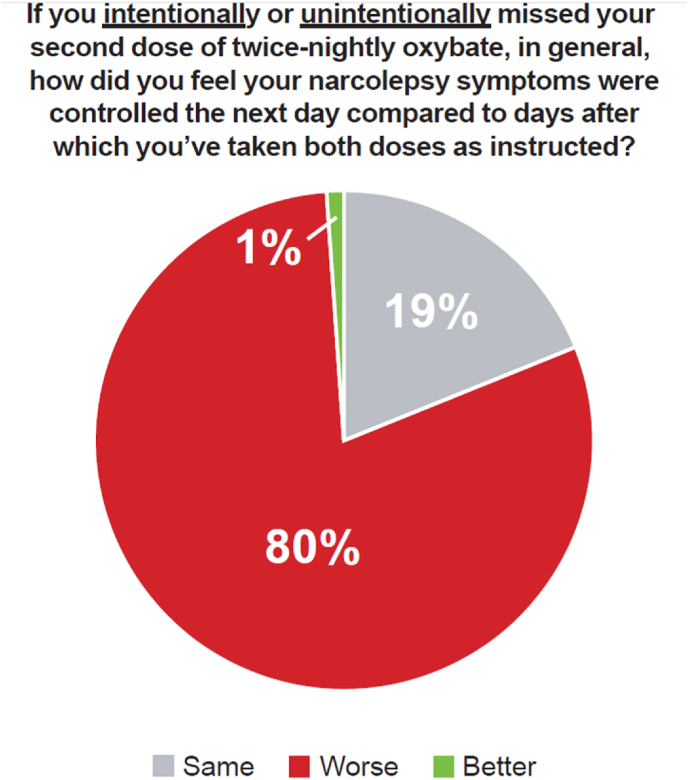
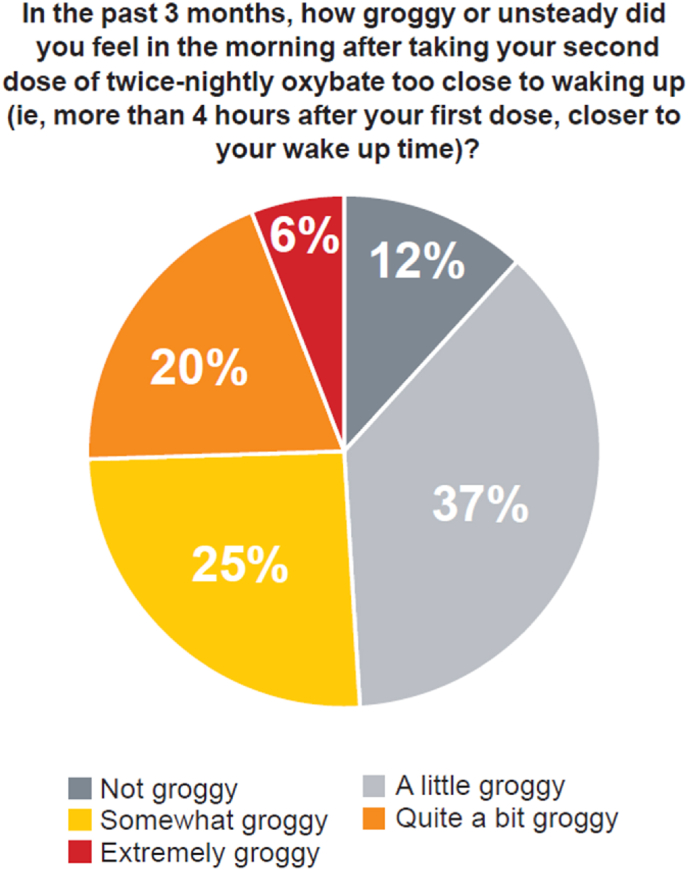
There were 130 switch participants; 92/98 (93.9 %) who completed the preference questionnaire preferred ON-SXB. At baseline, 69.2 % reported missing their second IR oxybate dose at least once; in these cases, 80 % felt worse the next day. Approximately 39 % reported taking a second nightly IR oxybate dose >4 h after the first dose, 51 % of whom felt somewhat to extremely groggy/unsteady the next morning; 120 participants (92 %) reported getting out of bed after their second oxybate dose. Of those, 9 (8 %) reported falls and 5 (4 %) reported injuries. Of the switch participants who completed the EOS questionnaire, 91.2 % felt better able to follow the recommended ON-SXB dosing schedule.
The second nightly IR oxybate dose presents significant treatment burdens and adherence concerns. Participants overwhelmingly preferred the once-nightly dosing regimen of ON-SXB.
目的/背景:在一项开放标签转换研究RESTORE(NCT04451668)中,对从速释羟丁酸钠(IR)转换为每晚一次的缓释羟丁酸钠(ON-SXB,FT218)的参与者进行了偏好评估。
患者/方法:年龄≥16岁、患有发作性睡病、完成了3期REST-ON试验、未使用过羟丁酸钠或正在使用稳定剂量的IR羟丁酸钠(≥1个月)的参与者符合RESTORE研究的条件。对于从每晚两次给药转换为ON-SXB的参与者,初始剂量最接近或等同于其之前每晚的IR羟丁酸钠剂量。这些参与者在基线时完成了一份关于前3个月夜间与午夜IR羟丁酸钠剂量相关不良事件的问卷,在稳定剂量ON-SXB治疗3个月后完成了一份偏好问卷,并在研究结束时完成了一份问卷。
共有130名转换参与者;92/98(93.9%)完成偏好问卷的参与者更喜欢ON-SXB。在基线时,69.2%的参与者报告至少有一次错过第二次IR羟丁酸钠剂量;在这些情况下,80%的人第二天感觉更糟。约39%的参与者报告在第一次剂量后>4小时服用第二次每晚IR羟丁酸钠剂量,其中51%的人第二天早上感觉有点到极度昏沉/不稳;120名参与者(92%)报告在第二次羟丁酸钠剂量后起床。其中,9人(8%)报告跌倒,5人(4%)报告受伤。在完成研究结束时问卷的转换参与者中,91.2%的人感觉更能遵循推荐的ON-SXB给药方案。
每晚第二次IR羟丁酸钠剂量带来了显著的治疗负担和依从性问题。参与者压倒性地更喜欢ON-SXB的每晚一次给药方案。