Department of Endocrinology and Internal Medicine, Aarhus University Hospital, Aarhus, Denmark.
Department of Endocrinology and Metabolism, Rigshospitalet, Copenhagen, Denmark.
Osteoporos Int. 2024 Dec;35(12):2153-2164. doi: 10.1007/s00198-024-07241-y. Epub 2024 Sep 12.
Thyrotoxicosis leads to loss of bone mass. Vitamin D is important to bone health. In this randomized, placebo-controlled trial, we showed that bone restoration did not improve when adding vitamin D supplementation to standard care of Graves' disease thyrotoxicosis. Bone density and microarchitecture improved markedly with treatment of thyrotoxicosis.
Vitamin D is important to skeletal health and ensuring a replete vitamin D status is recommended. In thyrotoxicosis, bone turnover is increased and bone mass density (BMD) reduced. We examined whether vitamin D supplementation improves bone recovery in thyrotoxicosis caused by Graves' disease (GD).
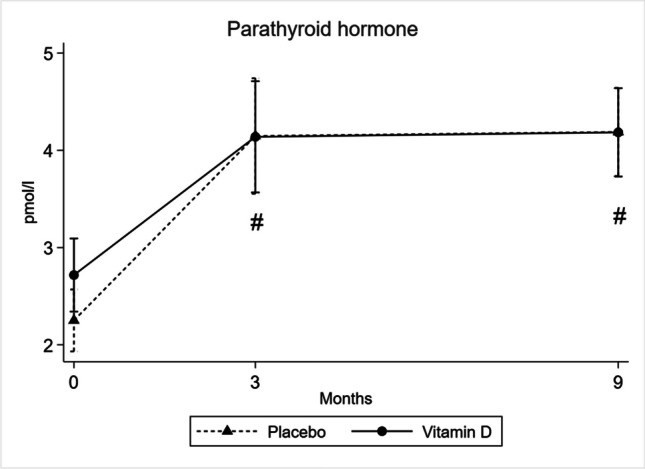
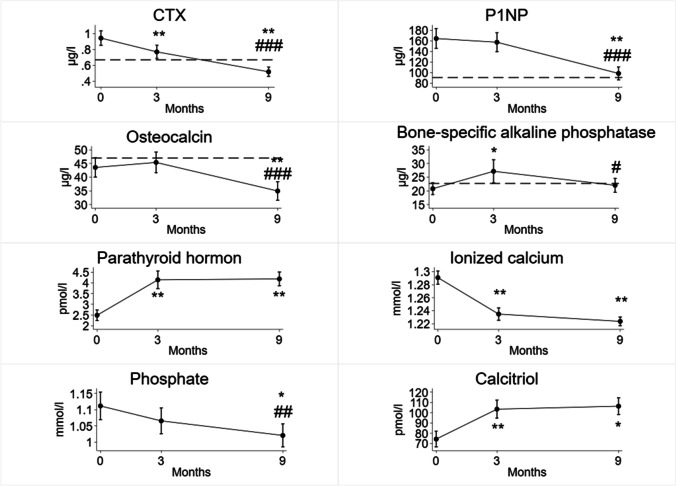
Using a double-blinded design, hyperthyroid patients with GD were randomized to vitamin D3 70 µg/day (2800 IU) or similar placebo as add-on to antithyroid drugs (ATD). At baseline and 9 months, we measured BMD and bone architecture using DXA and high resolution peripheral quantitative computerized tomography. Bone turnover markers (BTM) were measured at 3 months also. Effect of vitamin D versus placebo and the response to ATD treatment were analyzed using linear mixed modelling.
Eighty-six GD patients were included (age 41 ± 14 years, 86% females). Compared to placebo, vitamin D3 did not improve BMD or microarchitecture. In response to ATD, BMD increased in the hip by 2% (95%CI: 1-4%). Cortical porosity decreased in tibia (- 7% [95%CI: - 12 to - 2%]) and radius [- 14% [95%CI: - 24 to - 3%]), and trabecular thickness increased (tibia (5% [95%CI: 2 - 9%]) and radius (4% [95%CI: 1-7%]). Changes in BTM, but not thyroid hormones, were associated with changes in BMD by DXA and with changes in the cortical compartment.
In newly diagnosed GD, 9 months of high dose vitamin D3 supplementation does not offer benefit by improving skeletal health. Treatment of thyrotoxicosis is associated with the recovery of BMD and microarchitecture.
NCT02384668.
甲状腺功能亢进症会导致骨量流失。维生素 D 对骨骼健康很重要。在这项随机、安慰剂对照试验中,我们表明,在 Graves 病甲状腺功能亢进症的标准治疗中添加维生素 D 补充剂并不能改善骨骼恢复。甲状腺毒症的治疗使骨密度和微结构明显改善。
维生素 D 对骨骼健康很重要,确保维生素 D 充足的状态是很有必要的。在甲状腺功能亢进症中,骨转换增加,骨密度(BMD)降低。我们研究了 Graves 病(GD)引起的甲状腺功能亢进症中维生素 D 补充是否能改善骨骼恢复。
采用双盲设计,将甲状腺功能亢进的 GD 患者随机分为维生素 D3 70μg/天(2800IU)或类似安慰剂,作为抗甲状腺药物(ATD)的附加治疗。在基线和 9 个月时,我们使用 DXA 和高分辨率外周定量计算机断层扫描测量 BMD 和骨结构。还在 3 个月时测量骨转换标志物(BTM)。使用线性混合模型分析维生素 D 与安慰剂的效果以及对 ATD 治疗的反应。
共纳入 86 例 GD 患者(年龄 41±14 岁,86%为女性)。与安慰剂相比,维生素 D3 并不能改善 BMD 或微结构。在 ATD 治疗下,髋部 BMD 增加 2%(95%CI:1-4%)。胫骨(-7%[95%CI:-12 至-2%])和桡骨(-14%[95%CI:-24 至-3%])的皮质孔隙减少,而小梁厚度增加(胫骨(5%[95%CI:2-9%])和桡骨(4%[95%CI:1-7%])。DXA 测量的 BMD 变化以及皮质容积的变化与 BTM 的变化相关,而不是与甲状腺激素的变化相关。
在新诊断的 GD 中,9 个月高剂量维生素 D3 补充并不能通过改善骨骼健康带来益处。甲状腺毒症的治疗与 BMD 和微结构的恢复有关。
NCT02384668