Centre d'Anthropobiologie et de Génomique de Toulouse (CNRS UMR 5288), Université Paul Sabatier, Faculté de Santé, Bâtiment A, 37 allées Jules Guesde, 31000 Toulouse, France.
Lundbeck Foundation GeoGenetics Center, University of Copenhagen, 1350K Copenhagen, Denmark.
Cell Genom. 2024 Sep 11;4(9):100593. doi: 10.1016/j.xgen.2024.100593.
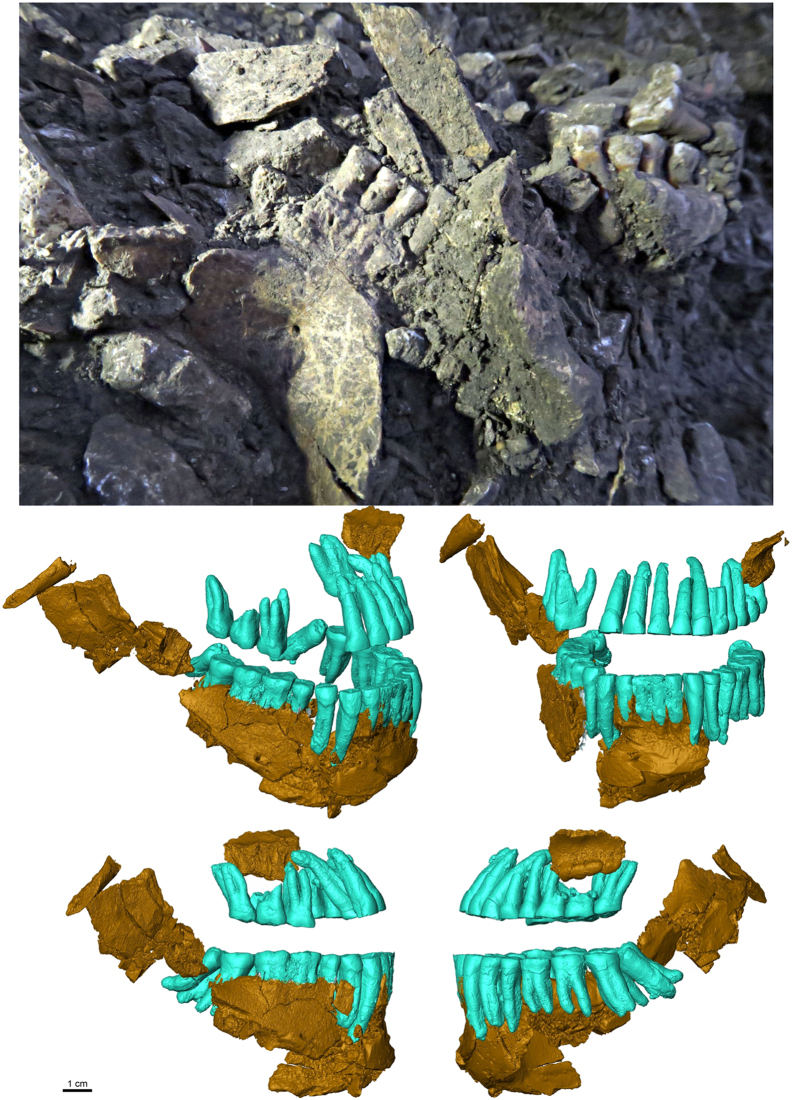
Neanderthal genomes have been recovered from sites across Eurasia, painting an increasingly complex picture of their populations' structure that mostly indicates that late European Neanderthals belonged to a single metapopulation with no significant evidence of population structure. Here, we report the discovery of a late Neanderthal individual, nicknamed "Thorin," from Grotte Mandrin in Mediterranean France, and his genome. These dentognathic fossils, including a rare example of distomolars, are associated with a rich archeological record of Neanderthal final technological traditions in this region ∼50-42 thousand years ago. Thorin's genome reveals a relatively early divergence of ∼105 ka with other late Neanderthals. Thorin belonged to a population with a small group size that showed no genetic introgression with other known late European Neanderthals, revealing some 50 ka of genetic isolation of his lineage despite them living in neighboring regions. These results have important implications for resolving competing hypotheses about causes of the disappearance of the Neanderthals.
尼安德特人基因组已从欧亚大陆各地的遗址中被提取出来,这为他们的种群结构描绘了一幅越来越复杂的图景,其中主要表明晚期欧洲尼安德特人属于一个单一的混合种群,没有明显的种群结构证据。在这里,我们报告了在法国地中海地区的 Mandrin 洞发现了一个名为“Thorin”的晚期尼安德特人个体及其基因组。这些齿骨化石,包括罕见的远中磨牙,与该地区大约 5 万至 4.2 万年前的尼安德特人最终技术传统的丰富考古记录有关。Thorin 的基因组显示出与其他晚期尼安德特人相对较早的分化,大约在 10.5 万年前。Thorin 属于一个小群体的种群,与其他已知的晚期欧洲尼安德特人没有遗传混合,尽管他们生活在邻近地区,但他的世系已经经历了大约 5 万年的遗传隔离。这些结果对解决有关尼安德特人消失原因的竞争假说具有重要意义。